Get in touch
info@canadiancyber.ca


Rafia Rizwan

December 8, 2025
ISO 27001 is becoming a must-have in B2B vendor contracts. Certification shows your company is secure, compliant, and enterprise-ready, helping you win deals, accelerate procurement, and build trust with clients, partners, and investors.
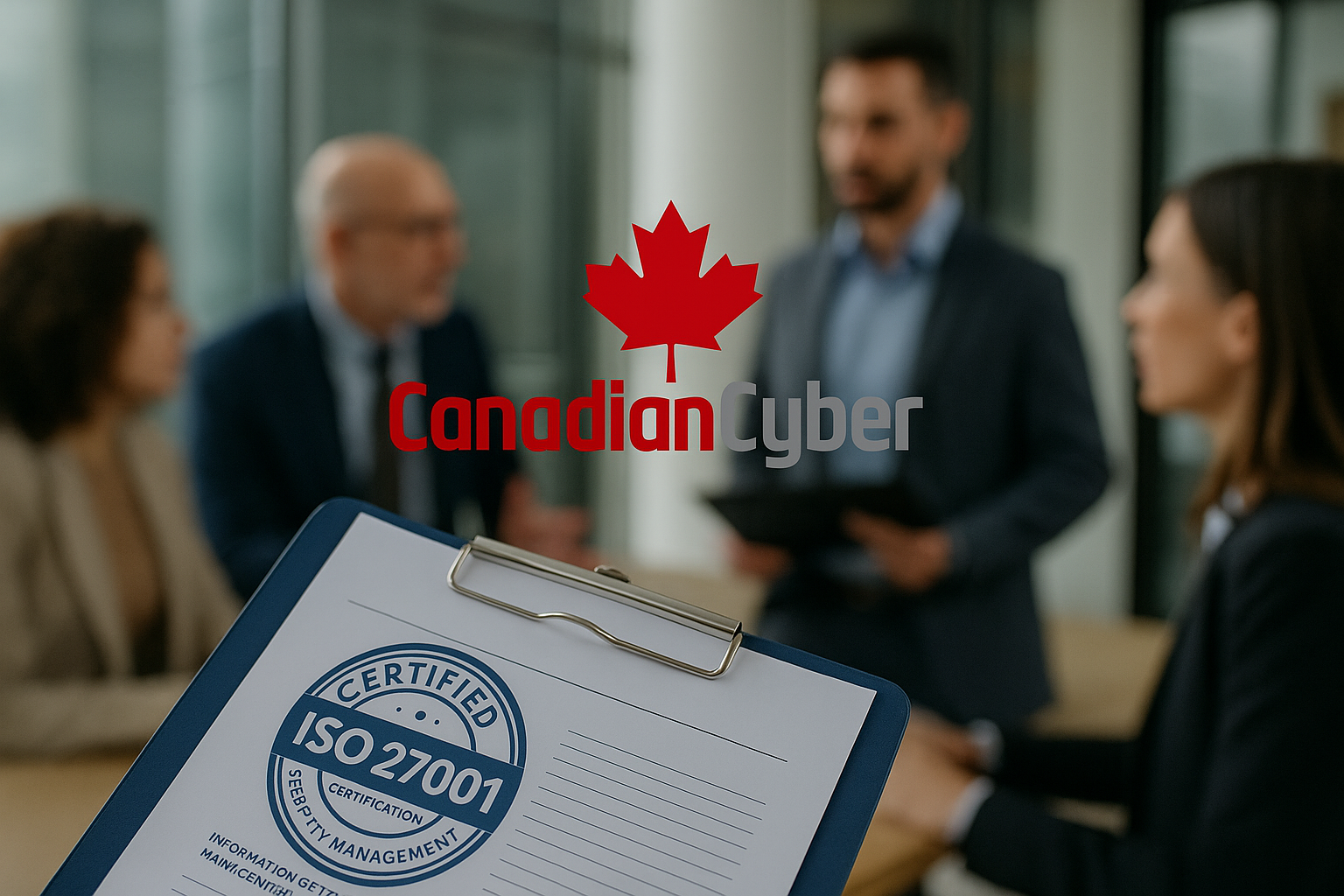
Why ISO 27001 Is Becoming a Requirement in B2B Vendor Contracts
The New Reality: You Can’t Sell to Enterprises Without Demonstrating Security Maturity
Ten years ago, ISO 27001 was a “nice-to-have” for large enterprises. Today, it’s quietly becoming a mandatory prerequisite in B2B vendor contracts especially for SaaS, tech, finance, healthcare, logistics, and professional services selling into mid-market and enterprise buyers.
Why? Because the way companies buy has changed. Procurement teams no longer ask only:
“Is your product good?”
They also ask:
“Is your company secure enough for us to trust with our data?”
And ISO 27001 is the fastest, clearest, most recognized way to answer “Yes.”
Let’s begin with a fictional but realistic scenario inspired by dozens of real procurement conversations we’ve seen across Canada.
Note: This scenario is fictional, created for educational illustration.
DataLoop Systems, a growing SaaS startup in Ontario, celebrated when a major logistics company shortlisted them as the final vendor for a large national contract.
Their team was confident the product was strong, the pricing was competitive, and the client loved the demo.
Then procurement asked one question:
Procurement Lead:
“Please provide your ISO 27001 certification or equivalent ISMS documentation.”
DataLoop CTO:
“We follow strong internal security practices, but we’re not certified.”
Procurement Reply:
“Unfortunately, our vendor policy requires ISO 27001 or SOC 2. Without it, we cannot move forward.”
Six months later, DataLoop returned with ISO 27001 certification and immediately qualified for contracts that were previously out of reach.
This scenario isn’t rare. It’s becoming the new standard across supply chains.
Modern supply chains are complex. Data flows between companies, systems, subsidiaries, cloud platforms, vendors, and partners. If one vendor is insecure, everyone is insecure.
Procurement teams know this. That’s why ISO 27001 has become the anchor of modern vendor risk management.
| Buyer Concern | What They’re Thinking | How ISO 27001 Helps |
|---|---|---|
| Data Protection | “Will this vendor leak our data or expose us to a breach?” | Risk assessments, access control, encryption, monitoring. |
| Regulatory Exposure | “Will using this vendor put us at odds with privacy laws?” | Structured ISMS mapped to privacy and security obligations. |
| Operational Resilience | “Will they keep services running during incidents and outages?” | Business continuity, incident response, backup and recovery. |
| Insurance & Liability | “Will our insurer accept this vendor’s risk profile?” | Demonstrable controls and governance, aligned with carrier expectations. |
| Reputation & Trust | “Can we trust this vendor in front of our customers and regulators?” | Independent certification and repeatable security processes. |
Canadian Cyber helps growth-focused SaaS, tech, and service providers build ISO 27001 programs that align directly with enterprise procurement requirements so you stay in the deal instead of being disqualified on security.
High-profile breaches at organizations like Target, SolarWinds, and Toyota exposed a harsh truth: third-party vendors can become the attacker’s easiest entry point.
As a result, enterprises now require vendors to:
ISO 27001 proves you’re not the weakest link in the supply chain.
Modern procurement and vendor management teams are responsible for:
Accepting a vendor without ISO 27001 is now considered a high-risk decision, particularly in:
ISO 27001 makes procurement’s job easier by providing:
Canadian organizations face strict privacy requirements. ISO 27001 supports compliance with:
Procurement teams love ISO 27001 because it provides:
It reduces legal risk for both the buyer and the vendor.
Procurement and security teams often require:
Without ISO 27001, answering these can take weeks and stall deals at the finish line.
With ISO 27001 in place, vendors can respond with:
Deals accelerate. Confidence increases. Security questionnaires become painless instead of painful.
Investors now ask:
Enterprise partners ask:
ISO 27001 is the answer to all of the above. It signals:
Companies with ISO 27001 close more deals, faster, with bigger clients.
Insurance carriers increasingly require controls such as:
All of these are core ISO 27001 expectations.
This often leads to:
Procurement teams rely on these insurance-backed requirements when scoring vendors another way ISO 27001 quietly supports your position in competitive deals.
This is the real reason ISO 27001 is popping up in contracts. Enterprises don’t want to carry full responsibility for vendor security failures. So they push requirements onto vendors contractually.
Common Contract Clauses Now Include:
ISO 27001 becomes the minimum bar, not the gold standard.
After achieving ISO 27001, DataLoop observed tangible business impact:
ISO 27001 didn’t “just” improve security —it unlocked business growth.
If your company:
…ISO 27001 is no longer optional. It’s a:
It’s how you prove to partners:
“We don’t just say we take security seriously we have the certification to prove it.”
Canadian Cyber helps organizations:
If enterprise clients are on your roadmap, ISO 27001 is your gateway.
Follow Canadian Cyber for more ISO 27001, vendor risk, and security governance insights: