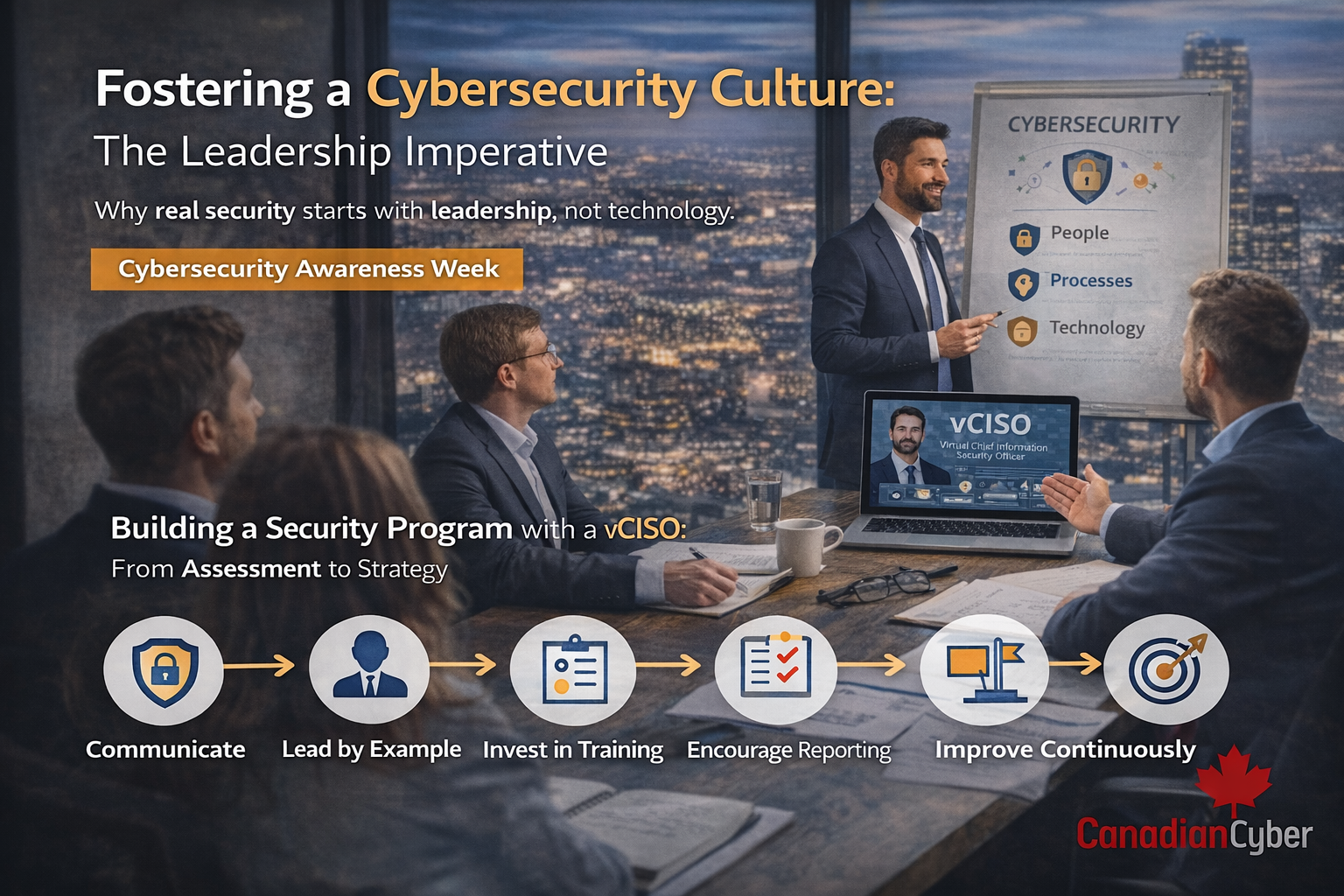
Fostering a Cybersecurity Culture: The Leadership Imperative
Why real security starts with leadership, not technology.
Most organizations invest heavily in cybersecurity tools.
- Firewalls are installed
- Endpoints are protected
- Policies are approved
And yet, incidents still happen.
- Phishing emails get clicked
- Passwords are reused
- Sensitive files are shared the wrong way
Cybersecurity does not fail because of missing technology.
It fails because of human behaviour and behaviour is shaped by culture.
Quick Snapshot
| Category | Detail |
|---|---|
| Core idea | Security culture drives daily behaviours that tools cannot enforce |
| Leadership role | Set the tone, remove fear of reporting, and keep security practical |
| What “good” looks like | Shared ownership, consistent training, safe reporting, continuous improvement |
| Where vCISO helps | Make culture measurable, embed it into governance, align it to ISO/SOC 2 |
A Short Story: Two Emails, Two Outcomes
This example is fictional but reflects real-world patterns.
On the same Monday morning, two employees at the same company received the same phishing email.
It looked convincing a fake Microsoft login page, urgent language, and a familiar logo.
| Employee | What happened |
|---|---|
| A | Clicked immediately, entered credentials, moved on security felt like “IT’s job.” |
| B | Paused, noticed the tone felt off, remembered a security session, and reported the email using the reporting button. |
Same tools. Same email. Very different outcomes.
The difference wasn’t technology. It was culture.
What Is a Cybersecurity Culture?
A cybersecurity culture is the shared set of values, behaviours, and expectations that guide how people think about and act on security every day.
In organizations with a strong security culture:
- Employees understand cyber risks
- Policies are followed because they make sense
- People feel safe reporting mistakes
- Security is seen as everyone’s responsibility
Strong security culture doesn’t happen by accident. It starts with leadership.
Why Technology Alone Will Never Be Enough
Most cyber incidents are not caused by advanced attackers breaking encryption. They are caused by everyday behaviours:
- Human error
- Poor awareness
- Workarounds to “get the job done”
- Silence after mistakes
- Confusion about what to report (and when)
No security tool can “install” culture. Only leadership can.
Leadership Sets the Tone (Whether Intentionally or Not)
Employees pay close attention to what leaders do not just what they say.
| If leaders… | Employees tend to… |
|---|---|
| Ignore training or rush through it | Treat training as “checkbox work” |
| Bypass controls for convenience | Create workarounds and normalize risk |
| Talk openly about cyber risk and priorities | Take security seriously and ask better questions |
| Support reporting and learning | Report issues earlier (before they become incidents) |
Leadership Actions That Shape Cybersecurity Culture
Strong cybersecurity cultures don’t come from posters or policies.
They come from consistent leadership behaviour.
1) Communicate why security matters
- How cyber risk affects customers
- How it impacts trust and reputation
- Why security supports the business
When people understand why, they care about how.
2) Lead by example
- Use MFA and enforce it for leadership too
- Follow access rules (even when it’s inconvenient)
- Complete training and participate visibly
3) Invest in ongoing training
One-time training does not build culture. Strong organizations provide:
- Regular awareness sessions (short and frequent)
- Phishing simulations (with learning, not humiliation)
- Practical, role-based examples (finance, HR, IT, leadership)
4) Encourage reporting without blame
A healthy culture treats mistakes as learning opportunities. Employees should feel:
- Safe reporting incidents
- Supported, not punished
- Valued for speaking up
Earlier reporting improves detection and response and reduces real-world impact.
The Security Culture Maturity Model
Cybersecurity culture evolves over time. Understanding maturity helps leadership decide what to do next.
| Level | How it sounds | Common signals |
|---|---|---|
| 1 | Reactive — “Security is an IT problem” | Minimal awareness, policies ignored, incidents hidden, disengaged leadership |
| 2 | Aware — “Security is a requirement” | Basic training exists, compliance-driven mindset, leadership reacts after incidents |
| 3 | Defined — “Security is shared responsibility” | Regular training, clear reporting paths, leadership support is visible |
| 4 | Embedded — “Security is how we work” | Security in daily processes, proactive flagging, incidents drive improvement |
| 5 | Resilient — “Security is a business value” | Strong risk awareness at all levels, continuous improvement mindset, security enables growth |
Most organizations sit between Level 2 and Level 3.
The goal is not perfection it’s progress.
The Role of a vCISO in Building Security Culture
Culture needs ownership. A Virtual CISO (vCISO) helps move organizations up the maturity model by making culture intentional and measurable. A vCISO helps:
- Align leadership messaging and reporting expectations
- Design effective awareness programs and phishing simulations
- Embed security into governance (roles, accountability, reviews)
- Connect culture to ISO 27001 and SOC 2 expectations
- Measure and improve behaviours over time
Want to Build a Security Culture People Actually Follow?
We help leadership turn security into a shared habit with practical training, clear reporting, and governance that sticks.
How Canadian Cyber Helps Build Cybersecurity Culture
At Canadian Cyber, culture is treated as a core security control not a soft topic.
| Service Area | What you get |
|---|---|
| Security Awareness & Training | Role-based training, phishing simulations, ongoing refreshers, and practical examples employees can use immediately. |
| vCISO Leadership | Culture maturity assessments, leadership coaching, governance integration, and executive reporting. |
| Compliance Alignment | ISO 27001 awareness requirements, SOC 2 training expectations, and privacy/regulatory support aligned to real operations. |
Why Cybersecurity Culture Is a Leadership Imperative
You can buy tools. You can write policies. But you cannot outsource culture.
Employees will care about cybersecurity exactly as much as leadership does.
That’s why culture isn’t optional it’s a leadership responsibility.
Ready to Strengthen Your Cybersecurity Culture?
If your organization wants fewer incidents, stronger compliance, and more confident employees, culture is the place to start.
Learn About Our Security Awareness & Training Programs
Book a Free Consultation
Stay Connected With Canadian Cyber
Follow Canadian Cyber for practical cybersecurity guidance, leadership insights, and awareness content: