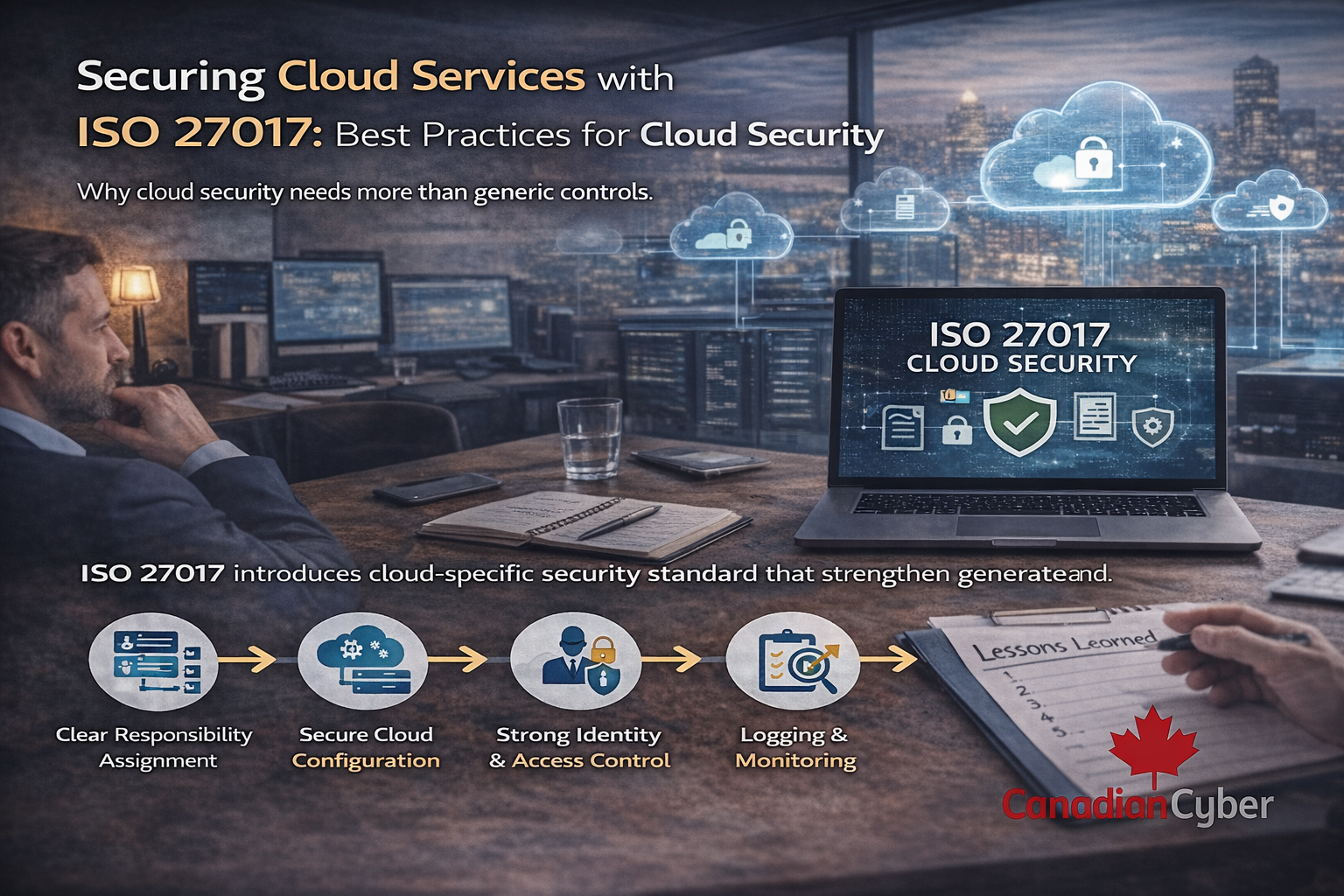
Securing Cloud Services with ISO 27017: Best Practices for Cloud Security
Why cloud security needs more than generic controls.
Cloud adoption has become the default.
Organizations run core systems on AWS, Azure, Google Cloud, and SaaS platforms. Teams deploy faster. Infrastructure scales easily. Costs are predictable. But security responsibility has become less clear, not more.
Many organizations still assume:
- “The cloud provider handles security”
- “ISO 27001 already covers this”
- “Our cloud setup is secure by default”
These assumptions create dangerous gaps. That’s exactly why ISO/IEC 27017 exists.
What Is ISO 27017?
ISO/IEC 27017 is a cloud-specific security standard that extends ISO/IEC 27001.
While ISO 27001 provides a general information security framework, ISO 27017 adds controls and guidance specifically designed for cloud environments.
ISO 27017 applies to:
- Cloud Service Providers (CSPs)
- Organizations using cloud services (customers)
- Hybrid environments with shared responsibility
In short: ISO 27017 addresses the question ISO 27001 alone cannot fully answer: “Who is responsible for what in the cloud?”
Why ISO 27001 Alone Is Not Enough for Cloud Security
ISO 27001 is intentionally technology-neutral. That flexibility is a strength but also a limitation in cloud environments.
Cloud introduces risks traditional data centres never had, such as:
- Shared infrastructure
- API-driven access
- Multi-tenant environments
- Rapid configuration changes
- Third-party managed controls
ISO 27017 fills this gap by clarifying responsibilities and controls unique to cloud computing.
The Shared Responsibility Problem (and Why It Causes Breaches)
Cloud security failures often happen because responsibilities are misunderstood.
| Common Misconception | Reality in the Cloud |
|---|---|
| “The cloud provider is responsible for security.” | Providers secure the infrastructure; customers secure configurations, data, access, and usage. |
| “Security is enabled by default.” | Many critical protections are available but must be configured, monitored, and enforced. |
Why ISO 27017 matters: It provides guidance to clearly assign shared security responsibilities, helping organizations avoid dangerous blind spots.
A Fictional Example: When Assumptions Go Wrong
This example is fictional but reflects real cloud incidents.
A company stored sensitive customer data in a cloud database.
- Encryption was available but not enabled
- Logging existed but wasn’t configured
- Access permissions were overly broad
After a data exposure, the organization blamed the cloud provider. The provider responded:
“Those controls were the customer’s responsibility.”
ISO 27017 exists to prevent this exact scenario.
What ISO 27017 Adds to Cloud Security
ISO 27017 introduces cloud-specific controls and guidance that strengthen governance and security. Here are the most important areas.
1) Clear Allocation of Cloud Security Responsibilities
ISO 27017 explicitly requires:
- Defined responsibilities between provider and customer
- Documentation of who manages which controls
- Understanding of shared responsibility boundaries
This prevents gaps where “everyone assumed someone else handled it.”
2) Secure Cloud Configuration Management
Cloud security failures often stem from misconfiguration. ISO 27017 emphasizes:
- Secure default configurations
- Change management for cloud resources
- Review of access permissions
- Monitoring configuration drift
3) Strong Identity and Access Management
Cloud environments are identity-driven. ISO 27017 reinforces:
- Role-based access control
- Least privilege principles
- Secure authentication methods
- Monitoring of privileged access
This limits damage when credentials are compromised.
4) Logging, Monitoring, and Visibility
Without visibility, cloud security fails silently. ISO 27017 stresses:
- Cloud activity logging
- Monitoring of administrative actions
- Retention and review of logs
- Detection of abnormal behaviour
This helps identify incidents early.
5) Data Protection in Multi-Tenant Environments
ISO 27017 provides guidance on:
- Data segregation
- Encryption in transit and at rest
- Secure deletion
- Data location awareness
This is critical for compliance and trust.
ISO 27017 Cloud Security Checklist (Quick Start)
Use this as a practical baseline for cloud governance and control hygiene:
| Control Area | What “Good” Looks Like |
|---|---|
| Shared responsibility | Responsibilities documented (provider vs customer) and reviewed regularly |
| Configuration management | Secure baselines, change control, drift detection, periodic reviews |
| Identity & access | Least privilege, MFA, RBAC, privileged access monitoring |
| Logging & monitoring | Central logging, alerting, retention, regular log review |
| Data protection | Encryption, segregation, secure deletion, location awareness |
✅ Want ISO 27017 cloud controls mapped to your real architecture?
We help you clarify responsibility, tighten configuration governance, and build audit-ready evidence without slowing delivery.
👉 Explore Our ISO 27017 Cloud Security Services
👉 Book a Free Consultation
Who Should Consider ISO 27017?
ISO 27017 is especially relevant for organizations that:
- Rely heavily on cloud infrastructure
- Offer SaaS or cloud-based services
- Handle sensitive or regulated data
- Use multiple cloud providers
- Want stronger cloud governance
It applies equally to cloud providers and cloud customers.
ISO 27017 and ISO 27001: How They Work Together
ISO 27017 does not replace ISO 27001. It builds on it.
- ISO 27001 defines what a security program should include
- ISO 27017 explains how to apply those principles in the cloud
Why ISO 27017 Matters for Canadian Organizations
Canadian organizations face increasing pressure from privacy and security expectations. Cloud security gaps often lead to:
- Privacy incidents
- Regulatory scrutiny
- Customer trust loss
ISO 27017 helps demonstrate reasonable safeguards and accountability in cloud environments.
How a vCISO Helps Implement ISO 27017 Effectively
ISO 27017 is not just about controls it’s about governance. A Virtual CISO (vCISO) helps organizations:
- Interpret ISO 27017 requirements
- Map controls to cloud architectures
- Define shared responsibility clearly
- Align cloud security with ISO 27001
- Avoid over-engineering or gaps
How Canadian Cyber Supports ISO 27017 Adoption
At Canadian Cyber, cloud security is treated as a governance and risk problem, not just a technical one.
ISO 27017 Cloud Security Consulting
- Apply ISO 27017 guidance practically
- Clarify cloud responsibilities
- Secure cloud configurations
- Strengthen governance and documentation
Integrated ISO 27001 & Cloud Security
- Align ISO 27001 ISMS programs with cloud controls
- Support privacy and compliance requirements
- Create audit-ready evidence for customer reviews
vCISO-Led Cloud Governance
- Oversee cloud security strategy
- Guide leadership decisions
- Support audits and customer reviews
- Reduce cloud-related risk exposure
Cloud Security Requires Clarity, Not Assumptions
The cloud is not insecure. But misunderstood responsibility is.
ISO 27017 provides the structure organizations need to:
- Clarify accountability
- Close cloud security gaps
- Strengthen trust with customers and partners
If your organization relies on the cloud, ISO 27017 is no longer optional guidance it’s a best practice.
Ready to Strengthen Your Cloud Security Governance?
If you want to secure your cloud environment with clarity and confidence, we can help.
👉 Learn About Our ISO 27001 & vCISO Services
👉 Book a Free Consultation
Stay Connected With Canadian Cyber
Follow Canadian Cyber for insights on ISO 27001, cloud governance, and practical cybersecurity for Canadian organizations: