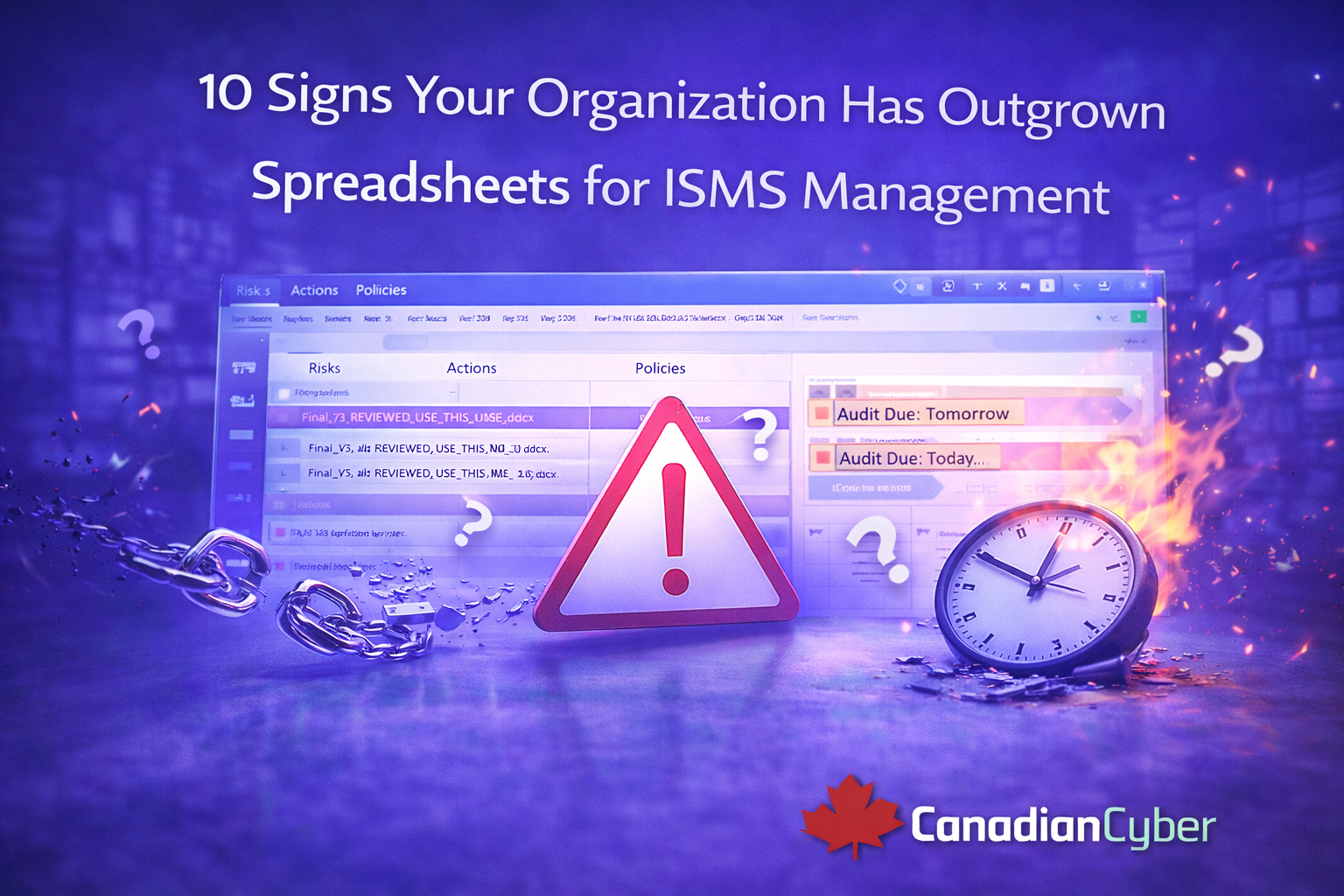
10 Signs Your Organization Has Outgrown Spreadsheets for ISMS Management
Spreadsheets are where most ISMS programs begin.
And for a while, they work.
Until one day… they don’t.
If ISO 27001, SOC 2, or control management feels harder every year,
this list will feel uncomfortably familiar.
Want to confirm if spreadsheets are now a risk?
Do this 30-second self-check and see what “good” looks like.
Ideal for teams running ISO 27001, SOC 2, or multi-framework compliance in Microsoft 365.
Quick snapshot: Spreadsheet ISMS vs. ISMS Portal
| Spreadsheets | ISMS Portal |
|---|---|
| Manual updates and email versions | One source of truth, live collaboration |
| High error risk | Automation reduces human error |
| Weak audit trails | Version history, approvals, traceability |
| Audits feel like fire drills | Audit-ready by design |
The 10 signs (be honest)
1) You have multiple “final” versions of the same policy
There’s Final_v3.docx, Final_v3_REVIEWED.docx, and “USE_THIS_ONE.”
And nobody is 100% sure what’s approved.
What this really means: Version control has broken down.
What fixes it: One policy library with built-in versioning + approvals.
2) Policy reviews are missed until the auditor asks
Review reminders live in someone’s inbox.
Or worse: someone’s memory.
What this really means: Your ISMS depends on people remembering.
What fixes it: Automated review schedules and system-driven reminders.
3) You chase people for updates more than you manage risk
Follow-ups. Status pings. Copy-paste updates.
You’re coordinating… not improving security.
What this really means: No accountability mechanism.
What fixes it: Clear ownership, task tracking, and dashboards.
4) Audits feel like a fire drill every single time
Files are gathered. Screenshots are taken. Evidence is rebuilt.
Even though you passed last time.
What this really means: Audit-reactive, not audit-ready.
What fixes it: Continuous evidence + structured repositories.
5) Spreadsheets are constantly emailed back and forth
Risk registers. Action logs. Control lists.
Each email creates another version. Each version creates confusion.
What this really means: No real-time collaboration.
What fixes it: A shared portal with live data and permissions.
6) You can’t quickly answer “Who owns this control?”
When something goes wrong, ownership is unclear.
That delay becomes risk.
What this really means: Ownership isn’t enforced by the system.
What fixes it: Role-based ownership tied to controls and tasks.
7) New regulations keep getting harder to track
ISO 27001 was manageable. Then came SOC 2, cloud extensions, privacy laws,
and customer security requirements.
What this really means: Spreadsheets don’t scale across frameworks.
What fixes it: A flexible ISMS structure that supports multiple standards.
8) Knowledge lives in people, not the system
When someone leaves, context disappears.
Reviews get missed.
Evidence vanishes.
What this really means: Your ISMS isn’t institutionalized.
What fixes it: A system that captures history, decisions, and ownership.
9) Leadership has no real visibility into ISMS health
“Are we audit-ready?”
If the answer requires manual reporting, it’s already a problem.
What this really means: No executive-level visibility.
What fixes it: Dashboards that show readiness, risk, and owners instantly.
10) You’re managing compliance but not improving security
You’re busy. But not better.
That’s the biggest red flag.
What this really means: Your ISMS is administrative, not strategic.
What fixes it: A platform that turns activity into insight and risk reduction.
Quick self-check (score yourself)
- 3+ signs: spreadsheets are slowing you down.
- 5+ signs: spreadsheets are now a compliance risk.
- 7+ signs: expect audit friction and missed reviews.
The spreadsheet trap (how it fails)
Spreadsheets don’t fail suddenly.
They fail quietly.
- Missed reviews
- Lost evidence
- Unclear ownership
- Audit stress
By the time leadership notices, risk has already increased.
If this list felt a little too familiar…
It’s time to move beyond spreadsheets.
Get one source of truth, automation, accountability, and audit-ready evidence.
Final thought
Spreadsheets are great for calculations.
They’re terrible for systems.
An ISMS is a living program, not a static file.
If your ISMS has outgrown spreadsheets, that’s not a failure.
It’s a sign you’re ready to do it properly.
Stay Connected With Canadian Cyber
Follow us for practical insights on ISO 27001, SOC 2, and ISMS best practices: