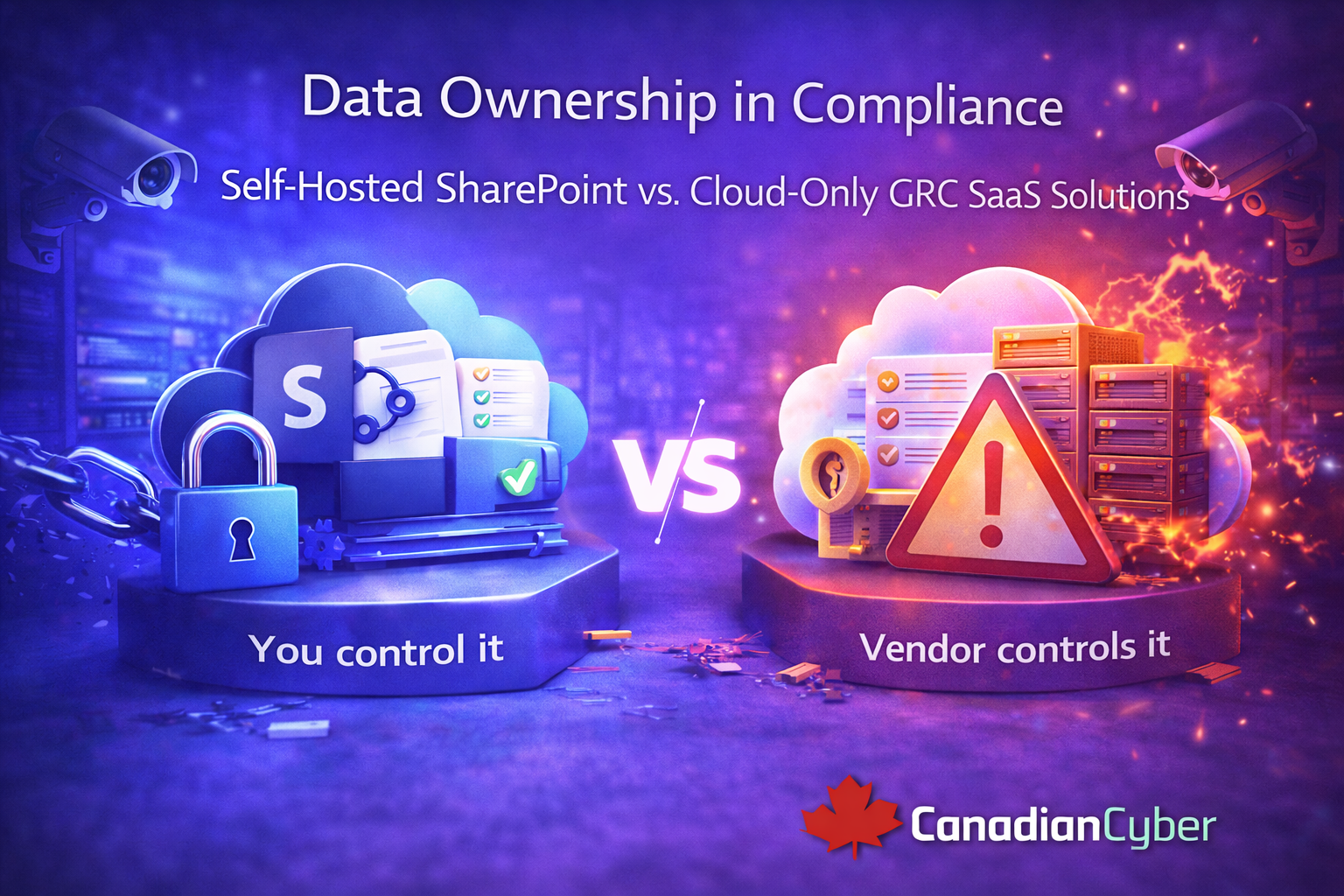
Data Ownership in Compliance: Self-Hosted SharePoint vs. Cloud-Only GRC SaaS Solutions
Every compliance program eventually asks the same uncomfortable question:
Who actually owns our ISMS data?
Not who uses it.
Not who exports it.
But who truly controls it.
In an era of audits, breaches, and vendor risk, data ownership is a security decision not a technical one.
If your ISMS includes risks, incidents, findings, and remediation plans, ask one more question:
Should that data live outside your security perimeter?
For ISO 27001, SOC 2, ISO 27017/27018, and regulated environments.
Why ISMS data is more sensitive than you think
Your ISMS doesn’t just store documents.
It stores the truth.
- Risk registers and known weaknesses
- Audit findings and nonconformities
- Incident logs and response details
- Control gaps and remediation plans
- Internal approvals and accountability trails
In plain terms: your ISMS is a map of your security posture.
Putting that map in the wrong place introduces risk even if the tool itself is “secure.”
Two models, two philosophies
When organizations choose an ISMS or GRC tool, they usually choose between:
Cloud-only GRC SaaS
Vendor-managed platform. Your ISMS data lives in their environment.
SharePoint ISMS in Microsoft 365
Your tenant. Your identity controls. Your policies. Your logs.
Both live “in the cloud.”
But control is very different.
Cloud-only SaaS GRC: convenience with trade-offs
Most SaaS GRC tools operate on a shared, vendor-managed platform.
That usually means:
- Your ISMS data lives in their environment
- Access is governed by their controls and admin model
- Availability depends on their uptime and incident response
- Breaches or outages can have cross-customer impact
Key point: even with strong security claims,
you are still outsourcing custody of your most sensitive compliance data.
For some organizations, that’s acceptable.
For others, it’s a red flag.
SharePoint ISMS: control without complexity
A SharePoint-based ISMS lives inside your Microsoft 365 tenant.
That means:
- Your identity controls (Entra ID / Azure AD)
- Your access policies and conditional access
- Your logging, monitoring, and retention rules
- Your data residency and governance decisions
No new third-party data custodian.
No extra vendor risk layer.
Quick comparison snapshot
| Area | Cloud-only GRC SaaS | SharePoint ISMS (M365) |
|---|---|---|
| Data ownership | Vendor-hosted custody | You control it in-tenant |
| Access control | SaaS roles + vendor admin model | M365 native permissions + identity |
| Data residency | Vendor-dependent | Tenant-controlled |
| Third-party risk | Higher (new vendor layer) | Lower (leverage existing stack) |
| Audit transparency | Often export-driven | Native versioning + traceability |
| Regulated fit | Varies | Strong (custody + governance) |
Why regulated industries care more about ownership
In healthcare, finance, government, and critical infrastructure, data custody matters.
Auditors and regulators increasingly ask:
- Where is this data stored?
- Who can access it?
- Who administers the platform?
Defensibility matters.
“It’s in our Microsoft 365 environment” is usually easier to explain than
“it’s in a third-party SaaS vendor’s platform.”
Reducing third-party risk by design
Every new SaaS tool adds:
- Another vendor to assess
- Another contract to manage
- Another breach surface
- Another dependency during outages
An ISMS built on SharePoint reduces vendor sprawl by leveraging what you already secure and manage.
Less outsourcing. Fewer dependencies. Cleaner risk profiles.
Practicality matters too (adoption is a control)
A control that nobody uses is a control that fails in practice.
SharePoint ISMS adoption is often faster because:
- Users already know Microsoft 365
- Authentication is seamless
- Permissions match org structure
- Evidence links naturally to Teams, Outlook, and files
Security-first about compliance data?
Keep your ISMS where your security already lives inside your Microsoft 365 tenant.
When cloud-only SaaS GRC might make sense
To be fair, cloud-only GRC tools can work if:
- You don’t have an existing Microsoft 365 footprint
- Data sensitivity is low
- Regulatory scrutiny is minimal
- You prefer prescriptive workflows over flexibility
Final thought
Compliance isn’t just about passing audits.
It’s about control.
If your ISMS documents describe your weakest points, ask yourself:
Who should really be holding them?
Put ownership back in your hands
Choose an ISMS model that keeps data under your control without adding another SaaS risk layer.
Stay Connected With Canadian Cyber
Follow us for real-world insights on ISO 27001, SOC 2, ISMS platforms, and security leadership: