Get in touch
info@canadiancyber.ca


Rafia Rizwan

February 9, 2026
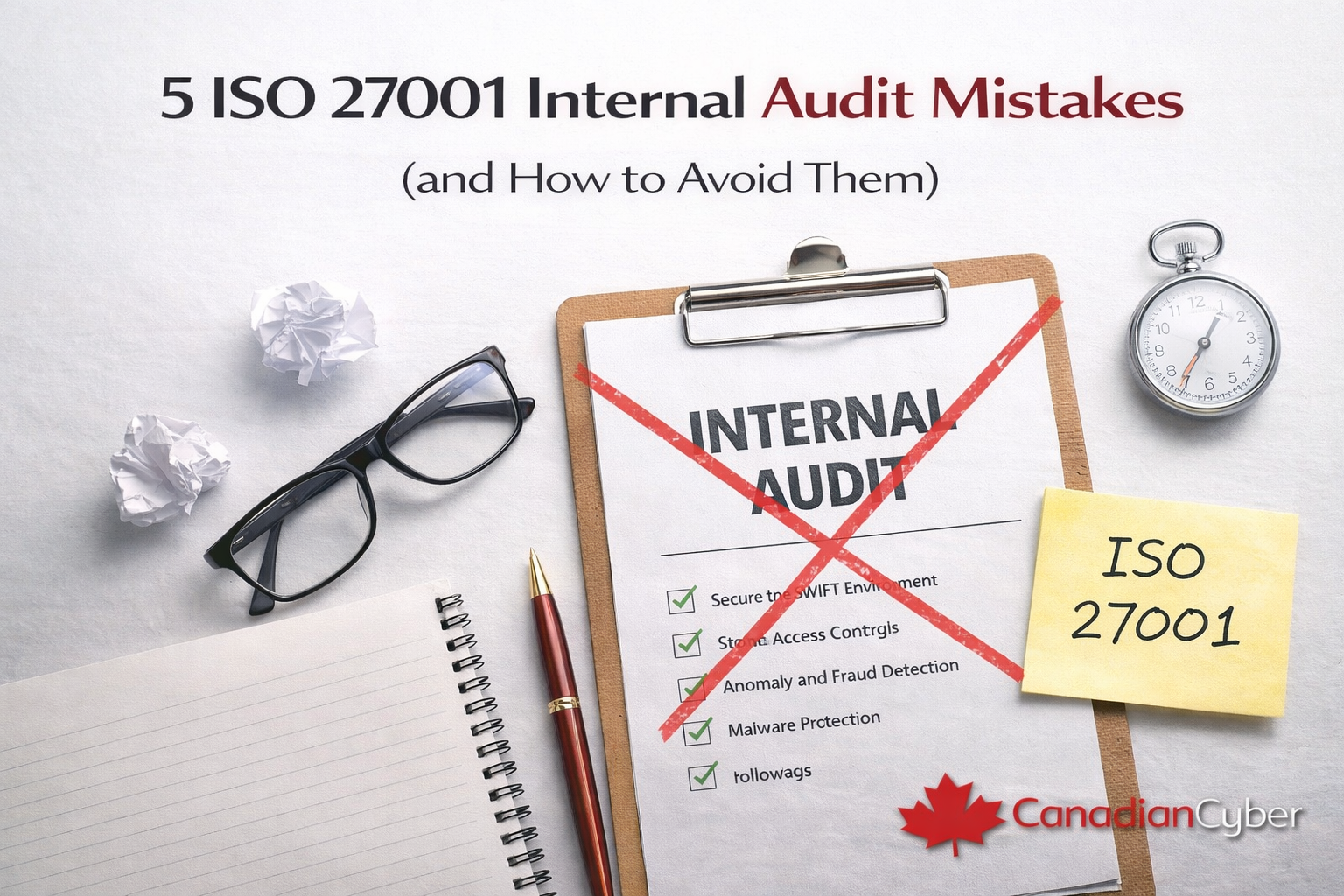
This guide explains the most common ISO 27001 internal audit mistakes and how to fix them before they derail your certification audit.
Most ISO 27001 certification failures don’t happen during the external audit.
They happen months earlier during the internal audit.
Internal audits are meant to be your safety net. Instead, for many organizations, they create a false sense of security.
Here are the five most common internal audit mistakes and how to avoid them so your certification journey stays on track.
Clause 9.2 of ISO 27001 is clear: you must conduct internal audits at planned intervals.
But external auditors expect more than a checkbox they expect proof of real testing, objective findings, and follow-through.
Many organizations treat internal audits as an annual event. That’s risky. Issues sit undetected, controls drift, and evidence gaps pile up.
How to avoid it
Bottom line: continuous readiness beats last-minute panic.
An internal audit is not a self-review. If control owners audit their own work, or auditors lack ISO 27001 competence, findings get softened and gaps stay hidden. External auditors can spot this fast.
How to avoid it
Non-negotiable: objectivity.
“Yes/No” answers don’t equal assurance. If controls are marked implemented but not tested, you end up with blind spots and painful surprises during certification.
Audit question to use: “Does this control work in practice and can we prove it with samples?”
If evidence is scattered across email, desktops, and old folders, audits slow down and confidence drops. External auditors read this as a governance problem even if controls exist.
How to avoid it
Shortcut: a SharePoint-based ISMS portal makes evidence retrieval routine.
The audit report is not the finish line. If corrective actions aren’t assigned, tracked, and closed, external auditors will ask:
“What did you do about last year’s findings?”
Rule: an audit without follow-up is wasted effort.
Get an independent review that tests effectiveness, samples evidence, and gives you a prioritized remediation plan.
A company says: “Our internal audit went fine.”
The certification auditor says: “Your internal audit didn’t test effectiveness.”
That gap costs time, money, and credibility. The right internal audit prevents that moment.
ISO 27001 internal audits are not a formality. They are your early warning system, your rehearsal for certification, and your chance to fix issues quietly. Avoiding these five mistakes can be the difference between first-time certification and a painful re-audit.
Audit smart, fix early, and walk into certification with evidence that speaks for itself.
Follow us for practical ISO 27001 insights, internal audit guidance, and compliance best practices: