Get in touch
info@canadiancyber.ca


Rafia Rizwan

February 9, 2026
A practical guide to writing ISO 27001 cybersecurity policies that reflect real operations, meet audit expectations, and avoid certification delays.
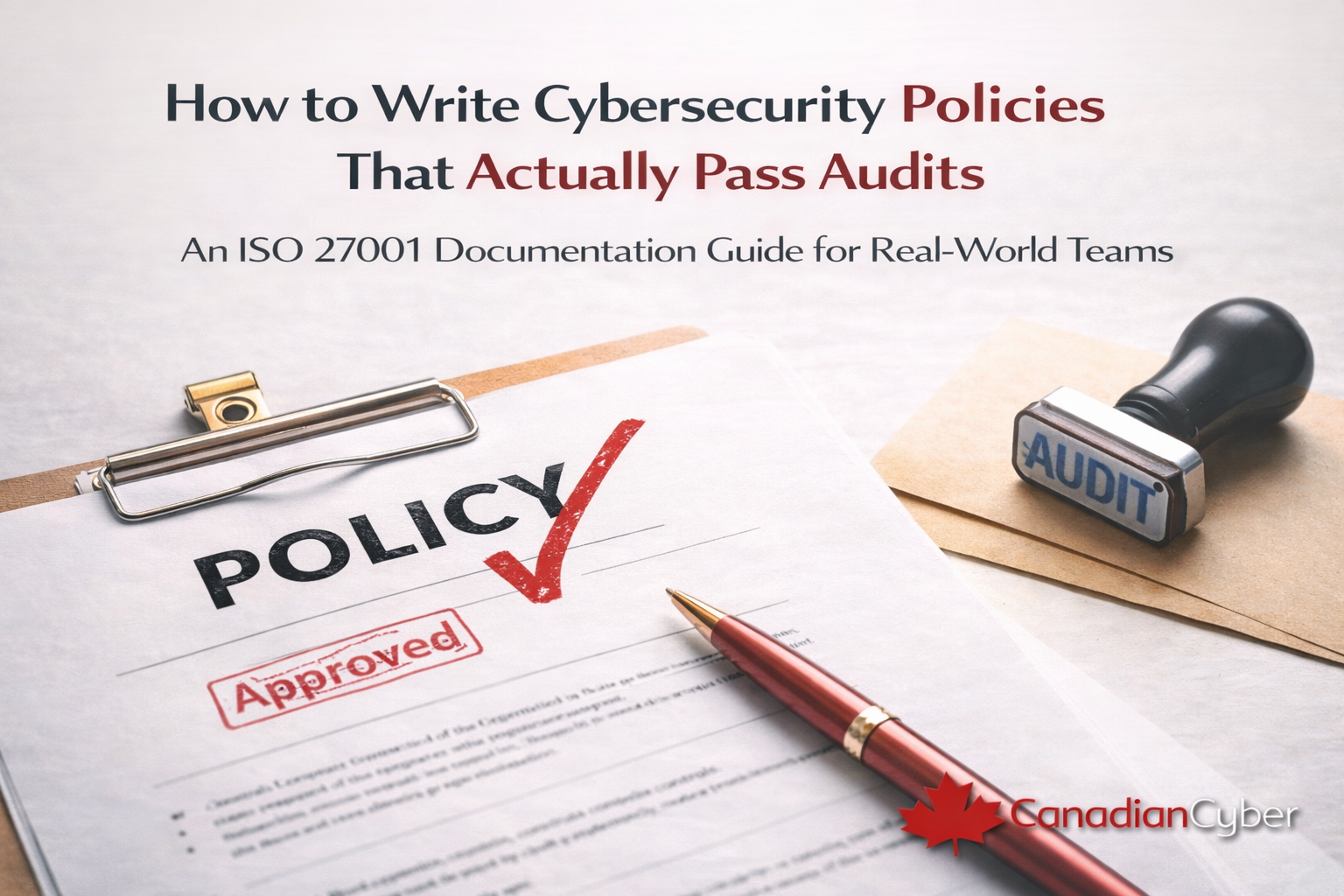
An ISO 27001 Documentation Guide for Real-World Teams
Most organizations don’t fail ISO 27001 audits because they lack controls.
They fail because their policies don’t prove those controls exist.
Auditors don’t read policies to admire formatting. They read them to answer one question:
“Does this organization actually run security the way it claims?”
This guide shows how to write clear, audit-ready cybersecurity policies that stand up to ISO 27001 audits without overengineering or endless rewrites.
From an auditor’s perspective, weak policies often look like this:
Result: nonconformities, follow-up audits, delayed certification.
Good practices don’t help if you can’t document them properly.
ISO 27001 doesn’t require long policies. It requires clear, controlled, and governed ones.
Before writing anything, answer three questions:
Quick test: If the policy doesn’t change behavior, it won’t pass scrutiny.
One of the most common findings is: “Policy exists, but control mapping is unclear.”
Best practice: maintain a simple ISMS index that shows which policies cover which controls in your SoA.
Auditors don’t reward complexity. They reward clarity. Good policies use plain language and focus on actionable requirements.
Writing tip: If employees can’t understand it, auditors will question whether it’s followed.
Every policy must have a named owner, a review cycle, and accountability for updates.
“IT” or “Security Team” is not an owner.
Version chaos is one of the fastest ways to fail an audit. Auditors want one authoritative version, clear effective dates, and archived history not “final-final-v3.”
ISO 27001 expects governance. Policies must be reviewed on schedule, changes approved, and management involved where required.
Approvals need to be traceable.
Practical move: use a SharePoint-based ISMS portal so approvals, versioning, and review reminders are automatic.
Auditors often ask: “How do you ensure staff are aware of this policy?”
Be ready to show training and real operational evidence.
Get a practical policy review and a clean mapping plan before your next audit cycle.
Most policy failures aren’t about writing. They’re about management. If policies live across folders and email threads,
you lose reminders, approvals, audit trails, and the single source of truth auditors rely on.
ISO 27001 audits don’t reward the longest policies. They reward: clarity, consistency, control, and proof.
When policies are written well and managed properly, audits become predictable not stressful.
Write policies once, manage them properly, and walk into audits with confidence.
Follow us for practical ISO 27001 guidance, ISMS automation tips, and audit-ready documentation insights: