

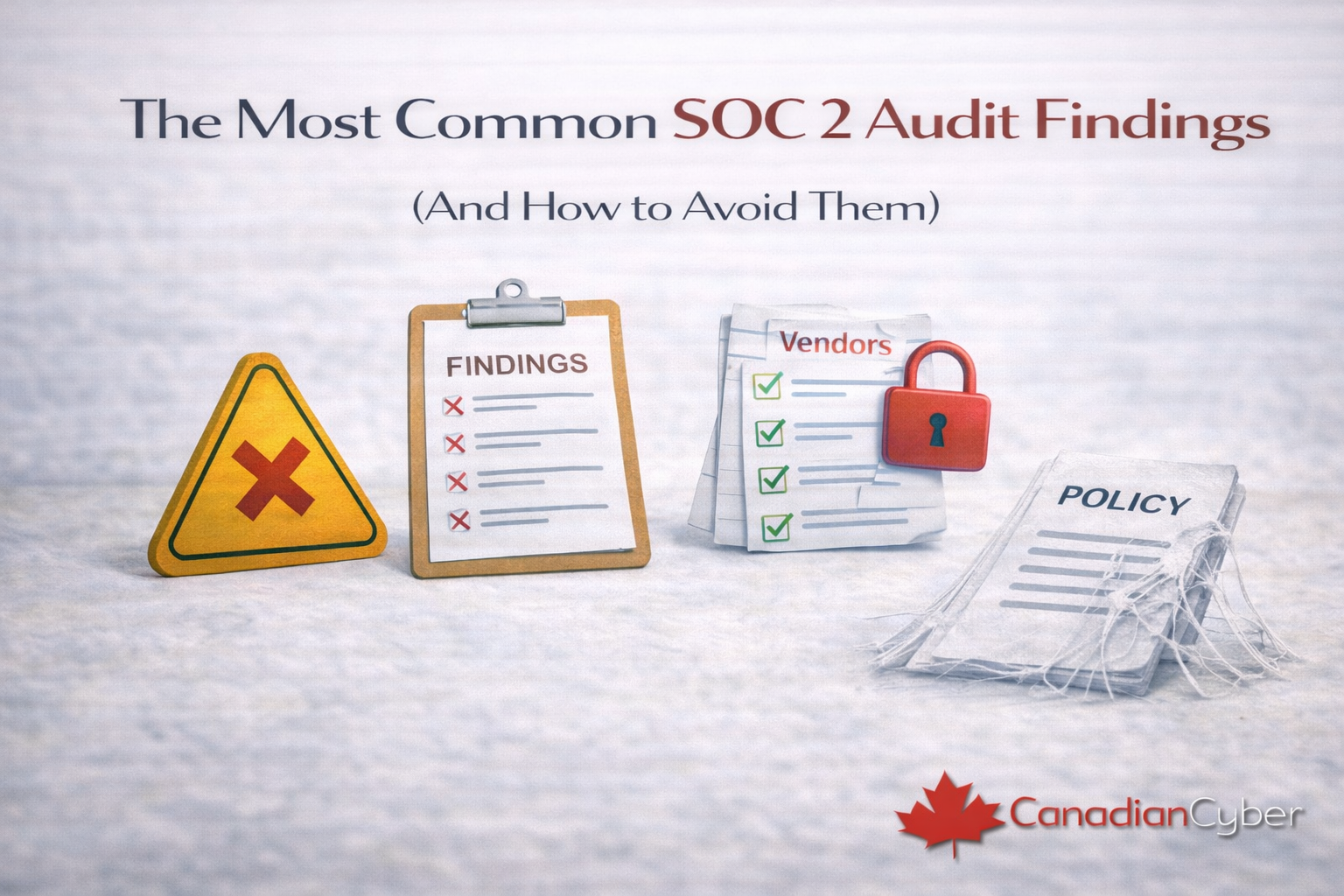
The Most Common SOC 2 Audit FindingsAnd How to Avoid Them (Before They Become Exceptions)
Preparing for a SOC 2 audit? Here’s a reality check:
most companies don’t fail because they lack security.
They fail because they lack evidence, consistency, or ongoing oversight.
SOC 2 auditors aren’t looking for perfection. They’re looking for control effectiveness and proof.
If you understand the most common findings in advance, you can fix issues early before they show up as exceptions in your report.
Why Findings Happen (Even in “Secure” Companies)
Most findings are not technical failures they’re operational gaps:
- Controls exist, but the evidence isn’t captured
- Policies exist, but enforcement is inconsistent
- Reviews happen, but no one can prove they happened
- Ownership is unclear, so tasks slip quietly
SOC 2 rewards repeatability. If your controls run on a schedule and your evidence is organized, your audit becomes faster, cheaper, and cleaner.
The Most Common SOC 2 Audit Findings (And How to Prevent Them)
1) Weak or Inconsistent Access Reviews
The finding:
- No documented quarterly access reviews
- Reviews are performed but not recorded
- Inactive accounts aren’t removed quickly
Why it happens: Access management feels operational. Documentation feels secondary.
Auditors disagree.
How to avoid it:
- Schedule formal quarterly access reviews
- Document reviewer name, date, scope, and outcome
- Remove terminated users immediately (and retain proof)
- Implement automated reminders to prevent missed cycles
2) Missing or Incomplete Security Monitoring
The finding:
- Logs are enabled but not reviewed
- No documented alert review process
- No evidence of investigation follow-ups
Why it happens: Companies assume enabling logging equals monitoring. It does not.
How to avoid it:
- Define a log/alert review cadence (daily/weekly for critical alerts)
- Document review activities (who/when/what)
- Configure alerts for critical events and privileged activity
- Record incident follow-ups in tickets with timestamps
3) Inadequate Vendor Risk Management
The finding:
- No formal vendor review process
- No security assessment for critical vendors
- No contracts addressing data protection
Why it happens: Startups rely heavily on cloud providers without structured oversight.
Auditors expect third-party risk controls.
How to avoid it:
- Maintain a vendor inventory (and update it)
- Classify vendors by risk level (critical/high/low)
- Conduct annual security reviews for critical vendors
- Ensure DPAs or security clauses are signed and stored centrally
4) Weak Password and MFA Enforcement
The finding:
- Password policies are not enforced technically
- No MFA on critical systems
- Inconsistent configuration across platforms
Why it happens: Policies exist but enforcement is manual. SOC 2 expects technical enforcement.
How to avoid it:
- Enforce MFA organization-wide (at minimum: admin + production + email)
- Implement conditional access policies where available
- Align password settings with your documented policy
- Test enforcement regularly and keep evidence snapshots
5) Poor Evidence Organization
The finding:
- Screenshots missing timestamps
- Evidence stored across email threads
- No centralized repository
Why it happens: Companies prepare reactively when auditors request documents. This creates chaos.
How to avoid it:
- Centralize documentation in a structured ISMS
- Store evidence continuously (not at the last minute)
- Maintain consistent naming conventions
- Use automation where possible
6) Outdated or Generic Policies
The finding:
- Policies copied from templates and not customized
- No documented approvals
- No version control
Why it happens: Policy writing is rushed before the audit. Auditors spot generic documents fast.
How to avoid it:
- Customize policies to reflect actual practices
- Track approval history (traceable sign-offs)
- Maintain version control with one source of truth
- Schedule annual reviews and document completion
7) No Formal Risk Assessment Process
The finding:
- Risk assessment not documented
- Risks identified but no mitigation tracking
- No executive approval
Why it happens: Companies focus on controls, not governance. Risk assessment is foundational to SOC 2.
How to avoid it:
- Conduct annual risk assessments
- Document methodology and scoring approach
- Assign remediation owners and due dates
- Obtain executive sign-off and store proof
8) Incident Response Plan Not Tested
The finding:
- Plan exists but never exercised
- No tabletop exercise documentation
- No defined escalation process
Why it happens: Incident response is treated as theoretical. SOC 2 expects validation.
How to avoid it:
- Conduct annual tabletop exercises
- Document scenarios, decisions, and lessons learned
- Update procedures based on outcomes
- Store evidence with date + approvals
Why These Findings Matter
- Delay report issuance
- Require remediation periods and re-testing
- Raise concerns with customers
- Increase audit fees and internal distraction
Preparing for a SOC 2 audit? Identify weaknesses before your auditor does and avoid costly report exceptions.
The Pattern Behind Most SOC 2 Findings
Nearly all common SOC 2 issues share one root cause:
lack of structure and ongoing oversight.
SOC 2 is not about last-minute preparation it’s about consistent control execution year-round.
How Canadian Cyber Helps You Avoid SOC 2 Findings
Canadian Cyber helps you prevent findings by strengthening control effectiveness not just assembling documents.
- SOC 2 readiness gap assessments
- Control testing and validation
- vCISO oversight and accountability
- Vendor risk management frameworks
- ISMS SharePoint solutions for structured evidence tracking
- Continuous compliance monitoring
Final Takeaway
SOC 2 audit findings are predictable and preventable. Fix issues early, organize evidence continuously, and keep controls running on schedule.
That’s how you avoid exceptions and pass with confidence.
Stay Connected With Canadian Cyber
Follow us for SOC 2 readiness tips, compliance strategy insights, and cybersecurity leadership guidance: