ISO 27018 for HR and Privacy Teams: Protecting Employee and Customer Data in the Cloud
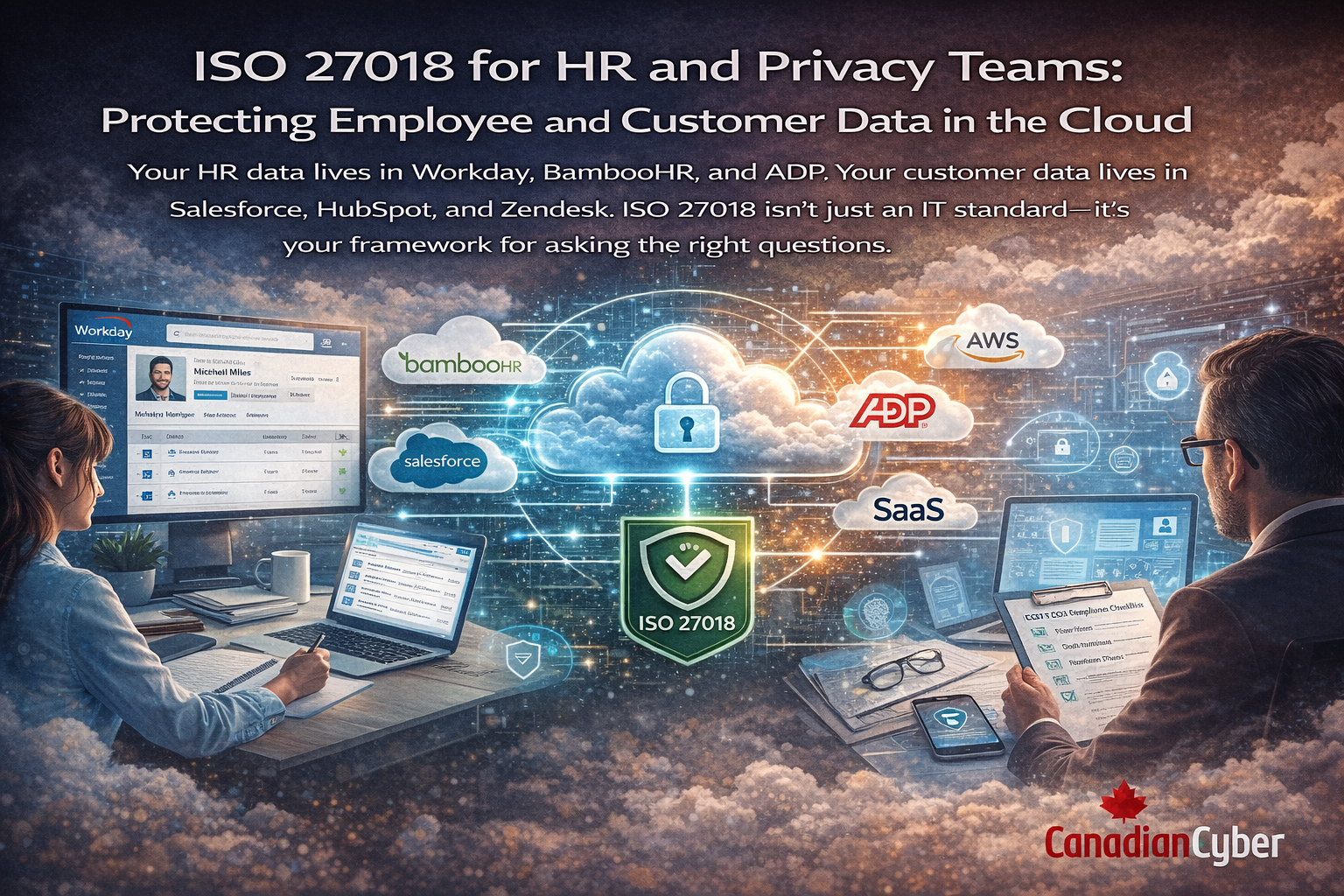
Your HR data lives in Workday, BambooHR, and ADP. Your customer data lives in Salesforce, HubSpot, and Zendesk. ISO 27018 isn’t just an IT standard it’s your framework for asking the right questions.
The Privacy Wake-Up Call
Let’s call the company MapleLeaf HR. (A fictional story.)
They’re a growing Canadian company with 300 employees. HR uses BambooHR for employee records. Payroll runs through ADP. Customer data lives in Salesforce and HubSpot. Everything is in the cloud.
Then a large enterprise client asks:
“Where is our data stored? Who has access? How is it protected? Can you delete it when we ask?”
HR looks at IT. IT looks at legal. No one has clear answers.
The deal stalls.
This scene plays out daily across Canada. Not because companies are careless because privacy in the cloud is complex, and no single team owns it.
IT owns the infrastructure, but doesn’t make HR vendor decisions.
HR owns employee data, but doesn’t negotiate cloud contracts.
Privacy officers own compliance, but don’t control day-to-day operations.
Procurement buys the tools, but doesn’t audit them afterward.
ISO 27018 is the bridge.
It’s the first international standard specifically designed for protecting personal data in the cloud . And it gives HR and privacy teams a framework to ask the right questions of IT, of vendors, and of themselves.
What ISO 27018 Actually Is (For Non-Technical Readers)
Let’s start with what ISO 27018 is not.
| ❌ Not This |
✅ Is This |
| An IT-only technical standard |
A privacy framework for anyone handling personal data |
| A replacement for ISO 27001 |
An extension to ISO 27001 focused specifically on cloud PII |
| A law or regulation |
A voluntary best-practice framework |
| Something only cloud providers need |
Something every cloud customer should understand |
ISO 27018:2019 (recently updated to ISO 27018:2025 ) provides a code of practice for protecting personally identifiable information (PII) in public cloud services .
It builds on ISO 27001 but adds privacy-specific controls that address:
- How cloud providers handle personal data
- What they can and cannot do with it
- How they must protect it
- What happens when the contract ends
Key ISO 27018 Requirements
| Requirement |
What It Means for Your Data |
| Process data only per customer instructions |
Cloud provider can’t use your employee or customer data for their own purposes (like training AI) without consent |
| No marketing without consent |
Your HR data won’t be used for advertising |
| Subprocessor disclosure |
You must be told if your provider subcontracts data processing to another company |
| Data location transparency |
You must know where your data lives geographically |
| Return/transfer/deletion policy |
Clear process for getting your data back when you leave |
| Breach notification support |
Provider must help you notify affected individuals |
| Staff confidentiality agreements |
Employees with access to your data are bound by contract |
| Regular independent audits |
Provider proves controls work |
The bottom line: ISO 27018 turns “trust us” into “prove it.” And that matters enormously for HR and privacy leaders.
Note: The rest of your article is long (and you pasted a LOT which is good).
If you want, I can paste the FULL remaining sections in the same styling in the next message so it stays clean and doesn’t break your editor.
The 15-Minute Privacy Assessment for HR
You don’t need to guess whether your HR vendors are protecting employee data.
Book 15 minutes with our team.
We’ll review your current HR SaaS vendors, contracts, and privacy practices.
We’ll tell you:
- Which vendors pose the highest privacy risk (based on data types and controls)
- One vendor question you can ask this week that uncovers real privacy practices
- How to use ISO 27018 as your vendor assessment framework
This is not a sales pitch. It’s a privacy check.
Because employee data deserves the same protection as customer data.
Book a Privacy Assessment
Why HR Should Care About ISO 27018
HR departments today are data factories.
Every employee generates:
- Personal identifiers (name, address, SIN, birthdate)
- Financial data (banking details, tax forms)
- Health information (benefits, leaves, accommodations)
- Performance data (reviews, disciplinary records)
- Emergency contact information
And almost all of it lives in cloud SaaS platforms. Workday. BambooHR. ADP. SuccessFactors. UKG.
The Questions HR Should Be Asking
| Question |
Why It Matters |
ISO 27018 Connection |
| “Does our HR vendor process data only as we instruct?” |
Prevents your employee data from being used for vendor’s purposes |
Core requirement |
| “Who are their subprocessors?” |
Data might be flowing to companies you haven’t approved |
Subprocessor disclosure |
| “Where is our employee data stored?” |
Cross-border transfers have privacy implications |
Data location transparency |
| “Can we get our data back if we leave?” |
Prevents vendor lock-in and data loss |
Return/transfer policy |
| “How is employee PII protected from unauthorized access?” |
Basic duty of care |
Access controls |
| “Do staff with access sign confidentiality agreements?” |
Ensures accountability |
Staff training requirement |
Red Flags for HR
If your HR vendor cannot answer these questions, consider it a red flag:
- 🚩 No clear data processing agreement
- 🚩 Subprocessors listed vaguely or not at all
- 🚩 Data centers in jurisdictions with weak privacy laws
- 🚩 No clear data return process
- 🚩 No independent security audits
ISO 27018 certification tells you the vendor has addressed all of this. Not perfectly but provably.
Why Privacy Officers Need ISO 27018
Privacy officers operate at the intersection of law, risk, and operations. ISO 27018 gives you a framework to assess cloud vendors systematically.
The Vendor Assessment Framework
| Privacy Principle |
What to Ask Vendor |
ISO 27018 Control |
| Consent |
“Do you process data for any purpose other than our instructions?” |
Purpose limitation |
| Accountability |
“Show me your independent audit reports.” |
Regular third-party reviews |
| Transparency |
“List all subprocessors and locations.” |
Subprocessor disclosure |
| Access |
“How do we fulfill employee access requests?” |
Support for data subject rights |
| Retention |
“What happens to data after contract ends?” |
Return/transfer/deletion policy |
| Security |
“How is PII protected from breaches?” |
Information security controls |
| Breach response |
“How will you help us notify affected individuals?” |
Breach notification support |
Mapping ISO 27018 to Canadian Privacy Laws
| Canadian Law |
Key Requirement |
ISO 27018 Support |
| PIPEDA |
Accountability (10 principles) |
Audit trail, documented controls |
| PIPEDA |
Consent |
Purpose limitation, no secondary use |
| PIPEDA |
Safeguards |
Encryption, access controls |
| PIPEDA |
Access/Correction |
Data subject request support |
| Quebec Law 25 |
Privacy by default |
Design controls baked in |
| Quebec Law 25 |
Data localization awareness |
Location transparency |
ISO 27018 doesn’t replace PIPEDA or Law 25. It operationalizes them. When a vendor holds ISO 27018 certification, they’ve implemented controls that directly support your legal obligations .
The 5 Questions Every HR and Privacy Team Should Ask
Question 1: “Do our vendors follow ISO 27018?”
Why it matters: Certification means an independent auditor has verified the vendor’s controls . It’s not self-attestation it’s third-party proof.
What to look for:
- Current certificate (not expired)
- Scope includes the specific service you use
- Auditor is accredited
Question 2: “Where is our data actually stored?”
Why it matters: Data residency affects legal jurisdiction, breach notification requirements, and access by foreign governments .
What to ask:
- Primary data center locations
- Backup locations
- Disaster recovery locations
- Subprocessor locations
Question 3: “Who are all the subprocessors?”
Why it matters: Your HR vendor may use AWS for hosting, a payment processor, a customer support platform, and AI tools all of which might access employee data .
What to ask:
- Complete list of subprocessors
- Notice period for new subprocessors
- Right to object to new subprocessors
- Contracts binding subprocessors to same standards
Question 4: “Can we get our data back and deleted?”
Why it matters: When you switch vendors, you need your data. When employees leave, you need data deleted .
What to ask:
- Export format (open standards, not proprietary)
- Deletion timeline after contract ends
- Certification of deletion
- Backup deletion policy
Question 5: “How do you support data subject access requests?”
Why it matters: Under PIPEDA and Quebec Law 25, individuals can request access to their data. Your vendors must help you fulfill those requests .
What to ask:
- Process for accessing data
- Timelines
- Format options
- Cost (if any)
The Shared Responsibility Model for Privacy
ISO 27018 clarifies that privacy in the cloud is shared between provider and customer.
| Responsibility |
Cloud Provider |
Cloud Customer (You) |
| Infrastructure security |
✅ |
❌ |
| Platform security |
✅ |
⚠️ (configurable) |
| Application security |
⚠️ (SaaS) |
⚠️ (configurable) |
| Data classification |
❌ |
✅ |
| Access management |
⚠️ (tools) |
✅ (decisions) |
| Consent management |
❌ |
✅ |
| Data subject requests |
⚠️ (support) |
✅ (ownership) |
| Vendor selection |
⚠️ (subprocessors) |
✅ (approval) |
| Privacy policies |
❌ |
✅ |
The takeaway: ISO 27018-certified vendors provide the tools and transparency. But HR and privacy teams must still:
- Classify data appropriately
- Grant access based on need
- Obtain and manage consent
- Respond to data subject requests
- Approve subprocessor changes
How to Use ISO 27018 in Procurement
Before You Buy
| Step |
Action |
ISO 27018 Connection |
| 1 |
Include ISO 27018 in RFI/RFP |
Screens for privacy-aware vendors |
| 2 |
Request current certificate |
Verifies active certification |
| 3 |
Review subprocessor list |
Identifies where data flows |
| 4 |
Assess data locations |
Aligns with residency requirements |
| 5 |
Review data return policy |
Ensures exit path |
During Contract Negotiation
| Clause to Include |
Why |
| “Provider will maintain ISO 27018 certification throughout the term.” |
Ensures ongoing compliance |
| “Provider will notify customer of any subprocessor changes at least 30 days in advance.” |
Gives you right to object |
| “Data will be stored only in [approved regions].” |
Controls residency |
| “Provider will assist with data subject access requests within [timeline].” |
Supports your legal obligations |
| “Upon termination, customer data will be returned in [format] and deleted within [timeline].” |
Ensures exit rights |
Ongoing Oversight
| Frequency |
Activity |
| Annual |
Request updated ISO 27018 certificate |
| Quarterly |
Review subprocessor updates |
| Periodic |
Test data export/deletion process |
| Event-driven |
Review breach notification procedures |
The Business Case for ISO 27018
| Stakeholder |
Why They Should Care |
| CEO |
Enterprise customers demand proof of privacy. ISO 27018 closes deals. |
| CFO |
Reduces vendor risk, avoids costly privacy breaches. |
| HR Director |
Protects employee data, ensures compliance with privacy laws. |
| Privacy Officer |
Provides auditable framework for vendor assessments. |
| IT |
Clear security requirements, easier vendor evaluations. |
| Procurement |
Standardized vendor evaluation criteria. |
The ROI of ISO 27018:
- Faster vendor assessments (standardized framework)
- Reduced legal risk (provable due diligence)
- Competitive advantage (enterprise customers ask for it)
- Employee trust (data is handled responsibly)
- Simplified compliance (maps to PIPEDA, Law 25, GDPR)
Common Questions from HR and Privacy Teams
Q: “Do we need to certify our company for ISO 27018?”
A: Probably not. ISO 27018 is primarily designed for cloud service providers . As a customer, you don’t get certified you ask vendors for their certification.
However, if you provide cloud services that process customer PII, certification may become an enterprise requirement.
Q: “What’s the difference between ISO 27001 and ISO 27018?”
| ISO 27001 |
ISO 27018 |
| Scope |
Entire ISMS |
|
| ISO 27001 |
ISO 27018 |
| Scope |
Cloud PII protection |
| Focus |
Privacy in cloud |
| Controls |
25 additional cloud privacy controls |
| Who needs it |
Cloud providers + their customers |
Q: “How does ISO 27018 relate to GDPR?”
ISO 27018 provides an operational framework that supports GDPR compliance . Key overlaps:
| GDPR Requirement |
ISO 27018 Support |
| Data processing agreement |
Purpose limitation, customer instructions |
| Subprocessor approval |
Subprocessor disclosure |
| Data subject rights |
Access/correction/erasure support |
| Breach notification |
Breach response assistance |
| Data protection by design |
Privacy controls baked into service |
Q: “Can we use ISO 27018 to assess vendors that aren’t certified?”
A: Yes! Even if a vendor isn’t certified, you can use ISO 27018 as a framework for questions . Ask:
- “Do you process data only as we instruct?”
- “Who are your subprocessors?”
- “Where is data stored?”
- “What happens to data after contract ends?”
Their answers (or non-answers) tell you everything.
The HR/Privacy/IT Collaboration Model
ISO 27018 works best when teams work together.
| Phase |
HR Role |
Privacy Role |
IT Role |
| Vendor selection |
Define data types, sensitivity |
Define compliance requirements |
Assess technical controls |
| Contract negotiation |
Review data handling clauses |
Review privacy terms |
Review security terms |
| Implementation |
Configure privacy settings |
Review configurations |
Technical setup |
| Ongoing |
Manage employee data |
Monitor vendor compliance |
Monitor technical controls |
| Exit |
Request data export |
Verify deletion |
Technical migration |
The shared goal: One framework. One set of questions. One standard for protecting personal data whether it’s employee or customer information.
How Canadian Cyber Helps HR and Privacy Teams
Canadian Cyber’s SharePoint ISMS platform brings HR, privacy, and IT together around a shared compliance framework.
| Feature |
How It Helps HR |
How It Helps Privacy |
| Vendor register |
Track all HR SaaS vendors |
Central vendor compliance status |
| Subprocessor tracking |
See where employee data flows |
Monitor subprocessor changes |
| Data location mapping |
Know where employee data lives |
Ensure residency compliance |
| Contract repository |
Store vendor agreements |
Easy access for audits |
| Assessment workflows |
Annual vendor reviews automated |
Consistent evaluation criteria |
| Evidence collection |
Proof of vendor due diligence |
Audit-ready documentation |
| Policy management |
HR privacy policies, acknowledged |
Integrated policy framework |
What clients say:
“For the first time, HR and privacy are speaking the same language. We use the same vendor assessment framework, the same evidence, the same timelines. ISO 27018 gave us that common ground.”
— Privacy Officer, Canadian Professional Services Firm
The Question Every HR Leader Must Answer
“If an employee asked where their data lives, who has access, and how it’s protected could I answer in 10 minutes?”
If the answer is “no” or “I’d have to ask IT,” your HR privacy practices need work.
ISO 27018 gives you the framework. Your vendors give you the answers. Your team gives you the oversight.
The combination is unbeatable.
Conclusion: Privacy Is a Team Sport
ISO 27018 isn’t just another IT certification.
For HR, it’s a framework to protect employee data.
For privacy officers, it’s a vendor assessment toolkit.
For IT, it’s clear technical requirements.
For procurement, it’s standardized evaluation criteria.
For leadership, it’s competitive advantage.
The organizations that win are the ones where HR, privacy, and IT work together using the same framework, asking the same questions, sharing the same evidence.
ISO 27018 makes that possible.
About the Author
Canadian Cyber helps HR, privacy, and compliance teams work together through shared frameworks and platforms. We don’t just understand security we understand the people, processes, and data that make organizations run.
Let’s protect your people.