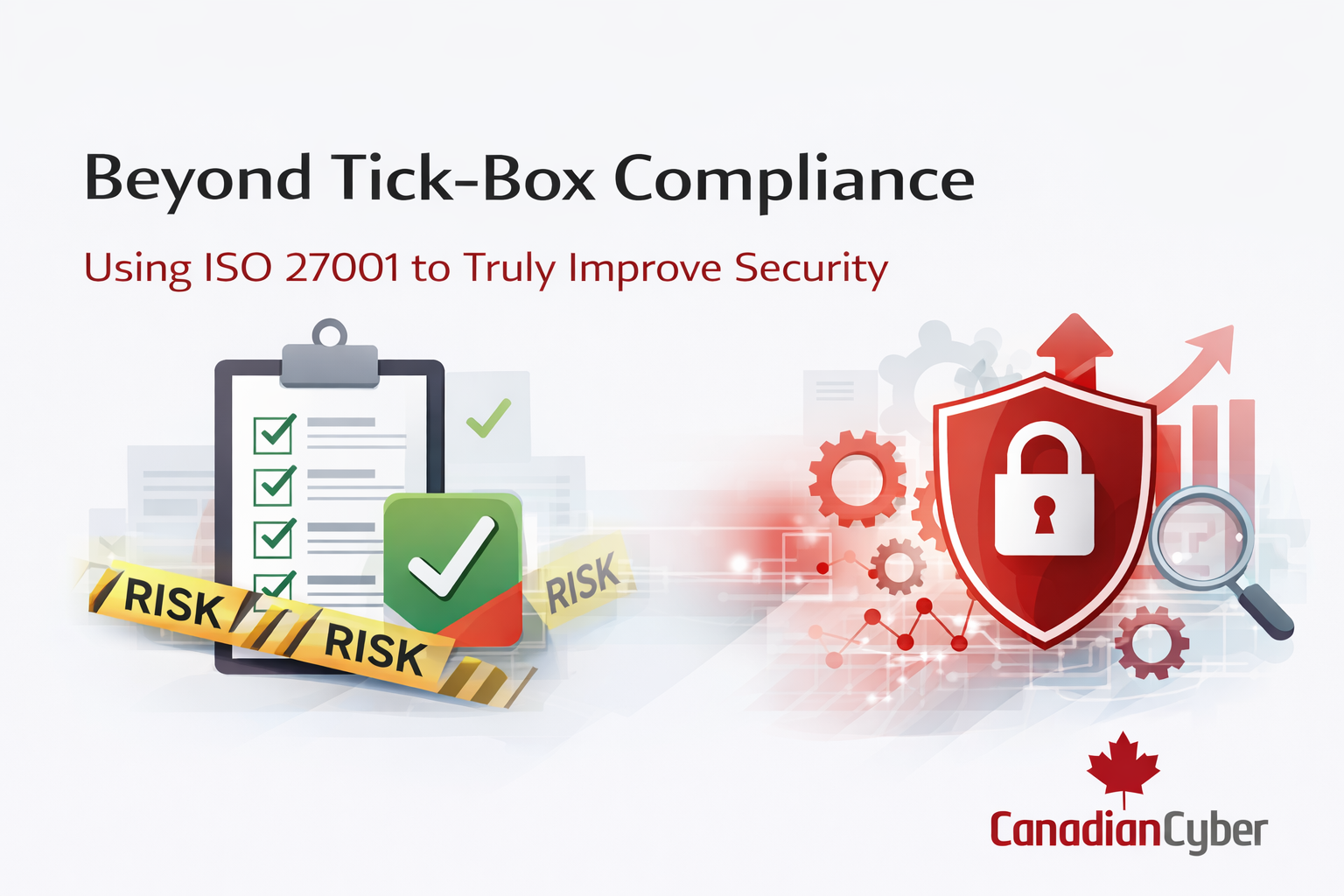
Beyond Tick-Box Compliance
Using ISO 27001 to Truly Improve Security
ISO 27001 shouldn’t be a one-time project to pass the audit.
It’s a management system designed to reduce real cybersecurity risk year after year.
Let’s be honest.
For many organizations, ISO 27001 becomes a project with one goal:
Pass the audit.
- Policies get written.
- Evidence gets uploaded.
- Controls get documented.
Certification is achieved.
Then… momentum slows.
This is where companies make a costly mistake.
ISO 27001 is not a badge.
It is a management system.
The Problem with Tick-Box Compliance
Tick-box compliance creates a perfect-looking ISMS on paper—and a quietly degrading security posture in reality.
Tick-box compliance looks like this:
- Policies written but rarely reviewed
- Risk register updated once a year
- Internal audits treated as formalities
- Controls implemented for audit evidence only
On paper, everything looks strong.
In practice, gaps grow quietly.
Attackers do not care about certificates. They exploit weak controls.
The purpose of ISO 27001 is not to satisfy auditors. It is to strengthen your organization.
What ISO 27001 Was Designed to Do
ISO 27001 is built around three powerful ideas:
- Risk-based decision making
- Continuous improvement
- Leadership accountability
When applied correctly, it forces organizations to ask:
- What are our real risks?
- Are our controls working?
- Are we improving year over year?
That mindset changes everything.
Turning Audit Findings into Security Wins
Findings are not just problems to close. They’re signals showing where your defenses are weak.
Instead of asking:
“How do we close this finding?”
Ask:
“What risk does this finding expose?”
| Scenario | Tick-box response | Security-focused response |
|---|---|---|
| Audit finding shows inconsistent access reviews | ✔ Perform review ✔ Upload screenshot ✔ Close finding |
Why were reviews inconsistent? Is role-based access defined clearly? Are privileged accounts monitored? Should automation be introduced? |
The second approach reduces risk. The first satisfies paperwork.
Using the Risk Register as a Strategic Tool
The ISO 27001 risk register isn’t a static spreadsheet. It’s a decision engine.
A mature risk register should be:
- Reviewed regularly
- Discussed in management meetings
- Used to guide investment decisions
- Linked to business objectives
If your risk register is not influencing decisions, it is underutilized.
Internal Audits Should Test Reality
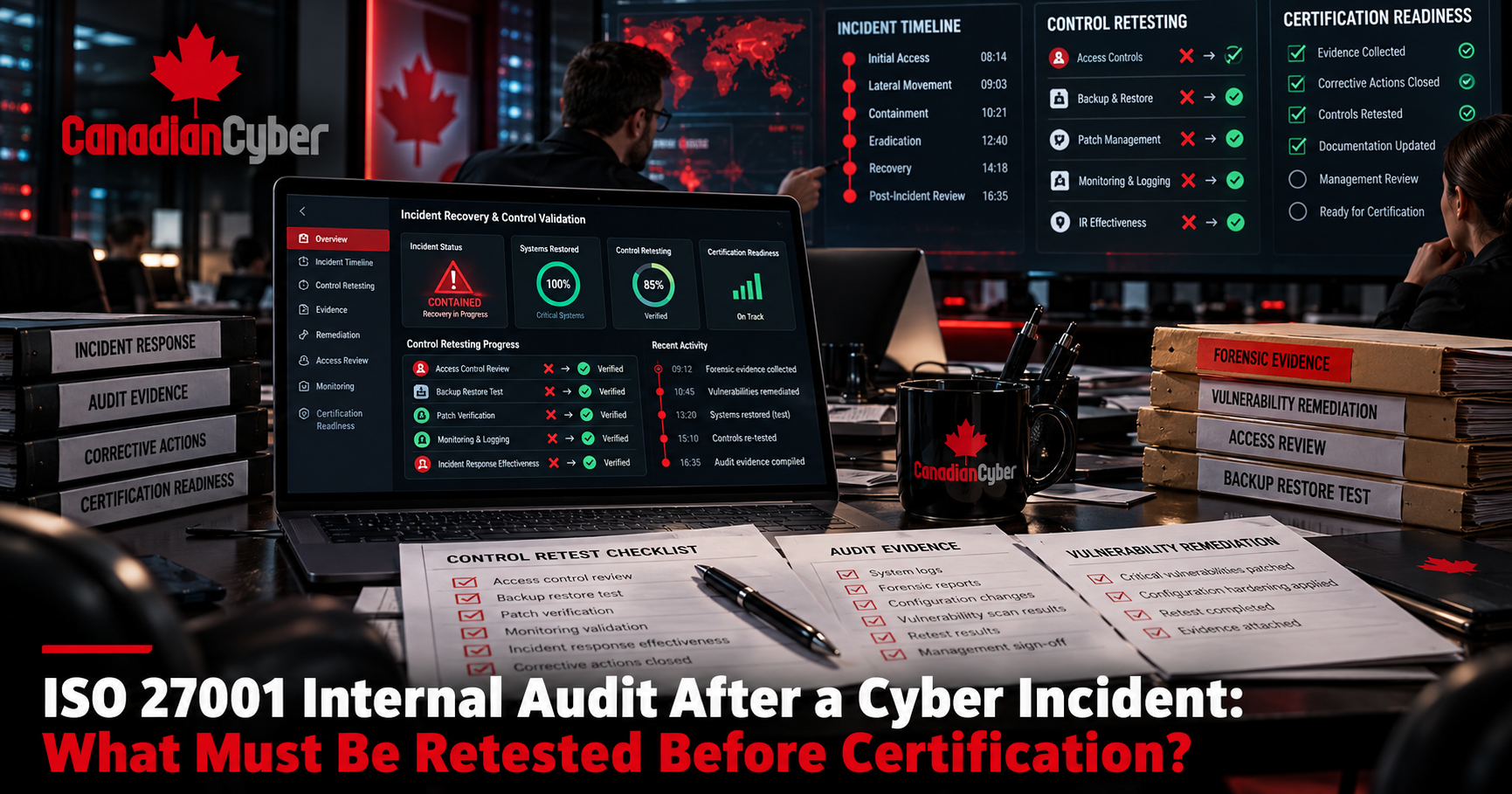
A strong internal audit program does more than review documents. It tests whether controls work in practice.
A strong audit asks:
- Are employees actually following policies?
- Are controls technically enforced?
- Are alerts reviewed in practice?
- Would incident response work in real life?
This is where ISO 27001 shifts from compliance to resilience.
At Canadian Cyber, internal audits are designed to test control effectiveness not just confirm existence.
Leadership Involvement Changes Outcomes
Clause 5 of ISO 27001 emphasizes leadership commitment for a reason: security improves when executives engage.
Security maturity increases when leaders:
- Review risk reports
- Approve security objectives
- Allocate resources
- Ask hard questions
ISO 27001 is not an IT project. It is a governance framework.
Continuous Improvement Is the Real Advantage
Clause 10 (Improvement) is where organizations separate “compliant” from “secure.”
ISO 27001 requires organizations to:
- Correct nonconformities
- Prevent recurrence
- Improve the ISMS over time
Certification isn’t the finish line. It’s the starting point.
Organizations that embrace improvement:
- Experience fewer incidents
- Reduce operational disruptions
- Build stronger client trust
- Respond faster to emerging threats
That is the difference between compliant and secure.
Real-World Scenario
Two SaaS companies both achieved ISO 27001 certification.
| Company A | Company B |
|---|---|
| Treated certification as a sales requirement Paused ISMS reviews post-audit Delayed control updates Experienced a preventable access-related breach |
Used audit findings to redesign access controls Automated monitoring Conducted quarterly internal reviews Passed surveillance audits smoothly and strengthened security posture |
Same certification. Different mindset. Different outcomes.
How to Move Beyond Tick-Box Compliance
Five practical steps you can apply immediately:
- Link risks to business impact — translate technical risks into financial and operational language.
- Test controls regularly — don’t assume controls work. Verify them.
- Use findings strategically — analyze root causes, not just symptoms.
- Automate where possible — reduce human error and increase consistency.
- Involve leadership — security maturity rises when executives are engaged.
Want a “Security-First” ISO 27001 Check?
If your ISMS feels like paperwork instead of protection, we’ll help you identify what’s missing:
control effectiveness, real audit readiness, and improvement loops that actually work.
How Canadian Cyber Helps Organizations Strengthen Their ISMS
We help companies move beyond checklist compliance through:
- Risk-driven ISO 27001 implementation
- Independent internal audits
- vCISO strategic oversight
- Continuous compliance monitoring
- SharePoint-based ISMS platforms for structured documentation and control tracking
Our approach focuses on effectiveness not just documentation.
Because passing the audit should never be the only goal.
Final Thought
ISO 27001 is not about ticking boxes.
It is about building a culture of accountability, resilience, and continuous improvement.
When treated as a management system, not a certification exercise, it becomes one of the strongest tools for protecting your organization.
If your ISMS feels like paperwork instead of protection, it may be time to rethink the approach.
Ready to Turn ISO 27001 Into a Security Advantage?
Canadian Cyber helps organizations transform ISO 27001 from compliance burden to security advantage.
We build ISMS programs that hold up under real-world pressure not just audit checklists.