Why third-party access is the whole game
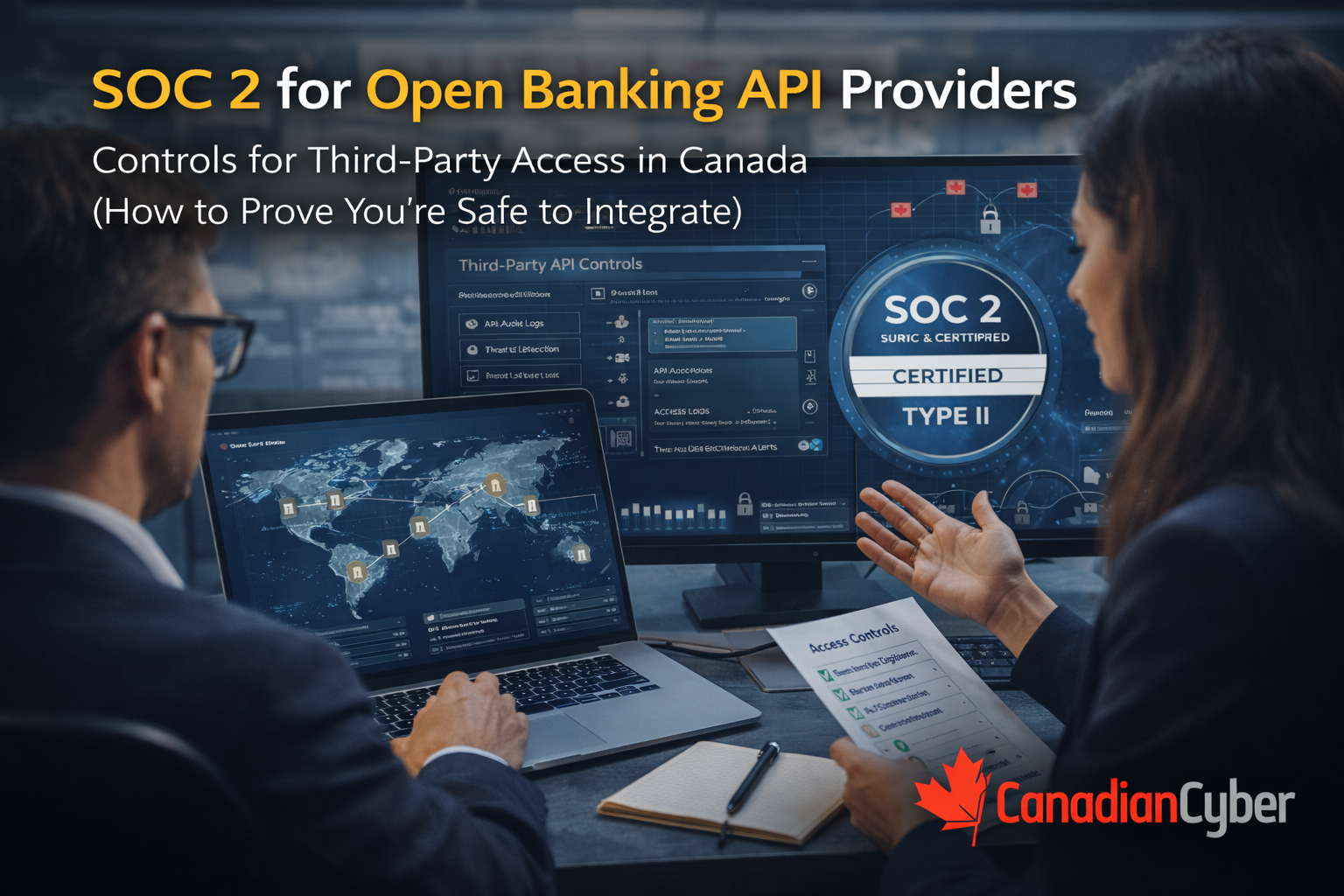
Open banking-style providers sit at the centre of a sensitive triangle: data holders, third parties, and end users. Your platform is not just another application. It is an access layer between financial data and external actors.
Data holders
Banks, financial institutions, and platforms expect you to preserve trust boundaries.
Third parties
Fintech apps, partners, and integrators need controlled, scoped, revocable access.
End users
Consumers and small businesses expect consent, visibility, and protection against misuse.
What buyers are really evaluating:
not whether you have an audit report in general, but whether your third-party access model is governed tightly enough to trust in production.
The control model: third-party access is a lifecycle, not a login
To pass SOC 2 and pass procurement, you need to show that third-party access is controlled across the full lifecycle not just at the moment a token is issued.
Lifecycle control areas
- partner onboarding
- consent and authorization
- credential and token security
- rate limiting and abuse controls
- logging and monitoring
- offboarding and revocation
- incident coordination
Plain-English translation:
SOC 2 for third-party access means you can show who got access, what they were allowed to do, how it was secured, how activity was monitored, and how access can be stopped quickly.
Controls buyers and auditors expect for third-party access
1) Partner onboarding controls
Open banking access should not begin with “sales said yes.” Buyers want to know that production access is only issued after the third party has been validated, approved, and contractually constrained.
SOC 2-ready onboarding controls
- documented onboarding workflow
- identity and legal entity validation where appropriate
- minimum security requirements for the partner
- sandbox first, then production
- contract clauses covering permitted use, data handling, incident cooperation, and downstream sharing restrictions
Evidence that passes: Partner Register, onboarding checklist, signed agreements, production approval record.
2) Consent and scope governance
This is where least privilege becomes real. Buyers want to know that partners can only access what the user consented to, and that consent is enforceable, reviewable, and revocable.
Good control design
- OAuth 2.0 / OIDC model with granular scopes
- consent records with who, what, when, expiry, and revocation status
- consent expiry and re-auth rules
Evidence auditors trust
- scope matrix showing exactly what each scope allows
- consent record schema or redacted screenshots
- sample consent revocation actions
- tests showing out-of-scope access is denied
If your consent and scope model still sounds abstract in security reviews, buyers will assume enforcement is weak. Make it concrete early.
3) Strong authentication and token handling
Long-lived risk is one of the biggest third-party access problems. Buyers will ask how tokens are issued, rotated, stored, revoked, and invalidated when something goes wrong.
SOC 2-ready controls
- short-lived access tokens
- controlled refresh token flow
- refresh token storage protections and rotation policies
- binding to client and tenant where applicable
- key rotation support with overlap for safe partner rotation
- emergency revoke capability per partner or client
Evidence: token lifecycle policy, token issuance and revocation logs, and a credential compromise runbook with one redacted example.
4) Third-party identity assurance
Buyers want to know that the partner app is actually the partner app. This is where client authentication, registration controls, and redirect URI discipline become important.
Strong controls here include:
- mTLS for higher-trust integrations where appropriate
- signed client assertions, depending on architecture
- client IDs tied to legal entities and environments
- strict redirect URI validation with no wildcard redirects
- formal approval for redirect URI changes
5) Rate limiting and anti-abuse controls
Open banking-style providers are expected to prevent scraping, misuse, and runaway calls. Rate limiting is not just a performance control here. It is part of third-party risk governance.
Expected controls
- rate limits by partner or client
- limits by tenant or customer
- stricter thresholds for bulk or high-value endpoints
- abuse detection for repeated failures and unusual volume
- controls to prevent noisy-neighbour impact
Evidence that helps
- rate limit policy
- gateway configuration proof
- alert to ticket to response chain
- logs showing throttling and partner communication
6) Logging and auditability
This is one of the most important trust signals in third-party access environments. Buyers want to know that you can reconstruct access events and investigate complaints or misuse.
| Log field |
Why it matters |
| timestamp |
establishes sequence and timing |
| partner or client ID |
identifies the external actor |
| end-user or subject ID |
links the event to the user context |
| consent ID |
ties access to consent state |
| scopes used |
shows least privilege in action |
| endpoint and method |
shows what access was attempted |
| result code |
supports troubleshooting and abuse analysis |
| request or correlation ID |
links activity across systems |
Good logging standard:
capture enough to reconstruct activity, but do not log secrets or sensitive payloads.
7) Privileged admin controls
Even excellent partner controls fail if internal administrators can bypass them without oversight. Internal admin access is part of third-party access risk.
SOC 2-ready admin controls
- MFA for all admins
- least-privilege admin roles
- quarterly privileged access reviews
- documented and monitored break-glass access
- logging for admin actions that affect partner configs, scopes, or revocation
8) Partner offboarding and revocation
Clean exits matter. Buyers want confidence that when a relationship ends or a partner is compromised access can be shut down quickly and provably.
Expected controls
- disable client
- revoke tokens or invalidate sessions
- disable keys and certificates
- follow retention and deletion rules aligned to contracts
- retain proof of offboarding action timing
9) Incident response and coordinated reporting
In a third-party access ecosystem, incident response is not just internal. It is coordinated. Your plan should cover partner compromise, token leakage, abnormal usage spikes, and notification routing to the right parties.
Strong evidence includes:
- incident response plan covering partner-related scenarios
- notification workflow by impact type
- tabletop exercise record with partner communication elements
- one incident or simulated exercise record showing who would be told and when
The buyer-ready evidence pack that accelerates approvals
If you want SOC 2 to generate trust early not just sit behind NDA package the most important controls into a short third-party access trust summary.
A strong trust summary includes:
- 1-page scope statement covering systems and APIs
- partner onboarding overview
- consent and scope model summary
- token lifecycle and revocation summary
- logging and audit trail summary
- incident response and notification approach
- clear path to request the full SOC 2 report under NDA
Common SOC 2 failures in open banking-style access models
- scopes are too broad or undocumented
- consent exists but is not enforceable at the API layer
- redirect URIs and client configs can be changed without approval
- token revocation is slow or poorly evidenced
- rate limiting exists but is not tuned by client and endpoint class
- logs exist but are not reviewed
- partner onboarding is sales-driven without security sign-off
Why this matters:
fixing these gaps is often the difference between “security review stalled” and “approved to integrate.”
Next steps
If you provide open banking-style APIs and want buyer trust to move faster, the goal is not just “have SOC 2.” The goal is to show third-party access control in a way procurement teams can approve quickly.
Final takeaway
Open banking API providers are evaluated on how safely they govern access, not just whether they can keep a system online. That is why SOC 2 must be translated into lifecycle controls for third-party onboarding, consent, scopes, token security, rate limiting, logging, revocation, and incident coordination.
When those controls are clearly described and backed by evidence, security reviews move faster because buyers stop trying to infer how your access model works. They can see it.
The fastest way to prove you’re safe to integrate is to show that third-party access is governed as a lifecycle with evidence at every step.
Follow Canadian Cyber
Practical cybersecurity + compliance guidance: