Why analytics platforms have high-risk surfaces
In analytics products, the highest-risk events are rarely “someone guessed a password.” They are usually dataset exposure, export misuse, privilege sprawl, support overreach, or a tenant isolation mistake that leaks data across customer boundaries.
Common high-risk events
- a workspace misconfiguration exposes a dataset
- a user exports sensitive data without approval
- a service account with broad permissions leaks tokens
- a support or admin pathway provides too much visibility
- a cross-tenant query bug leaks data
- logs do not capture enough context to investigate
The key point:
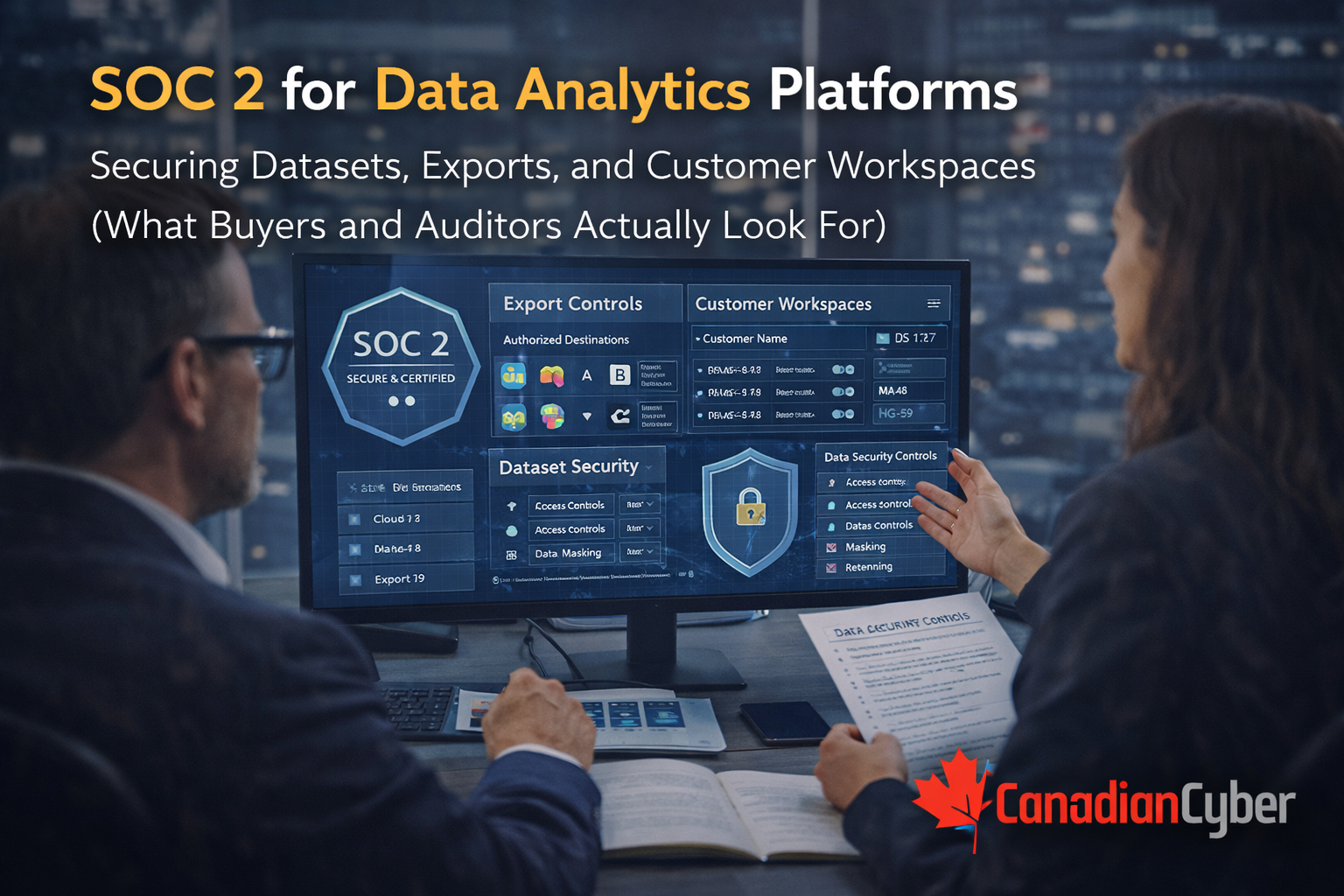
SOC 2 can absolutely cover these risks—but only if your controls are designed around datasets, exports, and workspace boundaries, not generic IT checklists.
The three pillars of SOC 2 for analytics platforms
Pillar 1: Dataset security
Protecting data at rest, controlling access at the right layer, and proving boundaries between customers.
Pillar 2: Export and egress control
Preventing unauthorized bulk movement of data—the issue buyers worry about most.
Pillar 3: Workspace governance
Giving customers usable control over roles, sharing, admin privileges, and lifecycle access.
1) Securing datasets: what auditors and buyers expect
A) Data classification and handling rules
Buyers want a clear answer to what kinds of data you process and whether you have explicit rules for sensitive content. This does not need to be complex, but it does need to be explicit.
Controls that help
- data classification policy such as Public / Internal / Confidential / Restricted
- rules for sensitive inputs, including guidance around PII and secrets
- secure defaults for dataset visibility and sharing
Evidence that helps
- data classification standard
- high-level one-pager describing data types processed
- workspace configuration defaults screenshot or export
B) Access control at dataset level
Analytics platforms need more than login security. Buyers usually want to know whether access can be restricted at the dataset, table, view, row, or column level, and whether workspace roles are least-privilege by default.
SOC 2-ready controls
- RBAC matrix with dataset and workspace permissions
- tenant enforcement in every dataset query path
- least-privilege role defaults such as viewer by default
- permission change workflow and review history
Evidence: role matrix, permission change logs, and quarterly access review evidence for privileged roles.
C) Tenant isolation and workspace boundaries
If you are multi-tenant, this is the non-negotiable control area. Buyers and auditors both want confidence that one customer cannot see another customer’s data because of query paths, storage paths, support workflows, or application bugs.
Evidence pattern that works well
- 1-page isolation statement describing the tenant model and enforcement points
- CI evidence that cross-tenant isolation tests run and pass
- segregated storage prefixes per tenant or workspace
- strict admin access governance and logs for denied cross-tenant attempts if available
If you can only show generic login controls, buyers will assume dataset and workspace controls are immature. In analytics platforms, that slows deals fast.
2) Exports and egress control: the controls that close deals
For analytics platforms, exports are often the breach path. Security reviewers care about them more than many product features because exports are where data leaves your control surface.
A) Export restrictions by role
Strong controls
- role-based export permissions
- download or export permission separated from view permission
- sensitivity labels that restrict export if supported
- approval workflow for bulk exports if the risk profile needs it
Evidence
- export permission settings screenshot or export
- role matrix showing export rights
- one sample export approval ticket if approvals are used
B) Egress monitoring
Restrictions are not enough by themselves. You also need to detect unusual or bulk movement of data so that misuse, probing, or automation stands out quickly.
Monitoring controls that help
- alerts for unusual export volume
- alerts for repeated export failures
- alerts for new API keys followed by export activity
- throttling and rate limits on export endpoints
Evidence: alert rules list, alert-to-ticket-to-closure chain, and rate limiting policy or gateway configuration proof.
C) Secure export destinations
If your product supports exports to cloud storage, SFTP, customer buckets, or other external locations, security reviewers will often ask how those destinations are controlled.
Useful controls
- destination allowlisting
- credential storage in an approved secret manager
- scoped credentials with rotation
- change approval for destination modifications
Evidence: destination control documentation, sample change approval record, and secret rotation proof.
3) Customer workspaces: governance customers can actually use
A) Workspace roles and admin boundaries
Customers want more than “admin” and “user.” They want a role model that lets them separate organization administration, workspace administration, editing, viewing, and external collaboration safely.
| Control area |
What buyers want to see |
Evidence |
| Role model |
org admin vs workspace admin vs editor vs viewer |
role model documentation |
| Invite controls |
restrictions on who can invite users or guests |
policy or configuration proof |
| Admin review |
periodic review of workspace admins |
quarterly access review sign-off |
B) Identity integration
Enterprise buyers often ask about identity controls early because they want assurance that workspaces can be tied into their own lifecycle governance.
Important controls
- SSO support using SAML or OIDC
- MFA enforcement for your admins at minimum
- joiner, mover, leaver process for access removal
- SCIM provisioning if available
Evidence: SSO configuration guidance, Entra or Okta settings export where relevant, and one sample offboarding record.
C) Shared workspaces and external collaboration
If your platform supports cross-company sharing, guest access, or workspace collaboration outside a single customer boundary, buyers usually treat that as a high-risk area.
Good controls
- guest access restrictions by policy
- time-bound guest access with expiry
- visibility controls for shared datasets
- audit trails for share events
Evidence: guest access policy, guest user list review record, and audit log sample showing a share event.
The analytics platform SOC 2 evidence pack
If you want audits and customer reviews to move faster, prepare a small set of artifacts that tell a complete trust story instead of forcing buyers to infer how the platform works.
A strong evidence pack usually includes:
- system scope and boundaries (1–2 pages)
- isolation proof, including test evidence
- workspace governance proof, including role model and admin reviews
- dataset and export control proof
- operating effectiveness samples such as log reviews, access reviews, tabletop records, and change samples
Common gaps that break trust reviews
- exports allowed to everyone by default
- no alerting for bulk exports or unusual egress
- support or admin access too broad or not reviewed
- no proof of tenant or workspace isolation testing
- sensitive payloads logged in application logs
- unclear retention or deletion for exports and backups
- evidence scattered as screenshots with no structure
Practical reality:
fixing just two or three of these usually removes the biggest buyer blockers immediately.
Next steps
If your analytics platform is going through enterprise security reviews, generic SaaS controls are not enough. Buyers want proof around datasets, exports, and workspace governance specifically.
Final takeaway
Data analytics platforms are judged by how safely they handle datasets, exports, and customer-controlled workspaces. That means SOC 2 has to be translated into controls that reflect how analytics products actually create risk.
When you can clearly show dataset security, export governance, workspace control, tenant isolation, and operating evidence, SOC 2 becomes more than a report. It becomes a trust story buyers can approve faster.
The fastest way to build trust in analytics platforms is to prove you can control datasets, exports, and workspace permissions the way buyers expect.
Follow Canadian Cyber
Practical cybersecurity + compliance guidance: