email-svg
Get in touch
info@canadiancyber.ca

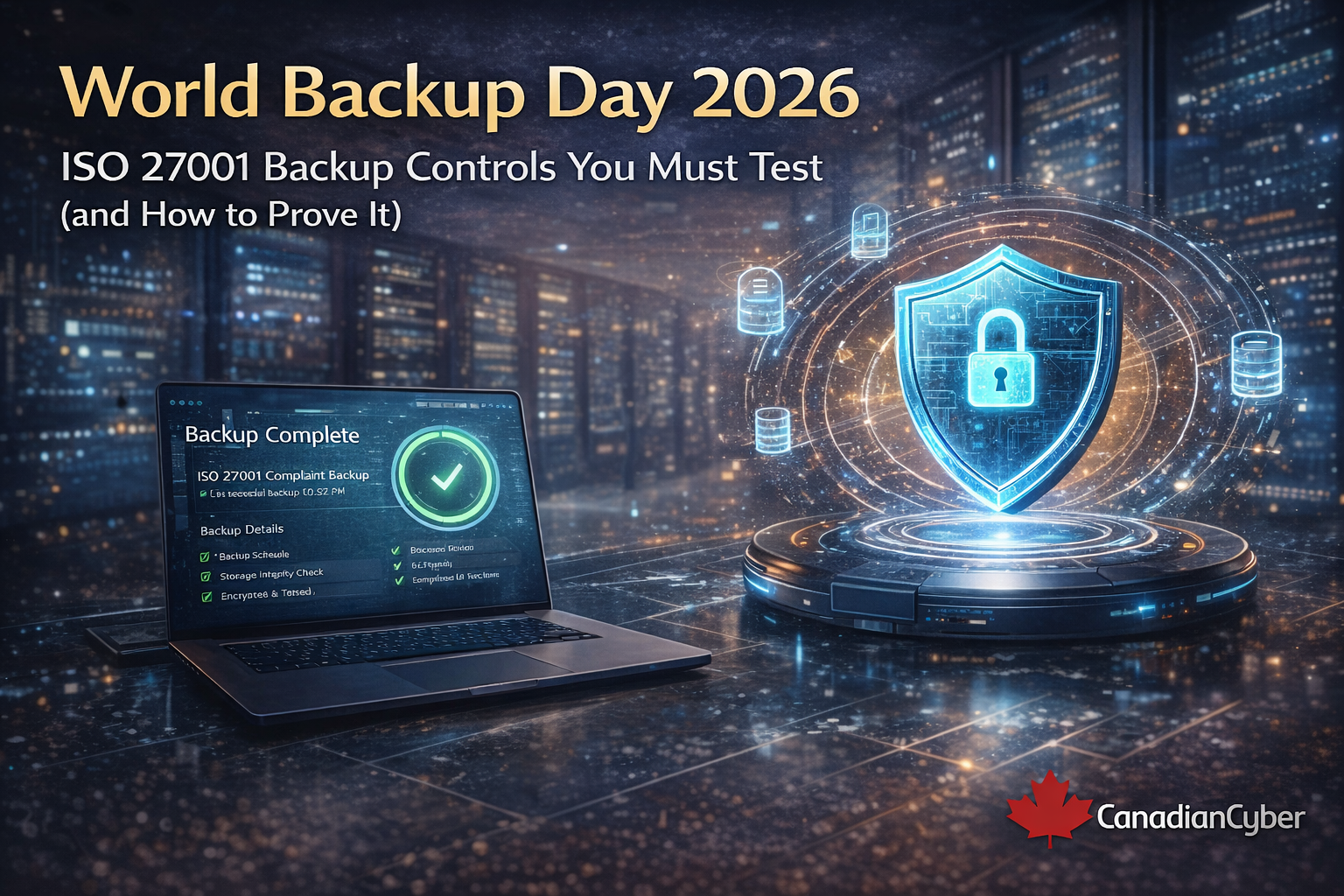
World Backup Day 2026

ISO 27001 backup controls require more than “we have backups.” This guide shows how to test restores, validate RTO/RPO, and build an audit-ready evidence pack.
Main Hero Image

World Backup Day 2026 • ISO 27001 • Restore Testing • Backup Evidence

World Backup Day 2026: ISO 27001 Backup Controls You Must Test (and How to Prove It)

“We have backups” is not a control. “We can restore” is.
World Backup Day reminder: backup maturity is one of the easiest places to get ISO 27001 findings not because teams fail to back things up, but because they cannot prove completeness, protection, restore success, and business-aligned recovery times.

In ISO 27001 audits, auditors will not stop at “do you back up?” They will ask whether the control is governed, tested, protected, and aligned to business needs. This is where many teams struggle in 2026: the jobs run, but the evidence does not.

This blog breaks down the backup controls that matter most, what you should actually test, and the evidence pack auditors trust when they want proof that recovery works.

Where backups sit in ISO 27001

In ISO/IEC 27001:2022 Annex A, backups are explicitly covered under A.8.13 Information backup, and are commonly supported by related controls like A.8.14 Redundancy and broader ICT continuity and recovery expectations.

Audit reality:
auditors will not just ask whether backups exist. They will ask you to show that restores work, recovery targets are realistic, access is controlled, and governance is repeatable.
ISO 27001 Area What Auditors Want to See Best Evidence
A.8.13 Information backup Coverage, frequency, retention, restore proof Inventory, job reports, restore test records
A.8.14 Redundancy Recovery options support continuity expectations RTO/RPO table, recovery walkthroughs
Continuity / recovery readiness Tested restoration process with owners Signed restore records, exceptions, remediation tracking

The backup controls you must test, not just document

The strongest backup programs do not stop at writing policy. They prove operating effectiveness across scope, success, restoration, timing, security, retention, and SaaS recovery.

1) Backup coverage: what is backed up, and what is not?

What auditors ask: what systems are in scope, whether critical SaaS is covered, whether configurations and secrets are recoverable, and whether dependencies are included.

What to test: validate a quarterly backup inventory for production databases, file and object storage, configs, infrastructure-as-code, privileged identity exports, and operational systems like monitoring, ticketing, and vaults.

What counts as proof: a backup inventory with owners and criticality, documented in-scope and out-of-scope rationale, and quarterly sign-off that the inventory is current.

2) Backup success: “job ran” is not enough

What auditors ask: how you know backups succeeded and how you know they are usable.

What to test: track job health trends, failure reasons, time to fix, and spot-check that expected data volume and key objects are actually present.

What counts as proof: monthly backup job reports, tickets showing failed jobs were corrected, and a simple KPI such as monthly success rate.

3) Restore testing: the control everyone claims and few can prove

What auditors ask: when you last restored, what you restored, whether it succeeded, and whether it met RTO and RPO targets.

What to test: quarterly restore tests for critical systems where possible, including one database restore, one file or object restore, and one broader service recovery walkthrough.

What counts as proof: a restore test record showing date, system, restore method, duration, validation steps, outcome, remediation, and sign-off.

World Backup Day test
If your team cannot produce one recent restore record with timing, validation, and sign-off, you likely have a documentation gap and an audit gap at the same time.

4) RTO/RPO alignment

Confirm backup frequency meets RPO needs and that restore methods actually support the RTO you claim. Validate access to vaults, keys, credentials, and runbooks.

5) Backup security

Test encryption, least-privilege access, MFA for admins, privileged access reviews, deletion protection, and immutability where feasible.

6) Retention and deletion

Backups are not “keep forever.” Test whether retention rules are enforced, documented by data class, and aligned to contractual and privacy obligations.

7) SaaS backup reality in 2026

Do not assume Microsoft, Google, GitHub, or ticketing platforms satisfy your recovery expectations by default. Define a recovery method and test it.

What strong proof looks like for each area

Control Area Minimum Test Auditor-Friendly Proof
Coverage Quarterly inventory validation Inventory, owner list, review sign-off
Success Monthly job health review Job reports, failure remediation tickets, KPI trend
Restore testing Quarterly or semi-annual restores Restore test record with timing and validation
RTO/RPO Compare targets against actual test results RTO/RPO table, exception decisions, risk acceptances
Security Access review and control validation Vault configs, admin review evidence, immutability settings
Retention / SaaS Annual review and one SaaS recovery test Retention table, SaaS recovery plan, test record

The ISO 27001 backup evidence pack auditors actually trust

If you want backup review to move quickly during audit season, do not scatter proof across tickets, screenshots, emails, and tool consoles. Keep one clean evidence pack per quarter or per year.

Policies and procedures
Approved backup policy and backup procedure, current and review-dated.
Inventory and schedule
Systems, owners, frequency, retention, and in-scope or out-of-scope rationale.
Operational proof
Monthly job health reports and tickets showing failed jobs were corrected.
Restore proof
Restore test records with duration, validation, remediation, and sign-off.
Recovery targets
RTO/RPO table tied to actual test results, with risk acceptances where needed.
Vault security and exceptions
Access reviews, encryption and immutability settings, plus tracked exceptions with expiry.
Simple rule:
if your backup evidence cannot be reviewed in minutes, it will likely create delays, follow-up requests, and avoidable findings.

The 7 backup mistakes that create audit findings

The most common issues auditors see
  1. Backups exist, but restore tests do not.
  2. Restore tests happen, but nobody validates data integrity.
  3. Backup administrator access is not reviewed.
  4. Retention is inconsistent or undocumented.
  5. SaaS recovery is based on assumptions about the vendor.
  6. Backups are exposed to ransomware due to weak deletion controls or no immutability.
  7. Evidence is scattered and slow to assemble during audit or due diligence.

Final takeaway

World Backup Day is useful only if it changes behavior. In ISO 27001 terms, that means moving from backup claims to restore proof, from generic policy to measurable control, and from scattered evidence to a review-ready pack.

The organizations that perform well in audits are usually not the ones with the most complicated backup tooling. They are the ones that can show scope, testing, recovery timing, access control, and ownership without hesitation.

Next steps
If you want World Backup Day 2026 to reduce actual risk and audit pain, the right next move is to test recovery, measure results, and package the evidence properly.

Follow Canadian Cyber
Practical cybersecurity and compliance guidance:

Related Post