Get in touch
info@canadiancyber.ca


Rafia Rizwan

March 31, 2026
A practical 2-hour ISO 27001 disaster recovery tabletop script to test your DR plan, define RTO/RPO, and generate audit-ready evidence.
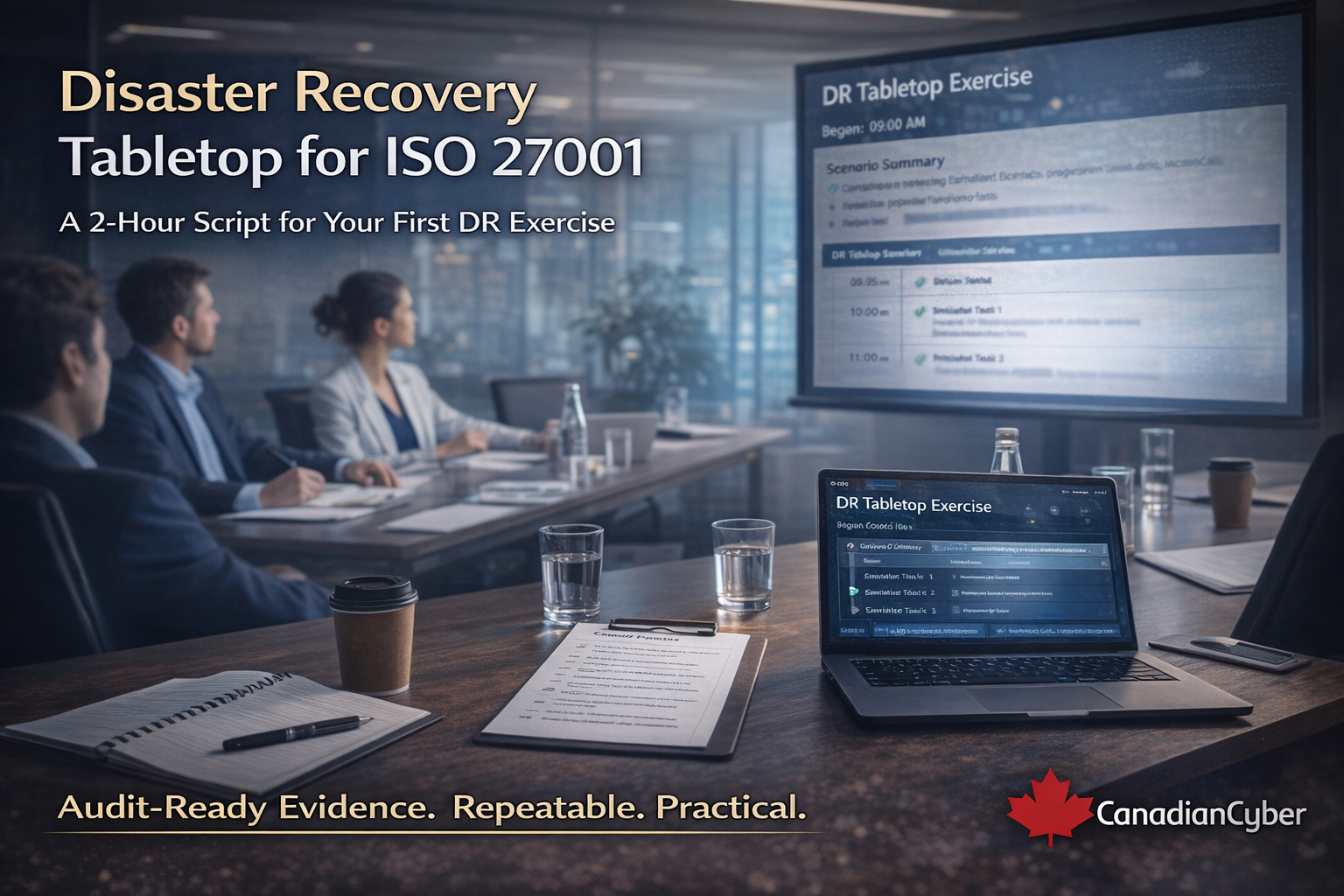
Many teams assume they need a complex simulation, a large consulting engagement, or a mature recovery program before they can run a meaningful exercise. In reality, a well-structured two-hour tabletop is often the right place to start. It is focused enough to be practical, but structured enough to reveal important gaps in recovery planning, ownership, communication, and validation.
If you are building an ISO 27001 program, this kind of exercise gives you something very valuable: a repeatable record that shows you planned for disruption, tested your approach, identified improvements, and assigned follow-up actions. That is exactly the kind of evidence auditors want to see.
ISO 27001 does not require perfect continuity planning. What it requires is that your organization thinks seriously about disruption, assigns responsibility, tests plans in an appropriate way, learns from the results, and keeps records that show improvement over time.
This is why tabletop exercises are so useful. Auditors generally accept them as a valid form of testing when they are structured, documented, and tied to real follow-up. A tabletop is not a “soft” substitute for action. It is a legitimate way to validate assumptions before a real incident forces those assumptions into the open.
| What ISO 27001 Expects | What a DR Tabletop Proves | Good Evidence Output |
|---|---|---|
| Planning for disruption | You have defined a realistic recovery scenario and discussed response options | Scenario record and exercise scope |
| Assigned responsibilities | The team knows who leads, who decides, and who communicates | Attendee list with roles and ownership notes |
| Testing and validation | Recovery assumptions are challenged and discussed against a realistic timeline | Decision log and validation checklist |
| Learning and improvement | Gaps are identified and converted into follow-up work | Action plan with due dates and owners |
A DR tabletop delivers value quickly because it forces important issues into a single, structured conversation. Without an exercise, these questions often stay hidden inside assumptions:
For a first exercise, keep the group small, focused, and decision-capable. You do not need a room full of observers. You need the people who understand the critical service, the supporting environment, customer impact, and decision-making authority.
Aim for six to ten people maximum. A good first group usually includes:
The exercise becomes much more effective if participants receive a simple one-page pre-read in advance. It does not need to be long. In fact, shorter is usually better.
A first tabletop works best when the scenario is familiar enough to be credible, but broad enough to test architecture, backups, and communications together. A cloud region outage affecting the production application and database is often the cleanest choice. It lets the team discuss failover, backup dependency, validation, and customer impact without getting stuck in technical forensic detail.
A tabletop becomes valuable when discussion stays focused on decisions, timing, ownership, and validation. These are some of the strongest prompts for a first exercise:
Auditors are generally looking for signs that continuity planning is real, structured, and improved over time. That means your evidence should be simple, clean, and easy to retrieve. You do not need a bloated report. You need a credible pack.
Teams sometimes worry that finding gaps means the exercise went badly. In fact, the opposite is true. The goal of a first tabletop is to make assumptions visible in a low-risk setting. If gaps are identified, the exercise is doing its job.
| Common Finding | What It Usually Means | Good Next Step |
|---|---|---|
| RTO and RPO are not agreed | Business and technical expectations are still misaligned | Schedule a leadership decision and document targets |
| Restore steps are undocumented | Recovery knowledge exists in people, not in a controlled process | Write a concise restore runbook |
| Break-glass access is unclear | Emergency access may fail at the worst moment | Define and test the break-glass process |
| DNS or cutover ownership is vague | Operational handoff is incomplete | Assign owner and document sequence clearly |
| Secrets or config drift is possible | Standby recovery may not actually work as expected | Implement sync checks and update procedures |
| Vendor dependency is underestimated | Partial recovery could still leave customer-facing impact | Add vendor assumptions to DR plans and comms |
The most effective tableops are realistic, but not theatrical. You do not need to overwhelm the room with complexity. Instead, use a clear scenario, realistic timing, and one or two well-chosen obstacles that match your actual environment.
Keep the discussion close to operational reality. Ask who owns the next step, who has access, how the team validates service health, and how customer communication would be handled if the incident lasted longer than expected. This keeps the exercise grounded in the real decisions that matter during disruption.
Your first DR tabletop does not need to prove that your organization is perfect. It needs to prove that your organization is thinking seriously about disruption, testing its assumptions, assigning responsibility, and improving with evidence.
That is why this exercise matters so much in an ISO 27001 program. It bridges the gap between documentation and operational reality. It helps leadership understand risk in practical terms. It gives technical teams a clearer path for recovery. And it creates a record that auditors, customers, and internal stakeholders can all understand.
In other words, a good tabletop does more than simulate a disaster. It turns continuity planning into something your team can actually use.