Get in touch
info@canadiancyber.ca


Rafia Rizwan

March 31, 2026
A practical post-incident review template for ISO 27001 and SOC 2. Capture timelines, root cause, and corrective actions with audit-ready evidence.
Most teams hold a lessons learned meeting after an incident, share a few takeaways, and then move on. The problem is that informal reflection rarely gives auditors, boards, or customers what they actually need. They want evidence that the incident was understood, addressed properly, and used to strengthen the system going forward.
A good post-incident review does more than summarize what happened. It becomes a bridge between response, governance, and improvement. It captures the timeline, explains business impact, identifies the real cause, turns lessons into actions, and feeds those actions into management review and the wider ISMS.
This template is designed to stay practical. It gives you a structure that works well for ISO 27001 and SOC 2 without becoming bloated or hard to maintain.
Not every alert needs a full post-incident review. A PIR works best when there is real business value in stopping, looking carefully at the event, and turning the findings into improvement.
In practice, a PIR is usually worth running after any incident that affected confidentiality, integrity, or availability, any customer-impacting outage, any security event that required coordination across teams, any near miss that could have been serious, or repeated incidents that show the same pattern of failure.
Timing matters too. The review is usually most useful within three to ten business days of containment or recovery, while details are still fresh and before the team mentally moves on.
A strong PIR should produce more than a narrative. It should produce three outputs that connect the incident to governance and improvement.
| Output | What It Should Contain | Why It Matters |
|---|---|---|
| PIR record | What happened, impact, response, and root cause | Shows the incident was understood properly |
| Corrective actions | Owners, due dates, required evidence, and status | Turns lessons into measurable improvement |
| Management review inputs | Trends, decisions needed, risk updates | Feeds governance and leadership oversight |
The template below is designed to stay practical. Each section has a clear purpose, and each one helps the review remain readable and useful.
This section should be fast to complete. It anchors the review and gives future readers enough context to understand what they are looking at.
Keep this short. Five to ten lines is often enough. The goal is to explain the incident in plain language to leadership, auditors, or anyone who needs the core picture quickly.
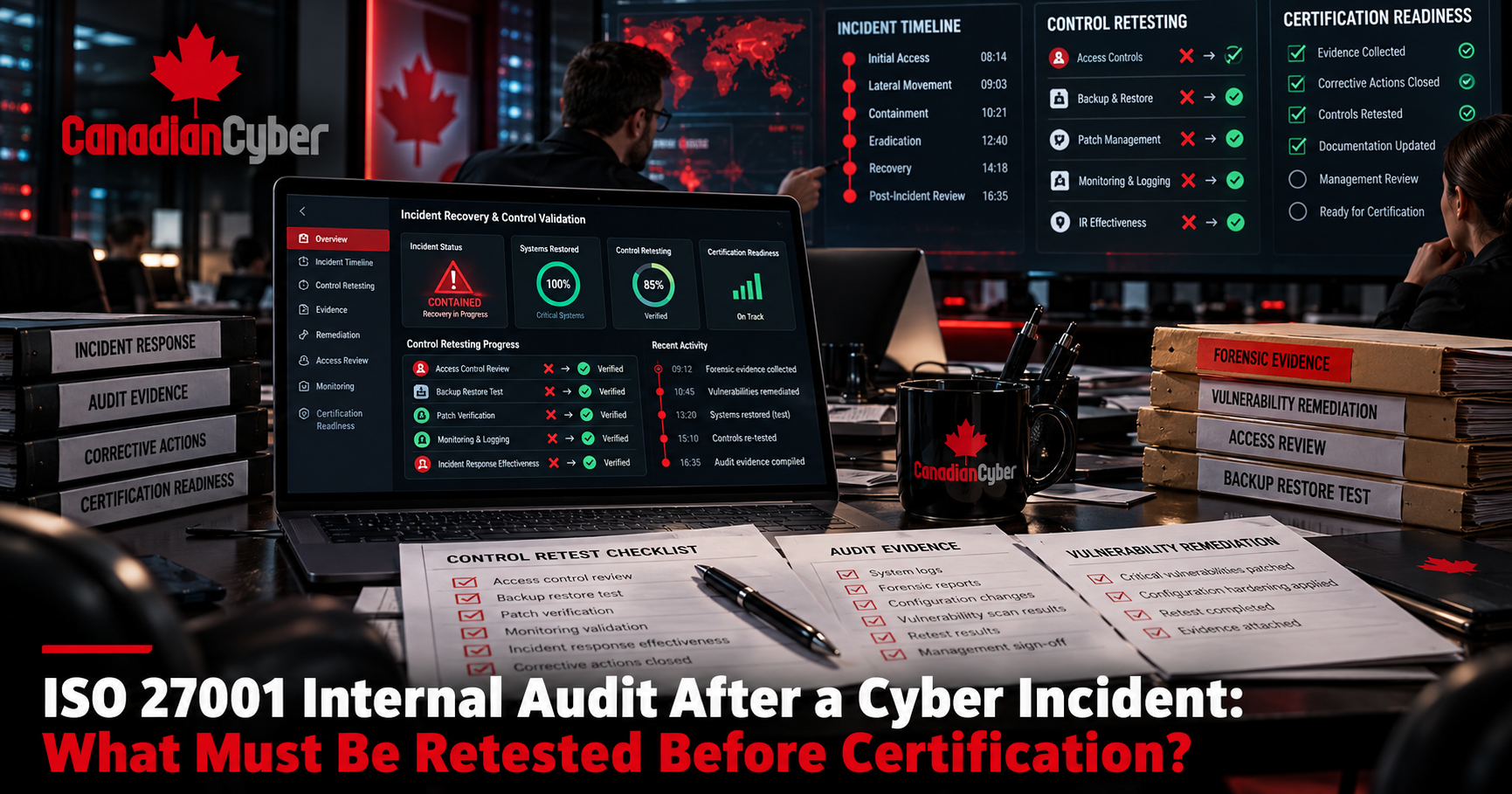
This section should stay factual and time-stamped. Avoid opinion here. A clean timeline helps everyone see what happened and when, without mixing interpretation into the sequence.
| Time | Event | Who or Team | Evidence |
|---|---|---|---|
| 09:12 | Alert triggered: unusual logins | SOC | Log link |
| 09:20 | Incident declared, owner assigned | Ops | Ticket |
| 10:05 | Containment action completed | Security | Case note |
| 12:30 | Service recovered | Engineering | Recovery record |
This is where the review becomes meaningful to the business. Instead of describing only technical symptoms, explain what changed in practical terms: downtime, degraded performance, data risk, customer friction, direct cost, or contractual impact.
Root cause analysis should explain why the incident happened, not who to blame. A simple structure often works best. Capture contributing factors, write one clear root cause statement, and use a short “5 Whys” chain if it helps the team get past surface symptoms.
A good root cause statement is usually one paragraph. It explains what made the incident possible, what the result was, and why normal controls did not stop it.
This section should stay honest and balanced. Record what worked well, what caused delay, how the event was detected, whether alerts were missed, whether logging gaps appeared, and whether communications worked at the right pace.
Good PIRs do not pretend the response was flawless. They identify where coordination, detection, escalation, or communication can be improved next time.
This is the most important part of the review. Every action should have an owner, a due date, and a defined form of evidence. If the action cannot be verified later, it is not really closed.
| Action ID | Action | Type | Owner | Due Date | Evidence Needed | Status |
|---|---|---|---|---|---|---|
| A1 | Enforce MFA for admin roles | Preventive | IT | 2026-04-15 | Policy export and access review | Open |
| A2 | Add alert for unusual bulk export activity | Preventive | Security | 2026-04-30 | Rule config and test ticket | Open |
| A3 | Update runbook and run a tabletop | Corrective | Ops | 2026-05-10 | Updated runbook and exercise record | Open |
Every meaningful fix should have a way to prove it works. That might be a rescan, a test case, sampling, a tabletop exercise, or a targeted re-audit. Record the method, the date, who verified it, and whether the control is effective.
Incidents should improve the system around them. That means checking whether the risk register, treatment plan, procedures, training material, vendor register, or change management process need updating.
This section is what makes the PIR valuable beyond the incident team. It should be easy to copy into the next management review and should summarize the event, the recurrence theme, the top actions, the decisions leadership needs to make, and the remaining risk after those actions.
A post-incident review should not be treated as paperwork after the “real work” is finished. Done properly, it is part of the real work. It turns response into learning, learning into action, and action into measurable improvement.
The most effective PIRs are clear, disciplined, and lightweight. They capture facts, explain impact in business terms, identify root cause without blame, assign actions that can be verified, and connect the incident to management review and ongoing risk improvement.
That is what makes them valuable to auditors, leadership, customers, and most importantly, to the team that has to do better next time.