Get in touch
info@canadiancyber.ca


Rafia Rizwan

April 2, 2026
A practical vCISO board pack template for SaaS founders. Track risks, metrics, vendors, and decisions monthly with a simple, audit-ready format.
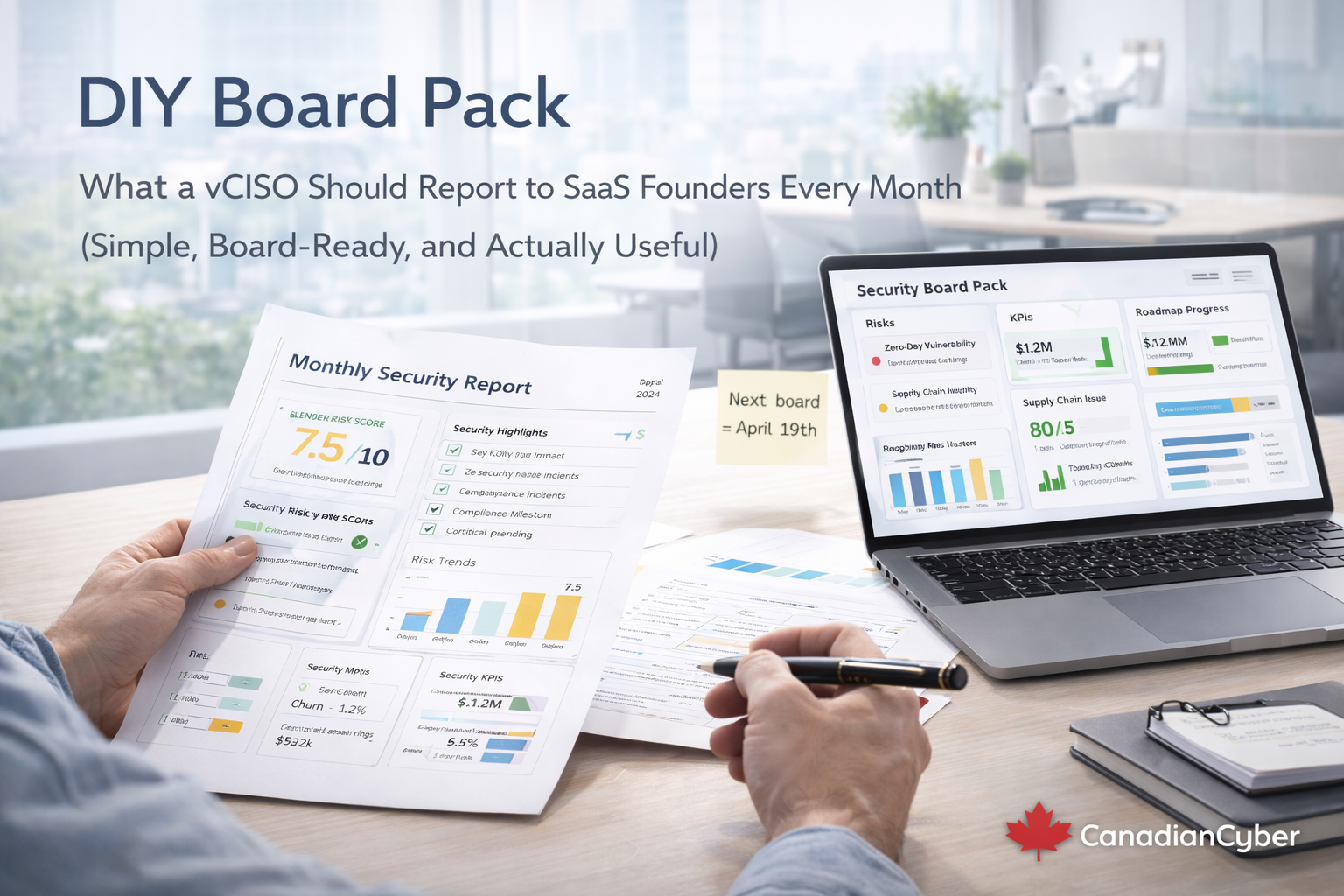
Founders do not need a monthly security lecture. They need something they can read in a few minutes and act on without translation. That means fewer metrics, fewer framework terms, and much more focus on risk, ownership, and decisions.
A strong monthly board pack does not try to prove that security is perfect. It shows whether the company is getting safer, where the real risk sits, and what needs leadership support right now.
This guide gives you a simple monthly board pack that works well for SaaS teams and aligns nicely with ISO 27001, SOC 2, and enterprise due diligence.
Quarterly reporting is often too slow for SaaS. Vendors change. Product releases move fast. Access drifts. Logging gaps appear. Backup assumptions go untested. A lot can change in a month, and even more can go wrong in a quarter.
Monthly reporting gives leadership a simple rhythm. It catches drift earlier. It reduces the chance of last-minute audit panic. It helps founders fund the right fixes instead of buying tools at random. It also makes customer security reviews easier because the company already knows how to summarize its posture clearly.
A good board pack should fit on one page or close to it. It should be fast to scan, easy to present, and direct enough that a founder or board member can understand what matters without a security background.
This is the sixty-second view. Keep it short. It should set the tone for the rest of the report.
Keep this section business-focused, not technical. Founders do not need CVEs here. They need to know what could hurt the business, who owns the issue, and what happens next.
| Risk | Business impact | Current status | Owner | ETA |
|---|---|---|---|---|
| Over-privileged admin access | Account takeover and possible customer data exposure | Mitigating | Head of Engineering | May 15 |
| Vendor assurance gap | Deal delay and third-party risk exposure | Reviewing | Operations | May 30 |
Keep this list to three to five items. Every risk should have an owner, a next step, and a clear reason it belongs on the page.
This is where many teams get too busy. The board pack does not need twenty metrics. It needs six to eight useful ones. Trend matters more than volume.
Avoid vanity numbers like “blocked attacks.” Boards care more about whether core controls are working on time.
Even if nothing major happened, include near misses. This helps leadership see that the company learns from issues instead of hiding them.
Keep it short. State what happened, the impact level, what changed because of it, and what is still open.
Founders do not need long vulnerability lists. They need to know exposure, deadlines, and exceptions. Focus on exploitable issues affecting internet-facing systems, the oldest overdue critical item, and any approved exceptions with expiry dates.
If patching is delayed, explain the compensating controls and the deadline. That is much more useful than a long technical appendix.
For SaaS companies, identity is often the breach path. This is usually one of the highest-value sections in the whole board pack.
In plain terms, leadership wants to know whether someone could get “god-mode” and the company would not notice quickly enough.
Keep this section scoped to the most important vendors. Usually the top ten to twenty-five is enough. Report upcoming renewals, major vendor incidents, missing assurance, and any new vendors introduced since the last cycle.
This is one of the best ways to prevent surprise deal blockers later.
If the company is working toward ISO 27001 or SOC 2, keep this short. Treat it like a product milestone view, not a framework lecture.
This is where leadership becomes useful. End the pack with one to three clear asks. These can be budget approvals, engineering time allocation, vendor decisions, or risk acceptances with expiry dates.
If the board pack ends with no asks, founders usually read it and move on. If it ends with a small number of useful decisions, security becomes part of the business rhythm.
The system only works if the team actually does it. The easiest way is to use the same rhythm every month, usually in the fourth week.
The board pack becomes much easier when it is not rebuilt from scratch each month. A SharePoint-based setup can hold the monthly pack, connect it to the risk register, vendor register, approvals, evidence links, and corrective actions, and make reporting more consistent over time.
This is one of the easiest ways to keep reporting green, repeatable, and audit-friendly without turning it into a manual spreadsheet exercise.
A good monthly board pack does not make security look busy. It makes security look managed.
That is what founders need. It is also what boards trust. Clear posture, real risk, visible ownership, and direct decisions. When reporting works this way, security becomes easier to fund, easier to explain, and much easier to maintain.
And that is exactly what a good vCISO should deliver every month.