Get in touch
info@canadiancyber.ca


Rafia Rizwan

April 10, 2026
A practical guide to data residency for Canadian SaaS using ISO 27018 to answer privacy questions, reduce procurement delays, and close enterprise deals faster.
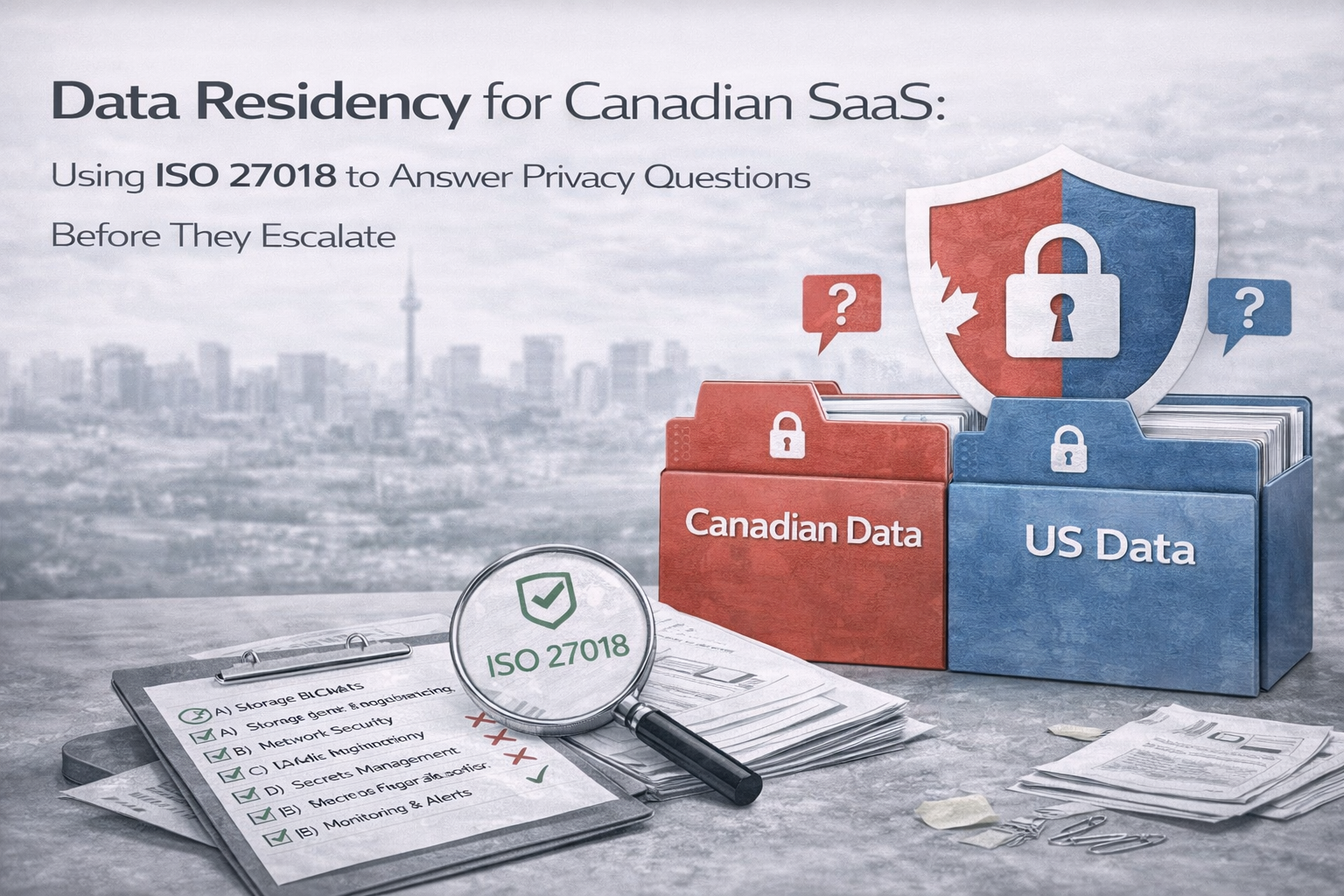
If your answer is vague — “we use AWS” or “data is in the cloud” the conversation usually escalates fast. ISO 27018 is useful here because it forces clarity around personal data handling, storage location, processing access, subprocessors, deletion, backups, and purpose limitation.
This guide shows how Canadian SaaS teams can use ISO 27018-style structure to answer residency and privacy questions before they turn into a slow legal and security loop.
Most buyers say “data residency” as if it is one issue. In practice, they are usually asking about three different risks at once.
You do not need to quote the standard in customer emails. You use its structure to give confident, consistent answers that prevent escalation.
When your residency answers follow this structure, customers usually stop digging because the next five privacy questions are already answered.
If you sell to Canadian enterprises, healthcare, finance, or public-sector-adjacent buyers, you should have a short “Data Residency and Privacy Pack” ready to send. It should answer the next questions before they become a multi-week loop.
Define what personal data actually means in your product, not in abstract terms.
State your primary hosting regions clearly. If Canada-only hosting is available, say so directly. If any service is outside Canada by design, disclose that plainly and explain why.
“Customer production data is stored in Canada Central for Canadian tenants.”
“Backups for Canadian tenants are stored in a Canadian region with encrypted storage and controlled access.”
This is where most vendors get stuck. Buyers want to know not just where the server is, but who can actually see the data and from where.
Customers will ask which vendors process data, where they process it, and how you govern them. Maintain a high-level subprocessor list, vendor tiering, and a review cadence. If you do not want to publish the whole list publicly, offer it under NDA.
This is often the make-or-break section because buyers want honest answers. Define retention by data type, define the deletion workflow, and explain clearly what happens in backups.
In 2026, privacy teams ask by default whether customer data is used for AI training, product improvement, advertising, or sharing with third parties. Be explicit. State whether customer data is used for advertising, sold, or used for AI model training, and define any aggregated or anonymized analytics use clearly.
You do not need to quote legal sections in the pack. You need to show that you detect incidents, triage them, escalate clearly, notify appropriately, and improve after the fact.
Many Canadian SaaS vendors can promise Canada-at-rest. “Canada-only” becomes harder when support is global, vendors operate internationally, monitoring tools process data outside Canada, communications tools route internationally, or SOC and MSP support is offshore.
| Model | What it means | Where it fits |
|---|---|---|
| Option A: Canada hosting plus Canada support access only | Canadian region hosting, support access restricted to Canadian-based personnel, stronger contractual commitments. | Premium or stricter privacy-sensitive deals. |
| Option B: Canada hosting plus controlled global access | Data stored in Canada, support access only by exception, time-bound, logged, and approved. | Most common workable model. |
If you already use SharePoint for your ISMS, store the residency response pack and its proof in one place so sales stops improvising and starts linking to approved answers.
Data residency questions rarely slow deals because buyers are being difficult. They slow deals because vendors answer only the first question and leave the important follow-ups unanswered. ISO 27018 helps because it makes the structure of a good answer obvious.
When your team can explain where data lives, where it is processed, who can access it, which subprocessors are involved, how deletion really works, and how data use is limited, privacy questions stop escalating and start closing.