The situation: “We’re technically ready—but procurement can’t see it”
A Canadian B2B services and software provider was bidding on a government contract with a security-heavy evaluation stage. The company had already done a lot of the right work:
- documented policies
- a risk register that was mostly maintained
- vendor SOC 2 reports collected
- access reviews happening, though inconsistently
- an incident response plan on file
The real issue was not the absence of security work. It was the absence of a buyer-readable system. Evidence existed, but it lived in separate folders, inboxes, attachments, and partial trackers. During the bid, the buyer asked for:
- security policy set
- proof of access controls and reviews
- incident response process and readiness
- vendor and subprocessor oversight
- corrective action tracking
- proof of continuous readiness, not one-time prep
The problem:
the company could answer these questions, but only after days of searching and stitching. In public-sector timelines, “we’ll get back to you” is a risk.
The turning point: they stopped telling and started showing
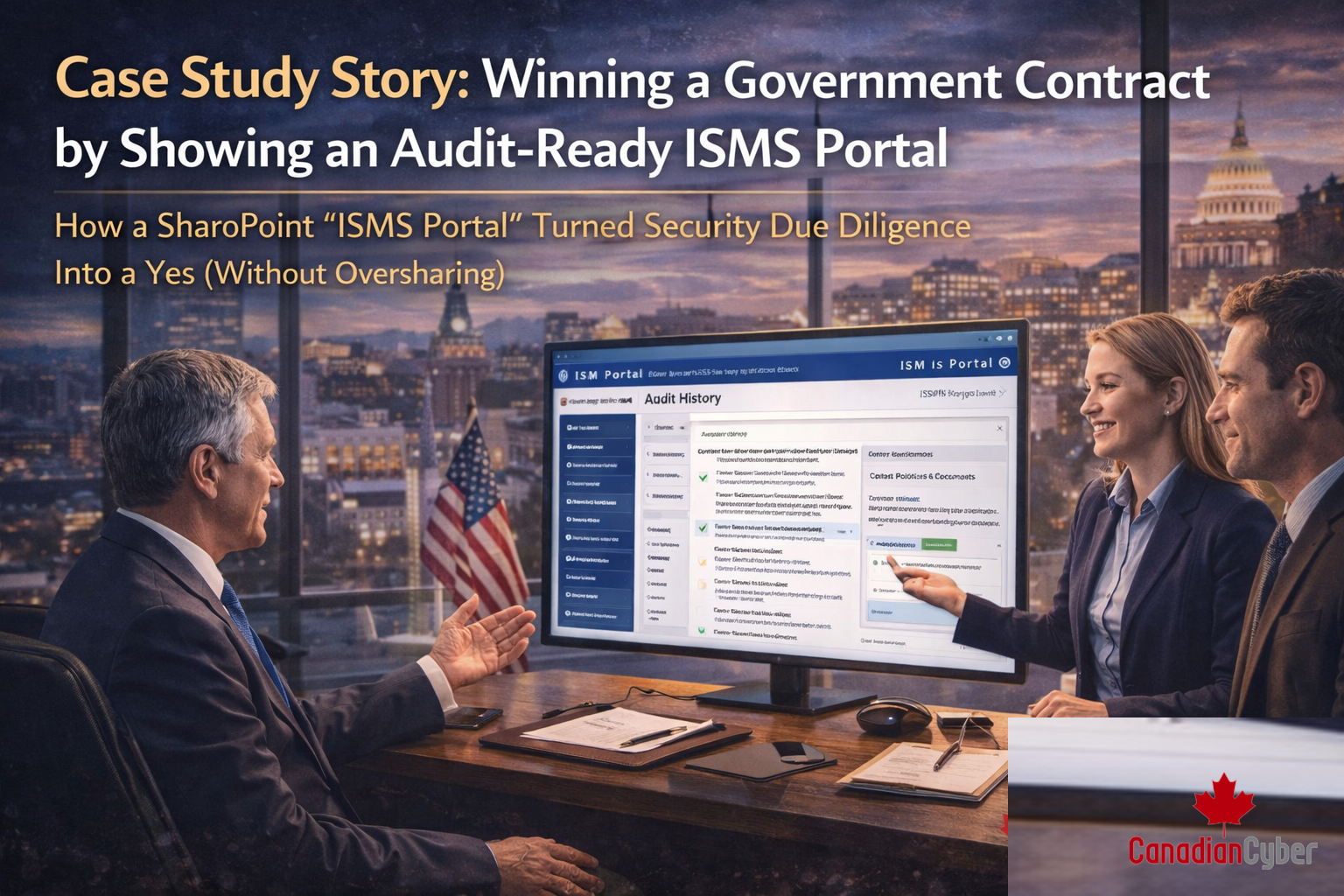
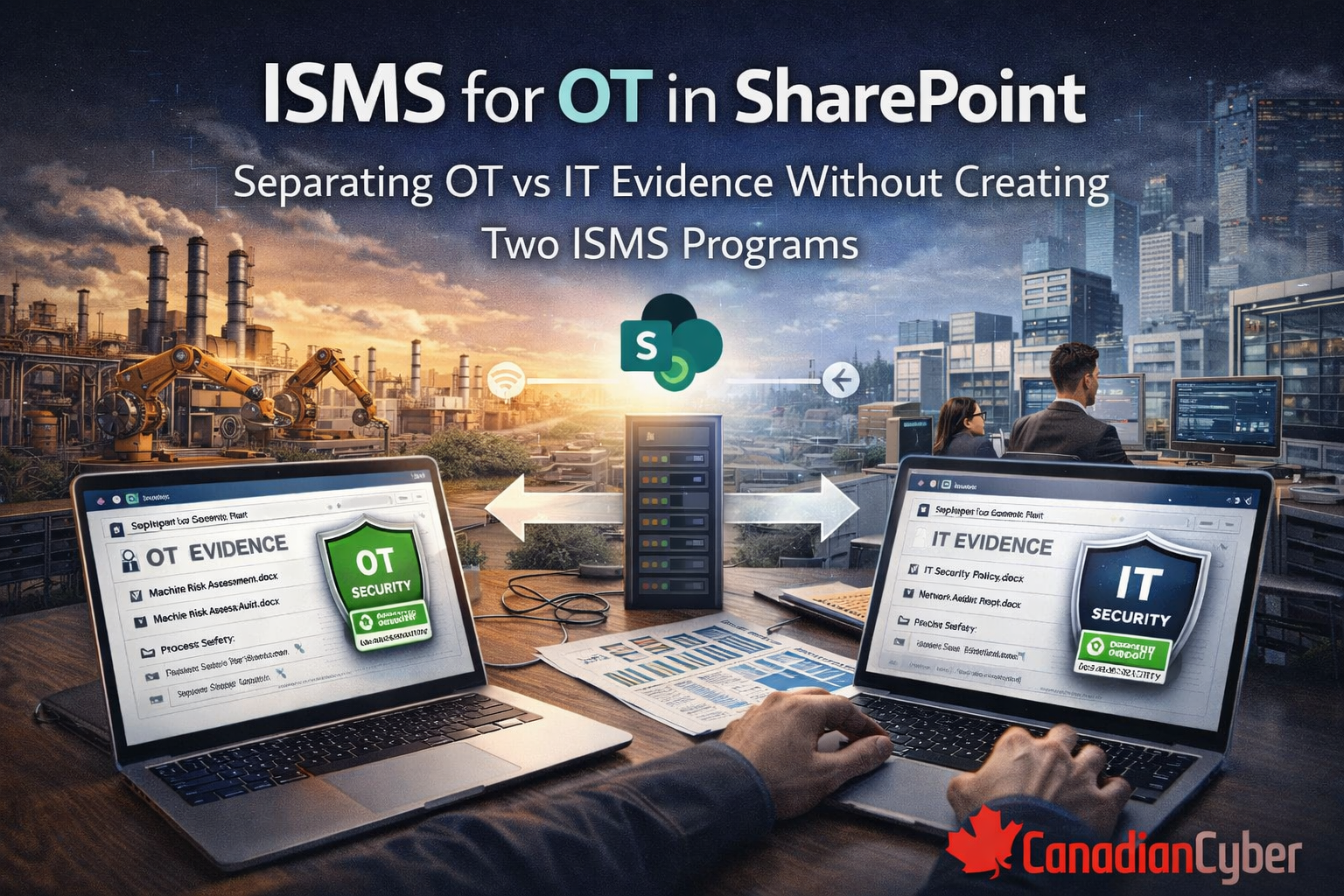
Instead of sending a 60-page PDF with a pile of attachments, the vCISO proposed a different move: build an audit-ready ISMS Portal in SharePoint with a curated Auditor/Buyer View.
The goal was not to reveal everything.
The goal was to prove control:
- make evidence retrieval instant
- limit access to only what was appropriate
- demonstrate governance maturity in minutes
What the procurement team actually needed
The buyer’s security reviewers were not looking for a perfect environment. They were looking for signals of operational maturity:
A system, not a folder
Evidence organized in a controllable structure.
Owned controls
Not “security’s job,” but named accountable ownership.
Evidence over time
Not content created just for this bid.
Continuity
The program survives staff turnover and keeps running.
What the vCISO built: the ISMS Portal structure
The portal was built in SharePoint with two clear layers:
Layer 1: Internal ISMS
- policy library with versioning and approvals
- procedure and runbook library
- evidence library tagged by control and period
- risk register
- vendor register with evidence links
- corrective action register
- management review minutes and tracker
- internal audit schedule and findings
Layer 2: Buyer / Auditor View
- approved current policies only
- selected evidence packs, redacted where needed
- latest management review summary
- critical vendor governance summary
- high-level corrective action status
- incident response overview and tabletop record
- security contact and incident notification process
Key design choice:
the Buyer View was curated to share what was needed without oversharing internal architecture, sensitive logs, or admin details.
If your team is still answering buyer security questions from scattered folders and inboxes, the biggest improvement is usually not more documentation. It is a better evidence system.
The portal demo that changed the tone of the evaluation
On the evaluation call, the vCISO did not begin with slides. They began with the portal. In about ten minutes, they walked the buyer through:
- Policy control: approved policies, version history, review dates
- Risk governance: risk register, top risks, owners, cadence
- Evidence continuity: current-quarter access review, log review, and vendor evidence
- Corrective actions: how findings become owned actions with due dates and closure proof
- Incident readiness: IR plan, tabletop record, lessons learned workflow
- Vendor oversight: critical vendor list, assurance status, review notes
Why it worked:
it did not feel like a sales pitch. It felt like walking through an operating system.
The evidence packs that made the biggest difference
The portal included focused packs that answered the most common public-sector questions without endless back-and-forth.
1) Access Control Evidence Pack
- privileged role export + review sign-off
- joiner, mover, leaver samples
- MFA enforcement statement and proof
2) Logging & Monitoring Pack
- logging standard
- log review sign-offs
- one sanitized alert-to-ticket example
3) Vendor Due Diligence Pack
- critical vendor list with tiers
- assurance artifacts and review notes
- exceptions with expiry dates
4) Incident Response Pack
- IR plan and escalation matrix
- tabletop exercise record
- PIR template and a completed example
5) Management Review Pack
- agenda
- inputs: risks, incidents, KPIs, vendor status, audit status
- outputs: decisions and action items with owners
What these packs proved:
not just that documentation existed, but that controls operated over time.
The governance move procurement noticed
The buyer asked a question that often kills deals: “What happens if your security lead leaves?”
Instead of reassuring them verbally, the vCISO showed:
- a documented ownership map
- recurring control cadence with reminders
- evidence structure by month and quarter
- standardized procedures and approvals
Signal sent to the buyer:
the ISMS did not depend on one person. It depended on a repeatable operating model.
The outcome: why the bid moved forward
The vendor did not win solely because of the portal. They won because the portal made their security posture low-friction to review. It changed the security evaluation from “prove it” to “confirm it.”
Fewer follow-ups
Reviewers had fewer gaps to chase down.
Faster internal sign-off
Security evaluators had evidence they could consume quickly.
Higher confidence
Governance and incident readiness felt mature and durable.
What you can copy, even if you are not bidding yet
- Create a buyer-ready Auditor View instead of exposing your full internal structure.
- Use evidence packs, not scattered files.
- Prove continuity over time, not just documentation existence.
- Use permissions and redaction to avoid oversharing.
Next steps
If government or regulated buyers are slowing deals because your evidence is hard to consume, the fix is usually not more documents. It is a better ISMS presentation layer.
Final takeaway
Public-sector and regulated buyers do not want a pile of attachments. They want a security operating system they can understand quickly. A SharePoint ISMS portal works when it makes evidence easy to retrieve, governance easy to explain, and due diligence easy to complete without oversharing.
That is what turns security from a review blocker into a reason the deal keeps moving.
Follow Canadian Cyber
Practical cybersecurity + compliance guidance: