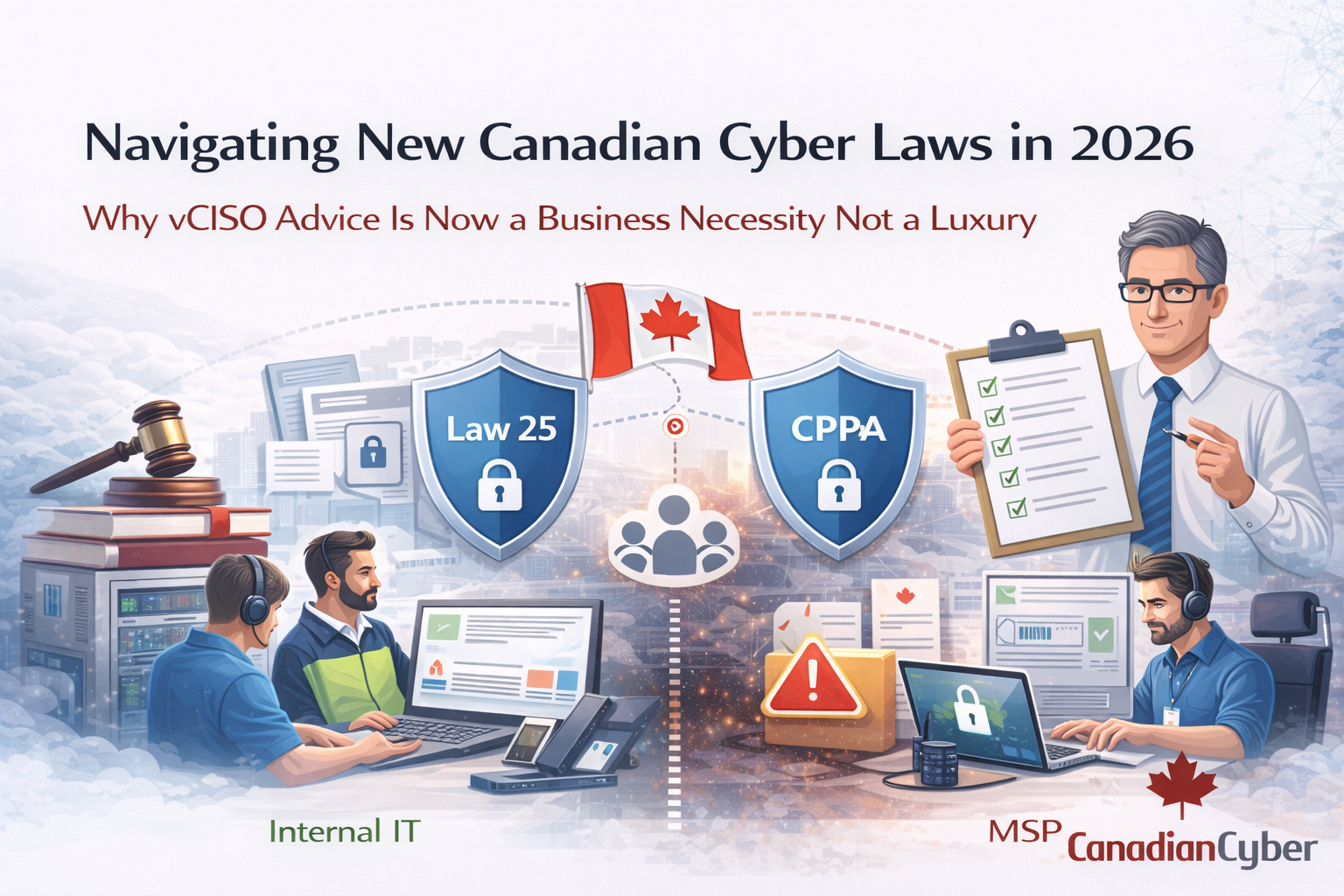
Navigating New Canadian Cyber Laws in 2026
Why vCISO Advice Is Now a Business Necessity Not a Luxury
Something has changed in Canada.
Cybersecurity is no longer just an IT issue.
It is a legal obligation.
With evolving privacy regulations (like Québec’s Law 25), the proposed CPPA at the federal level, and increasing pressure around critical infrastructure protection and supply chain security, Canadian businesses are entering a new era:
Security missteps are no longer just technical failures.
They are regulatory risks.
And most organizations are not structurally prepared.
The Regulatory Shift Is Real
Over the past few years, Canada has seen:
• Stronger privacy enforcement powers
• Higher administrative monetary penalties
• Expanded board-level accountability
• Mandatory breach notification expectations
• Increased scrutiny of third-party risk
• Proposed federal cybersecurity legislation targeting critical infrastructure
This means:
• Documentation must be defensible
• Risk assessments must be formalized
• Controls must be monitored
• Governance must be continuous
Not reactive. Not “when we have time.”
Continuous.
The Problem: Most Companies React Too Late
Here’s what typically happens:
1) A company hears about a new regulation
2) They download a summary
3) They update one or two policies
4) They assume they are compliant
Until:
• A regulator asks questions
• A breach triggers investigation
• A client requests proof
• An enterprise procurement review flags gaps
Then leadership scrambles.
That scramble is expensive.
It’s also avoidable.
Why Regulatory Compliance Is No Longer Just Legal’s Job
Legal teams interpret the law. But they do not implement:
• Technical controls
• Risk monitoring
• Access governance
• Cloud configuration management
• Incident response testing
Compliance today sits at the intersection of:
• Law
• Technology
• Governance
• Executive accountability
That intersection is where a vCISO operates.
What a vCISO Actually Does in a Regulatory Landscape
A Virtual CISO translates regulatory language into operational reality.
Instead of vague interpretations like:
“Ensure appropriate safeguards are in place.”
A vCISO defines:
• What controls are required
• Where gaps exist
• How to prioritize remediation
• What evidence must be retained
• How to demonstrate compliance
That clarity prevents regulatory drift.
Québec’s Law 25 Is a Wake-Up Call
Law 25 introduced governance expectations that many organizations underestimated:
• Mandatory privacy impact assessments
• Stronger consent requirements
• Clear accountability roles
• Administrative penalties that can reach the millions
Many organizations assumed: “We already have privacy policies.”
But Law 25 demands governance, not paperwork.
A vCISO helps ensure:
• Data inventories exist
• Risk assessments are documented
• Incident processes are tested
• Evidence is centralized
• Responsibilities are assigned
The Proposed CPPA Raises the Bar Federally
The Consumer Privacy Protection Act (CPPA), if enacted, increases expectations around enforcement, accountability, and defensible controls.
| CPPA Pressure Area | What Businesses Need | What a vCISO Builds |
|---|---|---|
| Enforcement authority | Defensible processes and evidence | Audit-ready documentation and monitoring cadence |
| Board-level accountability | Clear governance and reporting | Executive dashboards, risk reporting, decision logs |
| Transparency expectations | Policies that reflect reality | Policy governance, version control, approval workflows |
| Penalties tied to revenue | Risk-based investment and prioritization | Roadmaps aligned to risk impact and business goals |
The key advantage: compliance should not be rebuilt from scratch every time laws change.
A vCISO helps you build a scalable framework that adapts.
Critical Infrastructure and Supply Chain Pressure Is Rising
Beyond privacy, Canada is tightening expectations around:
• Supply chain security
• Vendor risk oversight
• Board-level cyber governance
• Critical infrastructure cyber resilience
If your company serves regulated industries or enterprise clients, you are likely affected indirectly even if you are not directly regulated.
Enterprise clients now push compliance requirements downstream.
A vCISO prepares you before those questionnaires arrive.
The Cost of Waiting Is Usually Hidden
Regulatory fines are obvious. But the hidden costs are often larger:
• Lost enterprise contracts
• Delayed procurement approvals
• Insurance premium increases
• Reputational damage
• Board confidence erosion
Compliance failures are rarely sudden. They build quietly through:
• Untracked vendor risk
• Incomplete risk registers
• Missing documentation
• Weak governance cadence
Continuous oversight prevents that buildup.
How a vCISO Keeps You Ahead
A proactive vCISO will:
• Monitor emerging Canadian cyber and privacy changes
• Update compliance roadmaps proactively
• Integrate privacy into ISMS governance
• Align security controls with regulatory expectations
• Prepare executive-level risk reporting
• Ensure documentation supports defensibility
The goal is not panic response. The goal is structured readiness.
Get a Clear Regulatory Roadmap
If you’re unsure how Law 25, CPPA, and enterprise security requirements affect your organization, don’t guess.
Get a short, practical readiness review.
Compliance Must Be Built Into Operations
Modern compliance is not a binder on a shelf. It is:
• Recurring risk review
• Scheduled control monitoring
• Centralized documentation
• Automated reminders
• Executive visibility
That’s why governance tools matter.
When your ISMS lives inside Microsoft 365 structured through SharePoint, Teams workflows, and automated tracking compliance becomes part of daily operations.
Not a quarterly scramble.
How Canadian Cyber Supports Regulatory Navigation
Canadian Cyber provides:
• vCISO services for strategic regulatory oversight
• ISO 27001 and SOC 2 alignment
• Privacy governance support (Law 25, CPPA readiness)
• Internal audit and audit simulation workshops
• SharePoint-based ISMS platform for structured documentation and evidence
• Continuous compliance automation
We don’t just interpret regulations. We operationalize them.
Ask Yourself This
If regulators reviewed your organization tomorrow:
• Could you demonstrate formal risk assessments?
• Are responsibilities clearly assigned?
• Is privacy governance documented?
• Can you show monitoring evidence?
• Would leadership confidently answer compliance questions?
If any of those answers are uncertain, you need structured oversight.
Book a Regulatory Readiness Strategy Call
If you want clarity on how emerging Canadian cyber laws affect your organization, we’ll review your exposure,
governance gaps, and practical next steps.
Stay Connected With Canadian Cyber
Follow us for insights on Canadian cyber laws, ISO 27001, vCISO strategy, and compliance automation: