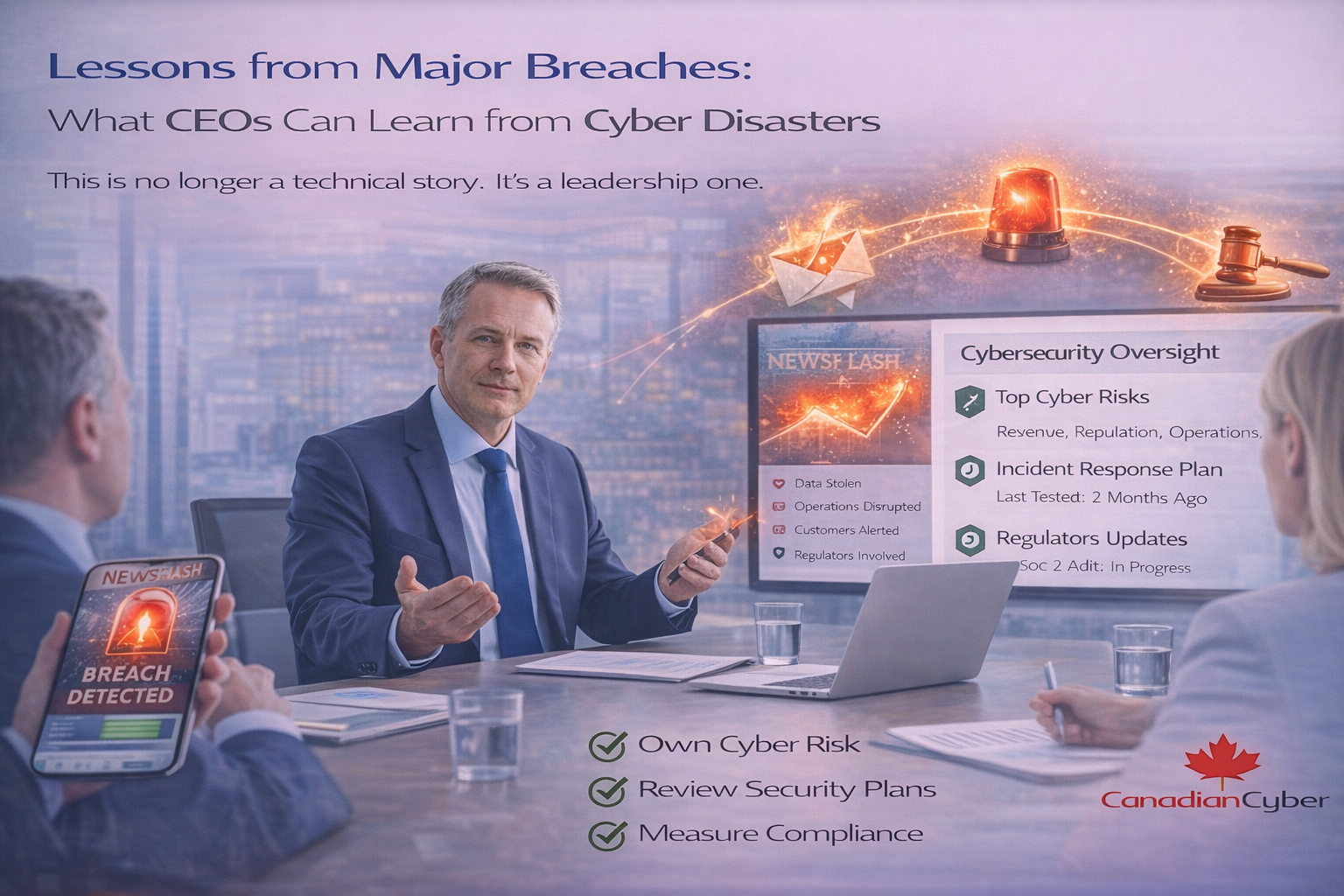
Lessons from Major Breaches: What CEOs Can Learn from Cyber Disasters
When cybersecurity fails, it is rarely just a technical problem.
Every major breach starts the same way.
A normal day.
A trusted system.
A small warning that felt easy to delay.
Then everything changes.
Customers panic.
Media calls.
Regulators ask questions.
And one question follows every CEO into the boardroom:
“What could we have done differently?”
Let’s look at a few major breaches and the lessons leaders cannot afford to ignore.
The Target Breach: Ignoring Early Warnings Is Expensive
Target’s breach began with a third-party vendor.
The attackers did not start in the payment system.
They moved quietly.
Alerts were triggered.
They were not acted on fast enough.
The result:
• Tens of millions of customers affected
• Massive financial losses
• Long-term brand damage
CEO lesson:
Security warnings are business warnings.
When alerts are ignored or delayed, the cost multiplies.
Leadership must ensure:
• Alerts are taken seriously
• Escalation paths are clear
• Someone owns the decision to act
Silence is not neutral.
The Equifax Breach: Delayed Upgrades Have Long Memories
Equifax suffered one of the most damaging breaches in history.
The cause was simple.
A known vulnerability.
A missed patch.
The impact was not simple:
• Sensitive data exposed
• Public trust lost
• Executives questioned publicly
• Years of reputational damage
CEO lesson:
Delaying security upgrades is a strategic decision. And it has consequences.
Security debt behaves like financial debt.
It grows quietly.
Then it explodes.
The SolarWinds Breach: Trust Can Be Weaponized
SolarWinds was not a typical breach.
Attackers compromised the supply chain.
Trusted software delivered the attack.
Even mature organizations were affected.
CEO lesson:
Trust must be verified.
Third-party risk is not theoretical.
It is operational.
Leaders must ask:
• Who has access to our systems?
• How do we verify vendors?
• Who owns supplier risk?
Ignoring supply chains creates blind spots.
The Common Thread Across All Major Breaches
Different industries.
Different attackers.
Same leadership themes.
Most cyber disasters share:
• Delayed action
• Weak governance
• Poor visibility at the top
• Reactive communication
These are not IT failures.
They are leadership failures.
The Cost of Poor Communication After a Breach
How leaders respond matters as much as what happened.
Poor communication causes:
• Loss of customer trust
• Regulatory pressure
• Legal exposure
• Long-term reputation damage
Transparent leadership does not mean oversharing.
It means:
• Acting quickly
• Communicating clearly
• Taking responsibility
Silence makes things worse.
Why CEOs Must Treat Cybersecurity as Business Risk
Cyber incidents affect:
• Revenue
• Operations
• Strategy
• Trust
Yet many CEOs still receive:
Technical reports.
Tool updates.
No clear risk summary.
That gap is dangerous.
Cybersecurity must be discussed in business terms.
What Prepared CEOs Do Differently
Prepared leaders:
• Ask about risk, not tools
• Fund security upgrades early
• Test incident response plans
• Expect regular cyber updates
They do not wait for headlines.
They prepare before crisis.
How vCISO Support Helps Prevent These Mistakes
Many organizations lack a full-time CISO.
That does not remove accountability.
A Virtual CISO (vCISO) helps CEOs by:
• Translating cyber risk into business impact
• Creating clear governance
• Preparing leadership for incidents
• Supporting calm, confident response
This turns chaos into control.
A Short Story of Two Outcomes
(This example is fictional.)
Two companies faced similar attacks.
One delayed action.
Ignored warnings.
Panicked after the breach.
The other had:
• Clear risk ownership
• Tested response plans
• Leadership oversight
Both were attacked.
Only one recovered with confidence.
Want to learn these lessons without living them?
Get a CEO-friendly cyber risk briefing and see where governance needs to improve.
Cybersecurity Disasters Leave Lessons Behind
Every breach leaves a trail.
Smart leaders learn from others.
They do not wait to learn the hard way.
Cybersecurity is no longer about perfection.
It is about prepared leadership.
How Canadian Cyber Helps Leaders Learn Before It’s Too Late
At Canadian Cyber, we help executives:
• Understand cyber risk clearly
• Build governance structures
• Prepare for incidents
• Protect trust and reputation
We focus on leadership.
Not fear.
Ready to Strengthen Cyber Governance Before a Crisis?
Let’s build clarity, ownership, and readiness at the executive level.
Stay Connected With Canadian Cyber
Follow Canadian Cyber for executive-friendly cyber governance insights: