Get in touch
info@canadiancyber.ca


Rafia Rizwan

April 2, 2026
A practical guide for fintech leaders comparing Fractional CISO vs Full-Time CISO. Learn which model fits your growth stage, security pressure, and compliance roadmap in 2026.
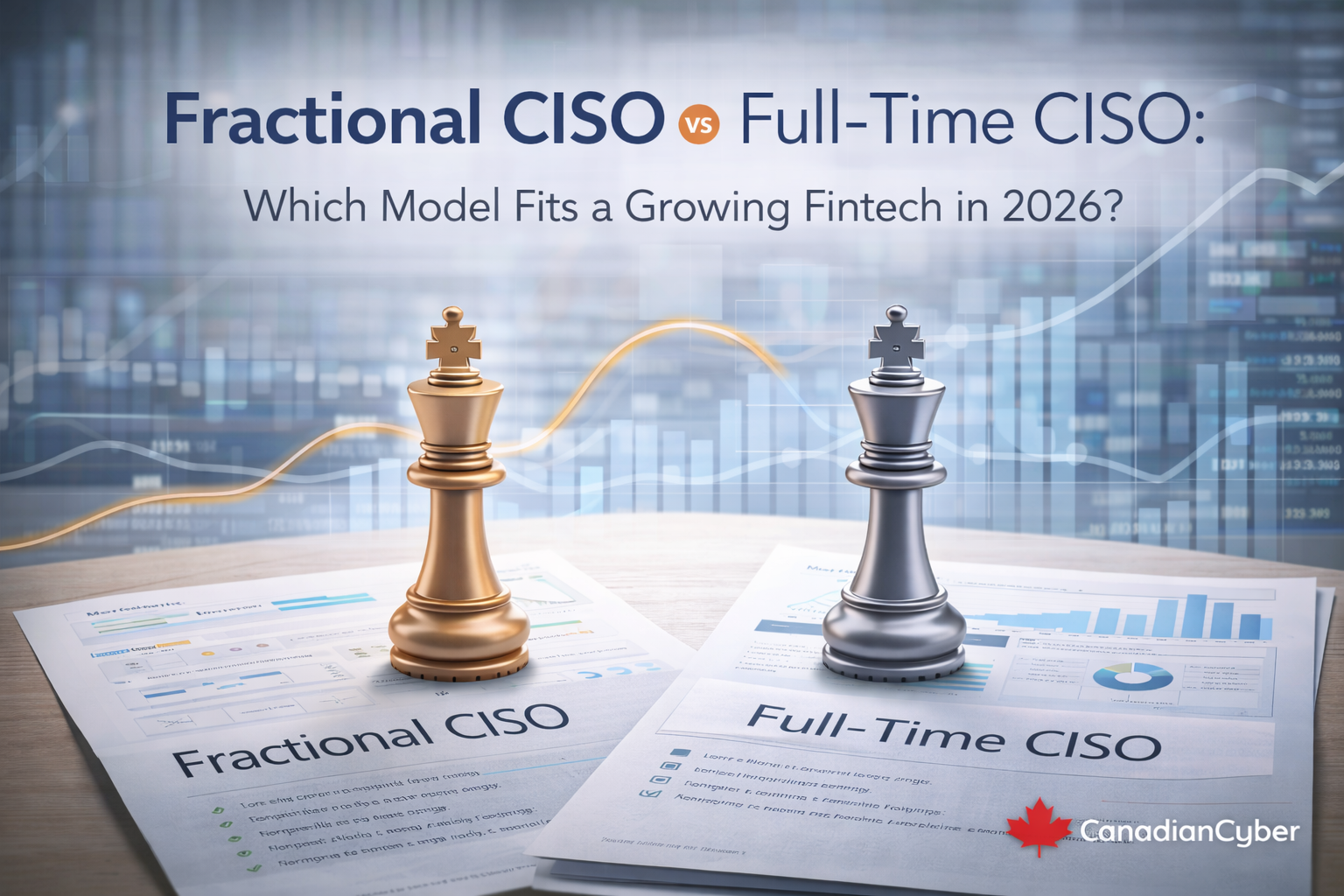
Fintech has a strange security reality in 2026. You are expected to look mature to customers, banks, platforms, auditors, and partners. But inside the company, you may still be operating with startup speed, a lean team, and limited headcount.
That makes the CISO question important early. Hire too soon, and you may pay for leadership before the program is ready to absorb it. Wait too long, and security reviews start slowing revenue, audit readiness slips, and founders end up answering the same hard questions with no real system behind them.
This guide breaks down Fractional CISO versus Full-Time CISO in practical fintech terms: governance, vendor risk, incident readiness, compliance proof, and board-facing reporting.
A Fractional CISO, often called a vCISO, is a senior security leader engaged on a part-time or as-a-service basis. They usually bring structure, frameworks, templates, and an operating cadence, then work with your internal team and vendors to move the program forward.
A Full-Time CISO is an in-house executive who owns security strategy, influences leadership every day, and usually helps build or lead the internal security function over time.
Fintech teams are pushed from several directions at once. That is why security leadership needs to create visible outcomes fast, not just long-term strategy.
In practice, security leadership in fintech is usually judged by outcomes like faster due diligence approvals, cleaner SOC 2 or ISO 27001 progress, better vendor oversight, stronger admin controls, and incident response that works without chaos.
A Fractional CISO is usually the better fit when you need senior security leadership now, but you do not yet need a full executive headcount.
This model often works best for fintech companies from pre-seed through Series B, or for companies growing fast with a small or non-existent security team. It is also a strong fit when you are starting SOC 2 or ISO 27001, dealing with customer questionnaires, or trying to bring vendor risk under control without building a full security department yet.
The main limitation is that a Fractional CISO is not a full-time internal operator. They can shape the system, drive governance, and help leadership make decisions, but if you need daily executive presence across product, engineering, legal, and operations, you may outgrow the model.
A Full-Time CISO becomes the right move when security is no longer a periodic leadership need and has become a continuous executive function. This usually means the company needs daily internal influence, active team building, and a dedicated leader who owns security full time.
A full-time CISO can own security strategy end to end. They can hire, influence roadmaps, negotiate internal tradeoffs, work closely with legal and product, and build long-term programs that go beyond immediate certification or questionnaire pressure.
The main limitation is cost and timing. If you hire too early, the company may not yet have enough internal execution capacity, budget, or operating maturity to support the role well. In that case, you end up paying for leadership without enough machinery behind it.
| Area | Fractional CISO | Full-Time CISO |
|---|---|---|
| Best stage | Early to mid growth, usually before a full security org exists | Later stage or high-complexity fintech environments |
| Main value | Fast structure, governance, and buyer-grade proof | Continuous leadership, staffing, and cross-functional influence |
| Execution model | Works through existing team and vendors | Builds and leads internal function more directly |
| Cost profile | More flexible and lighter on headcount | Higher fixed leadership investment |
| Main risk | May be outgrown if daily executive presence becomes essential | May be hired before the company is ready to support the role fully |
The simplest way to choose is to look at what the company needs in the next ninety days, not what it might need in two years.
In many fintech companies, the most efficient path is not one model forever. It is a staged sequence.
The company starts with a Fractional CISO to stabilize governance, access control, vendor risk, incident readiness, and evidence discipline. Then it adds a security lead or manager for day-to-day execution. Later, once security becomes a constant internal function, the company hires a full-time CISO with a much clearer role and stronger operating base.
There are usually clear signs that the company has outgrown the fractional model. If security leadership is consuming more than twenty to thirty hours a week, if revenue is frequently delayed by security review, if partner negotiations need constant executive attention, or if you are about to hire several security roles in the next year, full-time usually becomes easier to justify.
The same is true when incident or fraud pressure stays high, the environment grows across multiple clouds or markets, or complex security commitments start showing up in contracts every week.
Whether you choose fractional or full-time, good security leadership should produce visible outputs. If those outputs are missing, the model is probably not the real problem.
The best model is the one that gets your fintech to trusted outcomes fastest with the team and budget you have now.
In many cases, that means starting with a Fractional CISO, building a real operating system for risk, access, vendors, incidents, and evidence, and then moving to a full-time CISO once security becomes a constant internal function rather than a fast-growth governance problem.
The model matters. But the outputs matter more. If your security leadership is creating trusted proof, clear decisions, and steady execution, you are on the right path.