Get in touch
info@canadiancyber.ca


Rafia Rizwan

February 26, 2026
ISMS continuous improvement transforms ISO 27001 from a compliance exercise into a data-driven security strategy that strengthens governance and reduces risk.
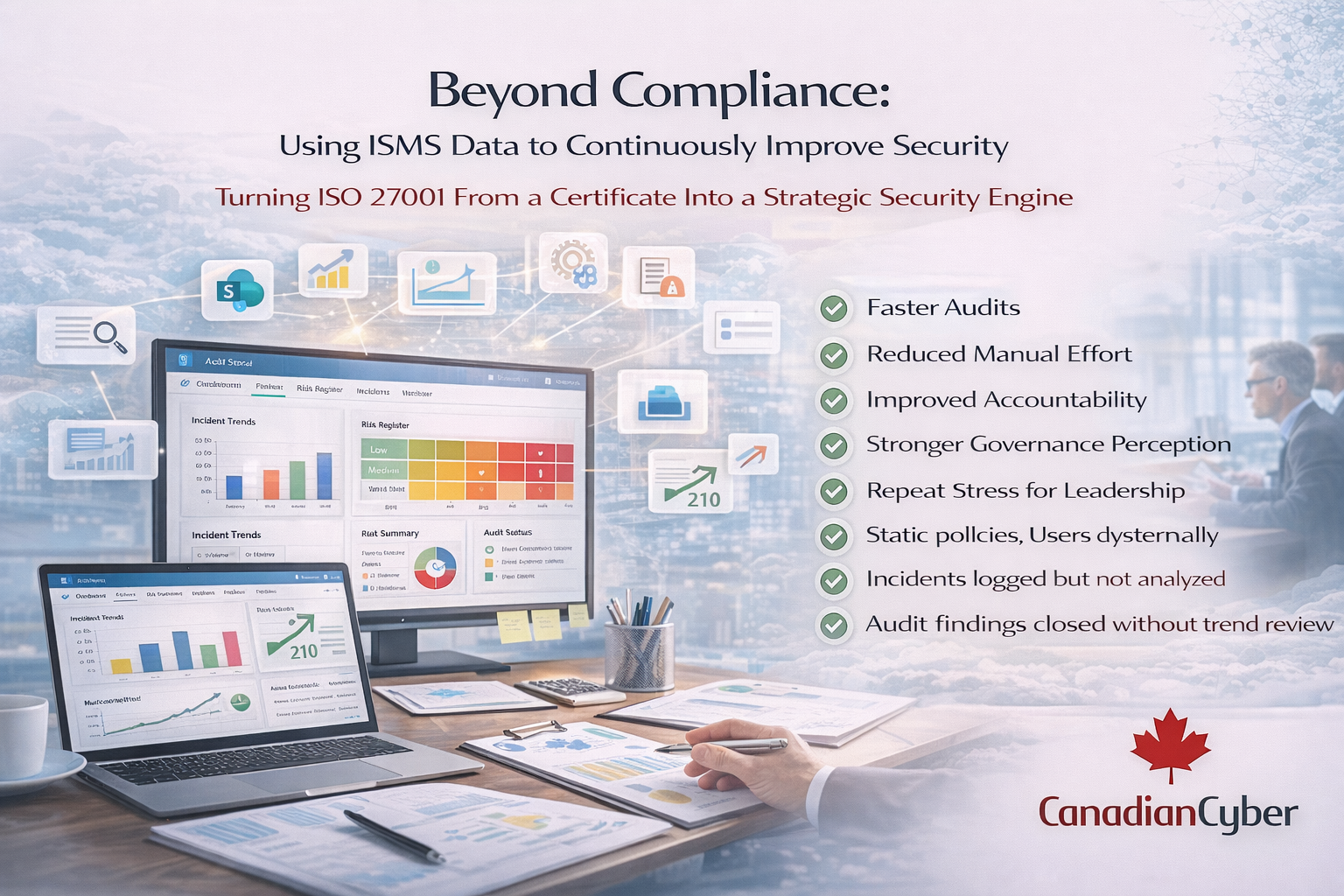
Turning ISO 27001 from a certificate into a strategic security engine.
Most organizations treat their ISMS as a compliance requirement.
They build policies, complete risk assessments, pass audits, file evidence, renew certification and then wait for the next audit.
But that’s not what an ISMS is meant to be.
An Information Security Management System is not just documentation.
It is a data engine.
And if you use it properly, it becomes one of the most powerful security intelligence tools inside your organization.
Many companies approach ISO 27001 like a to-do list: implement controls, document procedures, store evidence, satisfy the auditor, repeat next year.
The result is compliance achieved but security unchanged. That’s the missed opportunity.
If you operate a structured ISMS, you already collect:
This is not just paperwork it’s intelligence. And intelligence drives improvement.
ISO 27001 requires continual improvement, but many organizations interpret that as “close audit findings.”
True continual improvement means:
Your ISMS data gives you the answers if you analyze it.
Every incident tells a story. Instead of logging incidents and moving on, analyze them quarterly.
Questions to ask:
Example insight → action
If 60% of incidents involve access misuse or privilege creep, your improvement plan is clear:
strengthen identity governance, automate access reviews, and introduce tighter conditional access policies.
Most companies update the risk register once per year. That’s not enough for modern SaaS environments.
Trend questions to ask:
When you track risk trends over time, you can prove control effectiveness and justify budgets with evidence.
Internal audits generate nonconformities, observations, and improvement opportunities.
The real value is not the finding it’s the pattern.
Ask:
Repeated findings signal structural issues. Fix the system not just the symptom.
Book a free 15-minute ISMS data review. We’ll show you how to structure your risk, incidents, and evidence so trends become visible and improvement becomes automatic.
Access reviews are often treated as a compliance chore but they produce high-value insight.
Patterns to look for:
When you analyze access review data, you can measurably reduce insider risk and enforce least privilege with confidence.
Vendor assessments shouldn’t be reactive questionnaires. Your ISMS vendor data can reshape your procurement and reduce downstream risk.
This turns vendor risk management into a strategy not a scramble.
ISO 27001 requires management review, but most organizations treat it like a summary meeting.
With structured ISMS data, leadership can review real signals:
Now management review becomes proactive governance not an annual checkbox.
Because their ISMS data is scattered across spreadsheets, emails, and disconnected folders not structured for analytics.
Without structure, you can’t reliably identify patterns, track ownership, or prove improvement.
And when you can’t prove improvement, compliance becomes a cost not an asset.
When your ISMS lives inside a structured SharePoint platform:
That’s how an ISMS becomes a real-time security intelligence system.
Imagine your ISMS data shows: third-party risks increasing, vendor reviews delayed, and multiple audit findings tied to suppliers.
| Signal | What it means | Decision you can make |
|---|---|---|
| Vendor risk scores rising | Supplier controls don’t match your tolerance | Tighten onboarding requirements + scoring |
| Reviews overdue | Governance cadence is slipping | Automate reminders + assign owners |
| Repeat supplier findings in audits | Root cause is procurement + contract gaps | Standardize security clauses + evidence expectations |
| High-risk categories expanding | New dependency risk (AI tools, SaaS integrations) | Rebalance vendor portfolio + increase oversight |
That’s continual improvement — driven by evidence, not intuition.
ISMS-derived KPIs turn compliance into measurable governance. Consider tracking:
| KPI | What it tells you | Why it matters |
|---|---|---|
| Incidents per quarter | Threat and control pressure | Shows whether security posture is improving |
| MTTD / MTTR | Detection and response performance | Direct indicator of resilience |
| Risk score trend (12 months) | Residual risk movement | Proves controls reduce real exposure |
| % controls tested successfully | Control effectiveness | Strengthens audits + enterprise trust |
| Finding recurrence rate | Systemic governance issues | Reveals where “fixes” aren’t sticking |
| Corrective action aging | Remediation bottlenecks | Improves accountability + reduces audit risk |
| Vendor risk exposure index | Third-party posture over time | Supports procurement decisions + client assurance |
Regulators, auditors, and enterprise customers are shifting from:
“Do you have controls?” to “Can you prove they work and improve over time?”
A data-driven ISMS answers that question with confidence and positions your organization as mature, not just compliant.
Canadian Cyber’s SharePoint ISMS platform helps you centralize compliance data and make it useful:
We don’t just help you pass audits we help you extract security value from the system you already run.
Already running ISO 27001, SOC 2, or internal audits but not getting strategic value from your ISMS data?
Let’s fix that. We’ll identify visibility gaps, automation wins, and the KPIs that matter to leadership.
No pressure. Just clarity and a practical roadmap.
An ISMS is not a binder. It’s not a folder. It’s not a checklist.
It’s a security intelligence system.
If you treat it as paperwork, you get paperwork.
If you treat it as data, you get strategy and strategy builds resilience.
Follow us for ISMS automation insights and audit readiness strategies: