Get in touch
info@canadiancyber.ca


Rafia Rizwan

March 31, 2026
ISO 27001 backup controls require more than “we have backups.” This guide shows how to test restores, validate RTO/RPO, and build an audit-ready evidence pack.
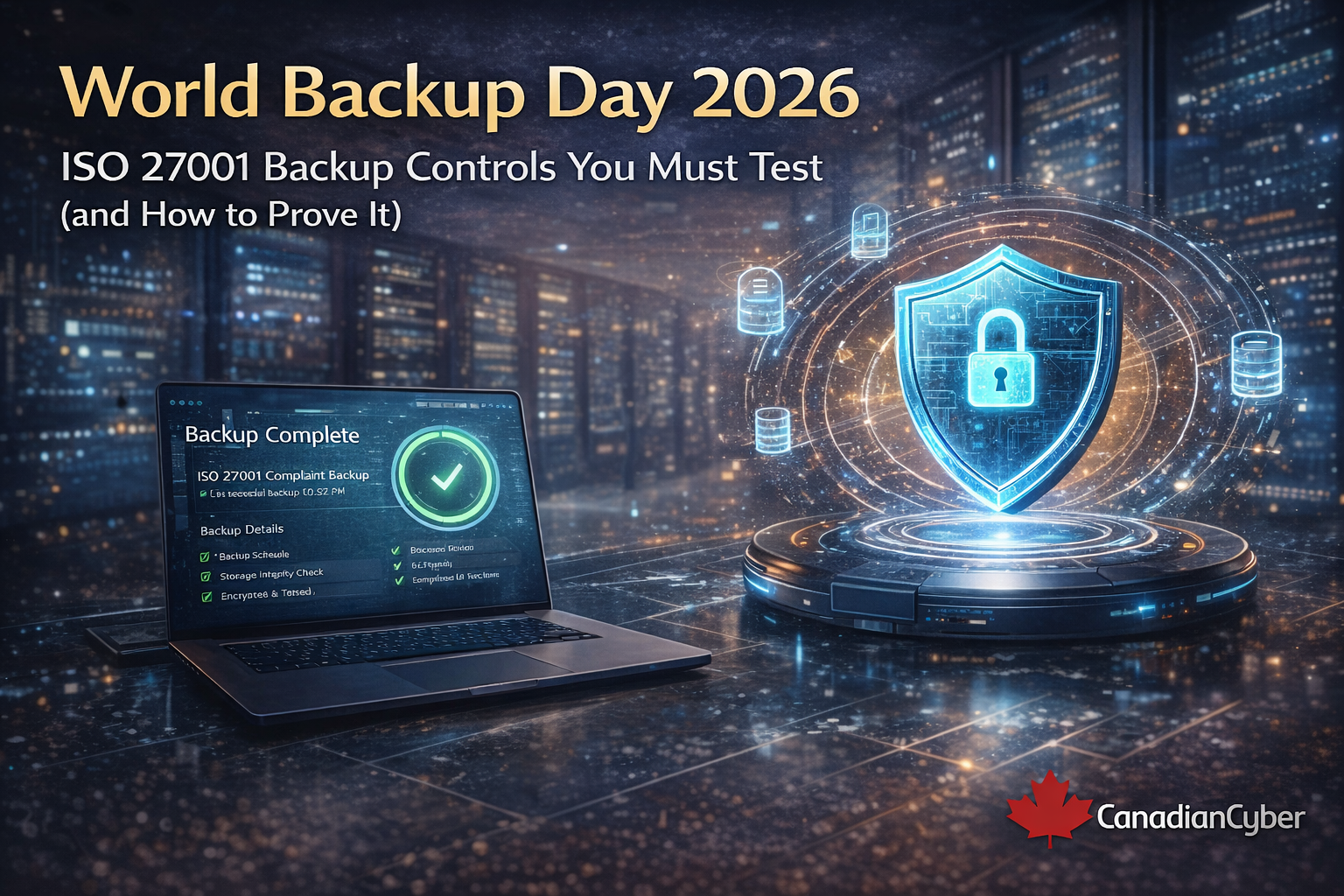
World Backup Day 2026 • ISO 27001 • Restore Testing • Backup Evidence
In ISO 27001 audits, auditors will not stop at “do you back up?” They will ask whether the control is governed, tested, protected, and aligned to business needs. This is where many teams struggle in 2026: the jobs run, but the evidence does not.
This blog breaks down the backup controls that matter most, what you should actually test, and the evidence pack auditors trust when they want proof that recovery works.
In ISO/IEC 27001:2022 Annex A, backups are explicitly covered under A.8.13 Information backup, and are commonly supported by related controls like A.8.14 Redundancy and broader ICT continuity and recovery expectations.
| ISO 27001 Area | What Auditors Want to See | Best Evidence |
|---|---|---|
| A.8.13 Information backup | Coverage, frequency, retention, restore proof | Inventory, job reports, restore test records |
| A.8.14 Redundancy | Recovery options support continuity expectations | RTO/RPO table, recovery walkthroughs |
| Continuity / recovery readiness | Tested restoration process with owners | Signed restore records, exceptions, remediation tracking |
The strongest backup programs do not stop at writing policy. They prove operating effectiveness across scope, success, restoration, timing, security, retention, and SaaS recovery.
Confirm backup frequency meets RPO needs and that restore methods actually support the RTO you claim. Validate access to vaults, keys, credentials, and runbooks.
Test encryption, least-privilege access, MFA for admins, privileged access reviews, deletion protection, and immutability where feasible.
Backups are not “keep forever.” Test whether retention rules are enforced, documented by data class, and aligned to contractual and privacy obligations.
Do not assume Microsoft, Google, GitHub, or ticketing platforms satisfy your recovery expectations by default. Define a recovery method and test it.
| Control Area | Minimum Test | Auditor-Friendly Proof |
|---|---|---|
| Coverage | Quarterly inventory validation | Inventory, owner list, review sign-off |
| Success | Monthly job health review | Job reports, failure remediation tickets, KPI trend |
| Restore testing | Quarterly or semi-annual restores | Restore test record with timing and validation |
| RTO/RPO | Compare targets against actual test results | RTO/RPO table, exception decisions, risk acceptances |
| Security | Access review and control validation | Vault configs, admin review evidence, immutability settings |
| Retention / SaaS | Annual review and one SaaS recovery test | Retention table, SaaS recovery plan, test record |
If you want backup review to move quickly during audit season, do not scatter proof across tickets, screenshots, emails, and tool consoles. Keep one clean evidence pack per quarter or per year.
World Backup Day is useful only if it changes behavior. In ISO 27001 terms, that means moving from backup claims to restore proof, from generic policy to measurable control, and from scattered evidence to a review-ready pack.
The organizations that perform well in audits are usually not the ones with the most complicated backup tooling. They are the ones that can show scope, testing, recovery timing, access control, and ownership without hesitation.