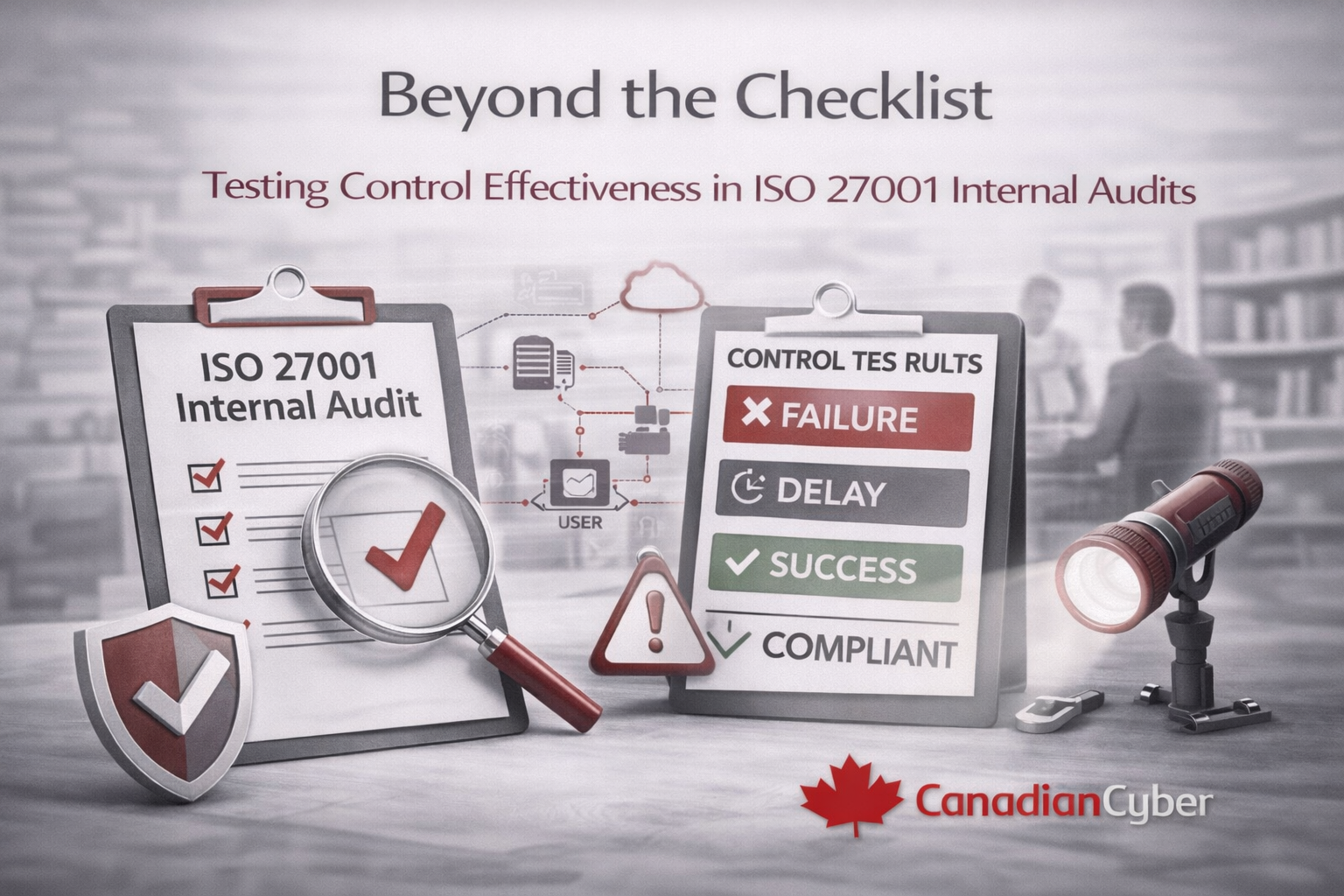
Beyond the Checklist
Testing Control Effectiveness in ISO 27001 Internal Audits
Most internal audits confirm controls exist. Strong audits prove controls work.
Here’s how to test control effectiveness so ISO 27001 becomes real security not paperwork.
Read time: 6–8 minutes
Keywords: ISO 27001 internal audit, control effectiveness, audit evidence sampling, configuration validation, incident response testing
Checkbox audits verify documentation. Effectiveness audits verify performance.
Test controls with sampling, technical checks, interviews, and scenarios to uncover gaps before attackers do.
Certified does not always mean secure
Most ISO 27001 internal audits look the same.
A control exists. A document is present. A box is checked.
And yet, breaches still happen.
In 2026, leading CISOs are asking a sharper question:
Do our controls actually work?
If you only audit for existence, you can pass and still be exposed.
Why checkbox audits no longer hold up
ISO 27001 was never meant to be a paperwork exercise.
It is a risk-based framework designed to reduce real-world security risk.
But internal audits often drift into checklist mode:
- Policies are reviewed, not tested
- Evidence is accepted, not challenged
- Controls are assumed effective
Auditors might be satisfied.
Attackers will not be.
What “control effectiveness” really means
A control is effective only if it:
- Operates consistently (not only when someone remembers)
- Reduces real risk (not just produces paperwork)
- Works under pressure (during incidents and change)
A simple test: If the control fails once, would you detect it quickly and fix it fast?
The hidden risk of untested controls
Untested controls create false confidence.
They look strong on paper and weak in real life.
- Access reviews occur, but aren’t validated
- Incident response plans exist, but aren’t exercised
- Backups are “done,” but restorations are never tested
In a checklist audit, everything appears compliant.
In a real incident, gaps appear instantly.
Quick snapshot: checklist audit vs effectiveness audit
How high-impact internal audits test control effectiveness
Canadian Cyber approaches internal audits differently.
We don’t only confirm a control exists.
We test how it performs.
1) Evidence sampling (not evidence dumping)
Instead of reviewing everything, we select samples and trace them end-to-end.
This shows whether controls are routine or occasional.
Example: Pick a sample of access reviews from different months and verify approvals, removals, and follow-ups actually happened.
2) Technical validation where it matters
Some controls can’t be proven with documents alone.
We validate through:
- Configuration checks
- Access verification
- System settings review
- Logging and alerting confirmation
This separates assumed security from actual security.
3) Staff interviews that test understanding
Controls depend on people.
We interview:
- Control owners
- Process participants
- Incident responders
Signal to watch:
If people can’t explain how the control works, it likely doesn’t operate reliably.
4) Scenario-based testing
Checklists don’t reveal how teams respond under pressure.
Scenario testing does.
We ask questions like:
- What happens if this control fails?
- How would we detect it?
- Who responds, and how fast?
- Where is evidence captured?
These discussions uncover gaps no checklist will ever catch.
Tired of audits that don’t improve security?
Upgrade your ISO 27001 internal audit to test control performance, not just documentation.
Why auditors and executives value this approach
External auditors increasingly expect:
- Evidence of operation (not just policies)
- Proof over time (not last week)
- Demonstrated maturity and ownership
Executives value:
- Fewer surprises
- Clear visibility into real risk
- Findings that drive improvement
How Canadian Cyber delivers stronger internal audits
Canadian Cyber’s ISO 27001 internal audits:
- Go beyond documentation review
- Test controls in real-world conditions
- Use structured templates for repeatable testing
- Deliver findings that drive improvement not just compliance
Our goal:
Not to help you “pass.”
To help your ISMS perform.
Supported by structure, not spreadsheets
Effectiveness testing is easier when evidence is organized and repeatable.
Our audits integrate smoothly with a SharePoint-based ISMS platform so teams can:
- Track control performance over time
- Store test evidence in one place
- Assign corrective actions with ownership
- Monitor improvements continuously
That turns internal audits into a feedback loop, not a yearly event.
The strategic value of effectiveness-driven audits
- Weaknesses are detected earlier
- Incidents become less likely and less severe
- Audit outcomes improve naturally
- Resilience becomes measurable
Final thought
Anyone can check a box.
Strong security comes from asking harder questions and testing the answers.
In 2026, the best internal audits don’t ask “Is the control there?”
They ask “Does it actually protect us?”
Next step: Move beyond checklists. Strengthen real security with effectiveness-driven audits.
Stay Connected With Canadian Cyber
Follow us for insights on ISO 27001, internal audits, and building security that works: