What a micro-audit is
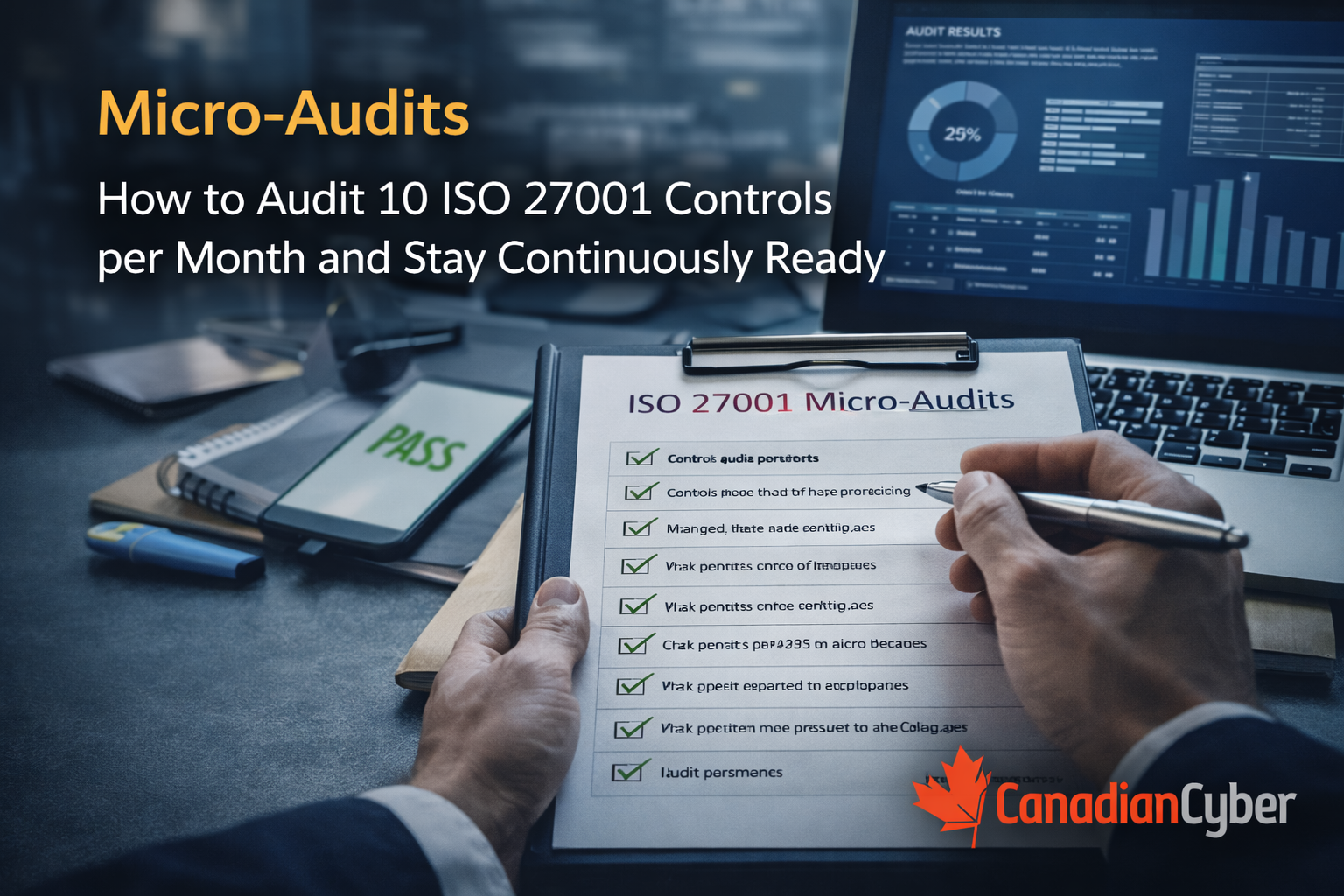
A micro-audit is a short internal audit cycle that tests a small set of controls, uses sampling and evidence review, records results and corrective actions, and closes the loop with verification.
Think of it like this:
2–4 hours per month, not 2–4 weeks per year.
Why micro-audits work so well for ISO 27001
ISO 27001 does not require painful audit events. It requires evidence that controls exist, operate over time, get corrected when they fail, and are overseen by leadership.
Consistent evidence
You build operating proof month by month instead of trying to reconstruct it later.
Predictable cadence
Owners stop treating audits like surprise exams and start treating them like normal operations.
Visible improvement loop
Small findings close faster before they become larger recurring problems.
Side benefit:
micro-audits reduce key-person risk because the ISMS no longer depends on one “audit hero” pulling everything together once a year.
The Micro-Audit Model (10 controls per month)
The monthly cadence
A practical monthly micro-audit loop is simple, repeatable, and light enough for a small team to keep running.
| Week |
Main activity |
Output |
| Week 1 |
select controls and confirm evidence owners |
micro-audit plan |
| Week 2 |
collect evidence and run sampling |
evidence set and test notes |
| Week 3 |
record findings and assign corrective actions |
results log and action tracker |
| Week 4 |
verify last month’s closures and report status |
monthly summary and closure verification |
That’s the loop.
Keep repeating it monthly and the ISMS becomes continuously ready instead of episodically documented.
How to choose the 10 controls
If you select controls randomly, micro-audits become busywork. A better model is to choose controls based on risk, common failure points, and recent change.
Bucket A: High-risk controls
- privileged access reviews
- MFA and admin governance
- logging and monitoring reviews
- backups and restore testing
- vulnerability management
Bucket B: Controls that commonly fail
- management review inputs and outputs
- corrective action closure evidence
- policy review dates
- asset inventory updates
- risk acceptance expiry tracking
Bucket C: Recently changed areas
- new SaaS tool onboarding
- cloud configuration changes
- new vendor or subprocessor
- new integration or API changes
Simple monthly selection rule
- 4 controls from Bucket A
- 3 controls from Bucket B
- 3 controls from Bucket C, or rotate if there were no major changes
If your internal audits still feel random or reactive, the control selection method is usually the first thing to fix.
The micro-audit test method
To keep micro-audits fast but defensible, use the same fixed test script for every control. This avoids overcomplicating the work and makes results easier to compare month to month.
Test these four things for each control
- Design: do we have a defined control statement, policy, or procedure?
- Ownership: is an owner assigned and aware of responsibilities?
- Operation: did it operate during the period and is there evidence?
- Effectiveness: did it achieve its purpose without obvious gaps?
Why this works:
it is lightweight enough for monthly use and still strong enough to satisfy internal audit intent.
Sampling rules that make evidence credible
Micro-audits are about smart sampling, not exhaustive checking. The goal is credible evidence with limited time.
| Control type |
Practical sample |
Why it’s enough |
| Monthly controls |
test one period evidence pack |
proves current operation without over-testing |
| Quarterly controls |
test the latest quarter plus one exception |
adds realism and depth |
| Ticket-based controls |
test 3–5 change samples |
enough to show whether the control is real or superficial |
| Vendor reviews |
test 2 critical vendors deep and 2 high vendors light |
balances effort and assurance |
Auditor trust tip:
include at least one imperfect sample—an overdue patch with acceptance, a vendor review with conditions, or a failed restore test with corrective actions. That proves the program is real, not curated.
What your micro-audit outputs should look like
Keep the templates simple. The goal is repeatability, not paperwork.
1) Micro-Audit Plan
- month or period
- controls selected
- owners notified
- evidence due date
- audit date
2) Micro-Audit Results
- control ID and title
- test performed
- evidence reviewed
- result: effective / partially effective / not effective
- findings and action need
3) Corrective Action Entries
- finding ID
- owner
- due date
- evidence required to close
- verification method
4) Monthly Summary
- controls tested
- effective / partial / ineffective counts
- top recurring themes
- overdue corrective actions
- decisions needed
A 12-month micro-audit schedule
A yearly rotation helps you cover the ISMS evenly without overwhelming the team in any single month.
| Month |
Theme |
Example controls |
| Month 1 |
Access and Identity |
privileged roles, joiner/mover/leaver, MFA, service accounts |
| Month 2 |
Logging and Monitoring |
audit logs, log reviews, alert handling, escalation |
| Month 3 |
Vulnerability and Patch Governance |
SLAs, exceptions, verification scans, change samples |
| Month 4 |
Vendor and Subprocessor Governance |
vendor tiering, vendor reviews, change log, contract terms |
| Month 5 |
Backup and Recovery |
backup success, restore tests, RTO/RPO, DR tabletop |
| Month 6 |
Policy and Training |
policy reviews, training completion, acknowledgements |
| Month 7 |
Asset and Configuration Management |
inventory, baseline checks, drift evidence, endpoint compliance |
| Month 8 |
Incident Readiness |
IR plan, tabletop, post-incident reviews, comms templates |
| Month 9 |
Change Management Deep Dive |
PR approvals, IaC, emergency changes, deploy access |
| Month 10 |
Data Protection and Privacy |
classification, retention, sensitive access review, DLP evidence |
| Month 11 |
ISMS Governance |
management review, corrective actions, risk register, objectives |
| Month 12 |
Full Readiness Sweep |
top 10 controls again, evidence continuity, external audit readiness |
How micro-audits reduce audit findings
Evidence continuity becomes normal
You stop trying to backfill months of evidence because you are validating it every month.
Owners learn the system
People stop treating audits like surprise exams and start understanding their role in the ISMS.
Corrective actions close faster
Small findings get fixed before they become recurring systemic weaknesses.
The ISMS becomes resilient
The audit process is standardized enough to survive turnover and changing priorities.
Common micro-audit mistakes
- Picking controls randomly → use risk buckets and rotation
- Auditing policies only → always include operating evidence
- Not verifying closure → build last month’s verification into Week 4
- Too many controls at once → start with 6–8 if needed, then scale to 10
- No reporting to leadership → add a short monthly summary with trends and needed decisions
Next steps
If you want to stay continuously audit-ready without annual panic sprints, micro-audits are one of the simplest ways to get there.
Final takeaway
Micro-audits work because they make audit readiness operational instead of episodic. You stop treating internal audit like an event and start treating it like part of how the ISMS runs.
That change matters. It means evidence stays current, owners stay engaged, findings close faster, and leadership sees a system that is improving over time instead of lurching from scramble to scramble.
The goal is not more auditing. The goal is smaller, smarter auditing that keeps the ISMS ready all year.
Follow Canadian Cyber
Practical cybersecurity + compliance guidance: