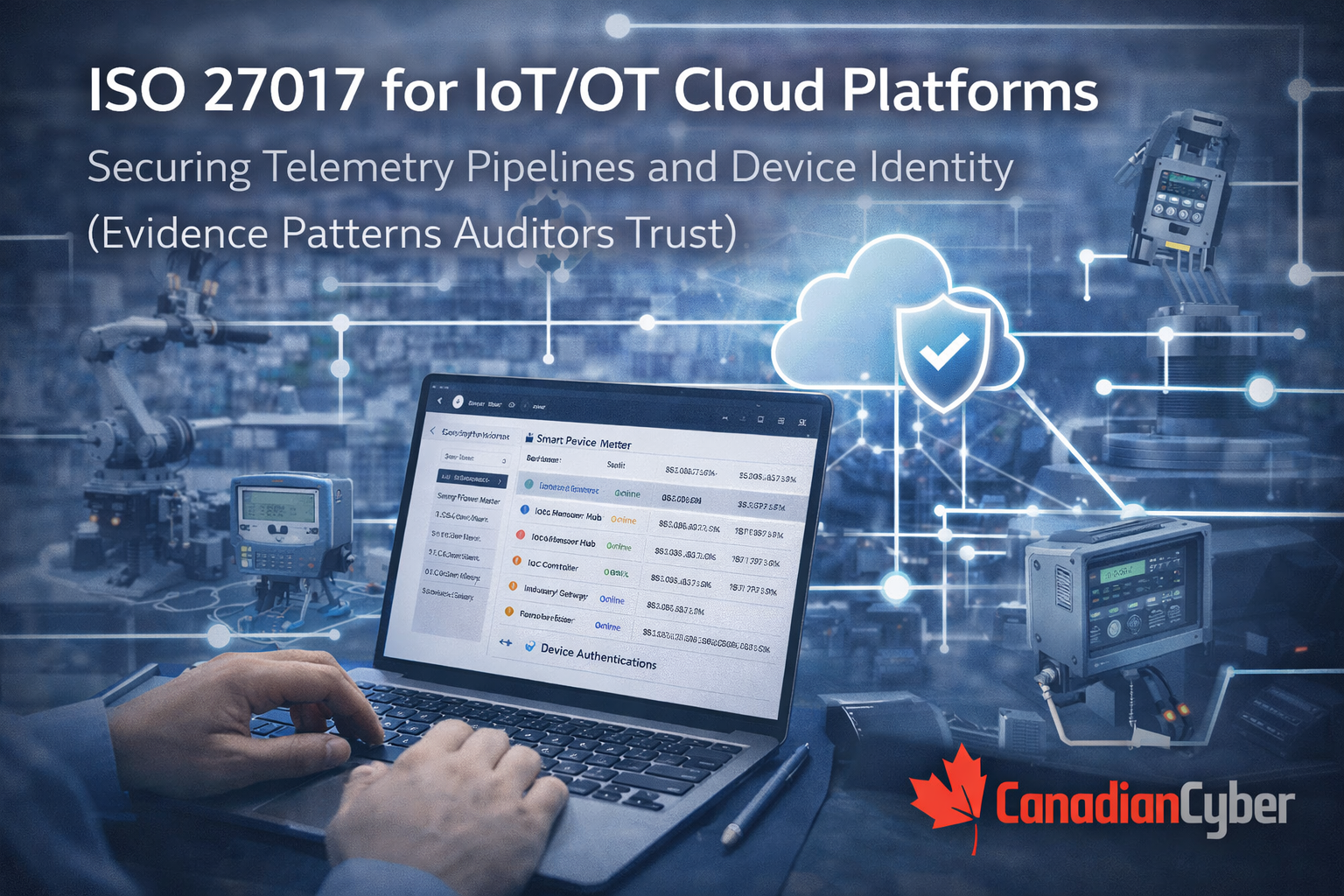
Why IoT/OT cloud platforms struggle in assurance reviews
If you have gone through audits or enterprise procurement, you have probably seen questions that generic SaaS answers do not handle well. IoT and OT risk lives in telemetry flows, machine identity, device lifecycle, and operational safety not just login screens and user roles.
Typical assurance questions
- How do you authenticate devices?
- Can a compromised device pivot into the cloud environment?
- How do you prevent telemetry tampering in transit?
- How do you isolate customer tenants and device fleets?
- How do you control remote command execution?
- How do you prove integrity and chain-of-custody for telemetry?
Practical takeaway:
generic ISO 27001 answers often feel incomplete here because buyers want proof at the telemetry, identity, and operational-control layers.
The ISO 27017 lens: shared responsibility, made explicit
Before you talk about technical controls, define the responsibility model clearly. A simple one-page statement often removes confusion early and makes the control mapping much more defensible.
Cloud provider
Physical infrastructure, baseline managed service security, and cloud availability foundations.
Platform provider (you)
Device identity, ingestion endpoints, tenant isolation, monitoring, data storage, and remote access features.
Customer
Physical device security, network segmentation, device lifecycle processes, and user governance on their side.
Why auditors like this:
it prevents invisible assumptions and makes it easier to explain exactly which controls you own and evidence.
The two core control domains
For most IoT and OT cloud platforms, the highest-impact controls fall into two areas:
1) Telemetry pipeline security
Ingest → transport → process → store → analyze.
2) Device identity and authorization
Provision → authenticate → authorize → rotate → revoke.
1) Telemetry pipeline security
A) Secure ingestion endpoints
Device ingestion is the front door to the platform. Auditors and buyers want to know whether telemetry submissions are authenticated, whether replay is blocked, and whether abusive traffic can be throttled before it becomes a security or cost problem.
Controls that matter
- mTLS or strong token-based auth for devices
- replay protection using timestamps, nonces, or sequence numbers
- rate limiting per device, fleet, and tenant
- request size limits to reduce payload abuse
Evidence that works
- ingestion security standard
- gateway or WAF config proof
- sample throttling or blocked-pattern logs
- runbook for ingestion abuse or malformed telemetry floods
B) Transport security
Telemetry security is not just about the first hop. You also need to show protected transport through brokers, streams, internal services, and storage paths where applicable.
Important controls
- TLS for device-to-cloud connections
- service-to-service encryption for internal pipeline hops where needed
- strict certificate management
- secure broker configuration for MQTT, AMQP, Kafka, or equivalent services
Evidence: TLS enforcement settings, broker ACL policy, sanitized broker config export, and certificate lifecycle documentation.
C) Integrity controls
Telemetry is often used for alerts, analytics, compliance evidence, billing, and sometimes operational or safety decisions. That means integrity matters as much as confidentiality.
Good integrity controls
- message signing or integrity checks where required
- hashing or validation for critical payloads
- immutable logging for system-of-record telemetry
- documented time-sync assumptions for replay detection
Evidence: integrity design note, validation logs, and retention or immutability settings for critical stores.
D) Segmentation and isolation across tenants and fleets
In multi-tenant IoT and OT platforms, telemetry isolation is not optional. One tenant’s devices, streams, topics, and data stores should never be readable by another tenant without a strictly governed pathway.
Evidence pattern that works well
- 1-page telemetry isolation statement
- tenant validation at ingestion
- separate topics, namespaces, streams, or queues per tenant
- storage segregation by tenant prefix, schema, or partition model
- automated tests proving cross-tenant reads are blocked
E) Logging and monitoring
Auditors do not just want logs to exist. They want to see that telemetry pipeline events are reviewed, monitored, and used to detect suspicious behavior or control failures.
High-value alerts
- sudden spikes in ingestion volume by device or fleet
- auth failures and replay detections
- unusual topic or stream access attempts
- ingestion endpoint config changes
- retention or storage policy changes
Evidence: logging standard, monthly or quarterly review sign-offs, and sample alert-to-ticket resolution chains.
If your current evidence explains web access well but says little about telemetry ingestion, broker controls, or tenant separation, your cloud assurance story is probably incomplete for IoT and OT buyers.
2) Device identity and authorization
A) Unique device identity
Shared credentials across devices are one of the fastest ways to create a fleet-wide compromise. Auditors will usually look for proof that device identity is unique, securely provisioned, and bound to the right tenant or fleet.
Controls
- unique per-device identity
- secure provisioning root
- binding between device ID and tenant or fleet
- no shared long-term secrets across the fleet
Evidence
- device identity model document
- provisioning workflow note
- sample device enrollment record
B) Secure provisioning
Provisioning is where trust begins. If devices can enroll without proper authorization, your identity model is weak no matter how strong the downstream controls look.
Controls that matter
- enrollment requires authorization
- provisioning keys are time-bound and scoped
- enrollment is logged and reviewable
- proof-of-possession mechanisms where appropriate
Evidence: provisioning runbook, enrollment logs for a sample period, and approval workflow evidence for high-impact devices.
C) Credential lifecycle: rotation and revocation
Rotation and revocation are non-negotiable. Auditors often look here because many device identity programs are strong at provisioning and weak at compromise handling or decommissioning.
Expected controls
- certificate or token rotation mechanism
- revocation process for compromised or decommissioned devices
- ability to quarantine one device identity without taking down the fleet
- documented response for compromised-device scenarios
Evidence: revocation runbook, sample revoke event log, rotation policy, and one quarantine workflow record if you use quarantine.
D) Authorization for remote commands
If your platform can send remote control commands, push configuration, or deploy firmware, that function should be treated like privileged access. In OT contexts especially, it can amplify risk quickly.
SOC 2 / ISO-friendly controls
- strong authorization on command endpoints
- role and scope controls for who can issue commands
- approval workflow for high-risk or safety-impacting commands
- command signing or non-repudiation where appropriate
- full audit logs showing who issued what, to which device, when, and with what result
Evidence: command authorization policy, sample command audit logs, and change-control evidence for firmware deployment processes.
The IoT/OT cloud audit pack
If you want ISO 27017 conversations to go smoothly, prepare a focused pack that answers the most common audit and procurement questions without oversharing.
A strong audit pack usually includes
- 1-page responsibility statement
- 1–2 page telemetry pipeline security overview
- 1–2 page device identity model
- sample enrollment logs
- sample revocation or rotation records
- rate limit or WAF configuration proof
- 2–3 monitoring alert chains
- quarterly privileged access reviews for platform admins
Common failures and how to avoid them
- Shared device credentials → move to unique device identity
- No revocation proof → implement quarantine and revoke record trails
- Telemetry topics not tenant-scoped → enforce topic naming and ACL policies
- Remote commands lack approvals or audit logs → treat them as privileged operations
- Logs exist but no review evidence → add monthly review sign-offs and ticket trails
- Provisioning is uncontrolled → add enrollment approval and monitoring
What buyers remember most:
if you cannot explain device identity, tenant isolation, and remote command control clearly, they will assume the operational-risk model is immature.
Next steps
If you operate an IoT or OT cloud platform and want ISO 27017-aligned governance without slowing delivery, the fastest path is to turn your pipeline, device identity, and command controls into a small, audit-ready evidence story.
Final takeaway
ISO 27017 works well for IoT and OT cloud platforms because it lets you frame controls inside the shared-responsibility model that actually exists in the field. But it only becomes persuasive when your evidence speaks to telemetry security, device identity, tenant isolation, and remote command governance directly.
When you can explain those controls clearly and back them with logs, approvals, tests, and review records, audits get easier and enterprise buyers stop trying to guess whether your cloud platform can be trusted in operational environments.
In one line
The strongest ISO 27017 story for IoT and OT platforms is the one that proves telemetry and machine trust are controlled end to end.
Follow Canadian Cyber
Practical cybersecurity + compliance guidance: