email-svg
Get in touch
info@canadiancyber.ca

Proving Multi-Tenant Isolation

A practical guide explaining how SaaS companies prove multi-tenant isolation using architecture, authorization controls, testing, monitoring, and audit-ready evidence.
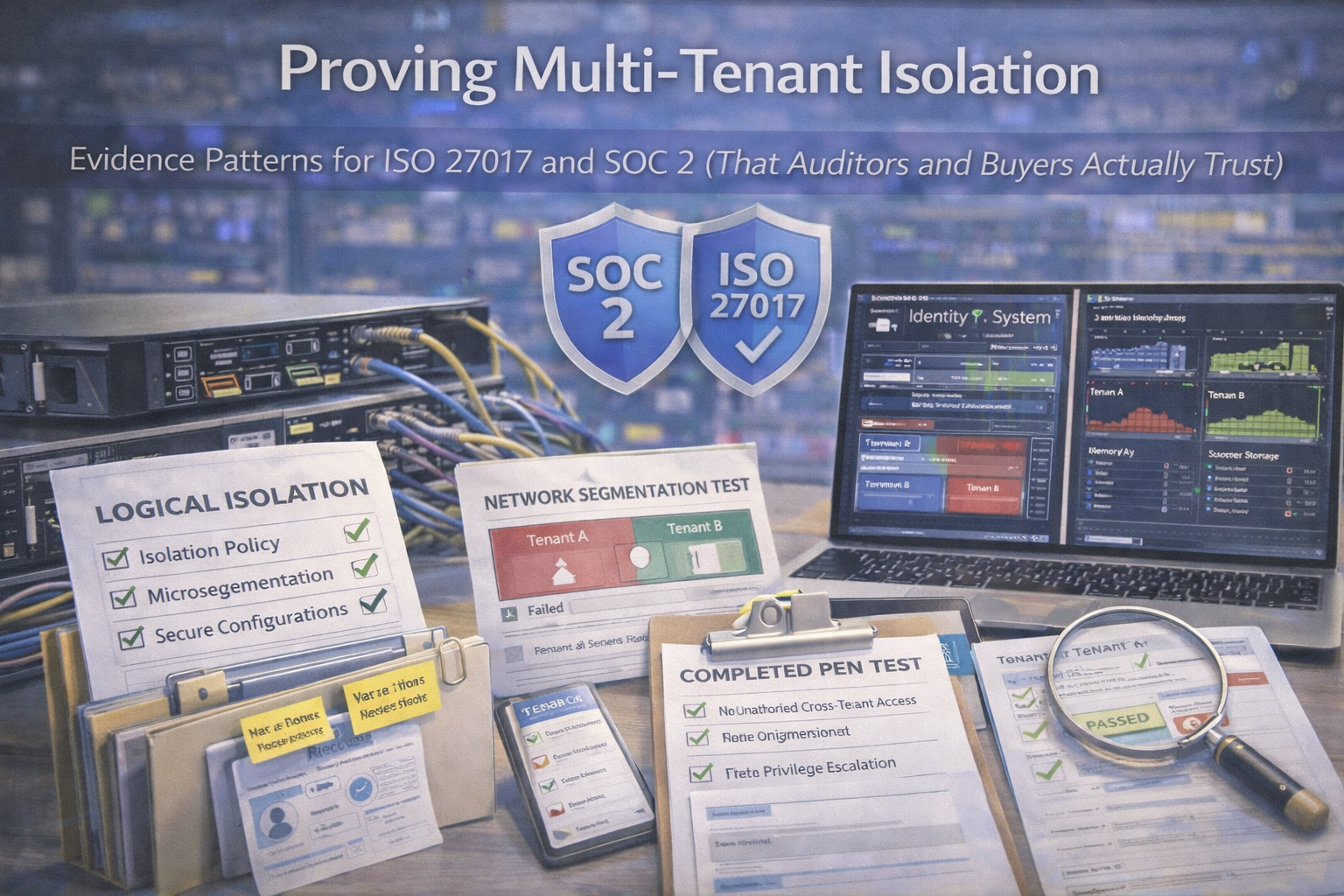
Main Hero Image
Tenant Isolation • Support Access • Tests • Logs • Operating Evidence

Proving Multi-Tenant Isolation

Evidence Patterns for ISO 27017 and SOC 2 (That Auditors and Buyers Actually Trust)

Multi-tenant isolation is one of those topics where everyone believes it’s true until an auditor or enterprise buyer asks:
“How do you prove one customer can’t see another customer’s data?”

  • “What stops a support analyst from pulling records across tenants?”
  • “What evidence do you have that isolation is tested and monitored?”
If you’re cloud-hosted and multi-tenant, isolation is a trust anchor. ISO 27017 and SOC 2 both reward you when you can show isolation is designed, implemented, tested, and monitored over time.

Why multi-tenant isolation is a “high intent” control

Buyers and auditors focus on isolation because the failure mode is catastrophic: cross-customer exposure, regulatory notifications, breach reporting, and contract fallout. Unlike many controls, isolation isn’t proven by policy alone.
It’s proven by architecture + code + configuration + tests + logs + operating evidence.

What ISO 27017 and SOC 2 are really asking for (plain English)

ISO 27017 angle (cloud shared responsibility)
Show cloud-aware controls that prevent leakage between tenants, including access control enforcement, segregation mechanisms,
monitoring of privileged activity, and change control for security-relevant updates.
SOC 2 angle (Security, often Confidentiality)
Show logical access controls enforcing tenant boundaries, secure SDLC and change management, monitoring/IR readiness, and consistent operation over the Type II period.
Bottom line
Both frameworks want the same story—just framed differently. Your job is to make the story provable.

The 6 evidence patterns that consistently pass audits

Pattern 1: “Isolation Statement” + Tenant Model (one page)
What it includes
  • your tenant model (single app + multi-tenant DB / separate schemas / separate DBs)
  • where tenant boundaries are enforced (API/service/DB/storage path/IAM)
  • what is not shared across tenants (data, admin roles, boundary rules)
  • shared components and how they remain isolated
Why it works: it prevents the “tell me everything about your architecture” spiral and creates a crisp claim your evidence supports.

Pattern 2: Authorization controls you can prove (RBAC + ABAC)
What buyers/auditors ask
  • How is tenant ID assigned and validated?
  • Can any endpoint query outside tenant scope?
  • What prevents IDOR-style issues (changing an ID to pull other tenant data)?
Evidence that works
  • role/scope matrix explicitly stating tenant restrictions
  • documented guardrails (no code sharing): “all queries require tenant context”
  • endpoint classification (privileged vs standard) with boundary expectations
  • link to automated authorization tests (Pattern 3)
Red flag: if boundaries depend on “developers remembering to filter by tenant_id,” you’ll struggle to prove isolation.

Pattern 3: Automated tenant isolation tests (most trusted evidence)
What “good” looks like
  • tests that attempt cross-tenant access and must fail
  • tests run in CI/CD on every change (or at least releases)
  • tests cover read, write, and export actions
Auditor-friendly evidence artifacts
  • one-page “Isolation Test Suite” summary (what is tested)
  • CI pipeline logs showing suite runs and passes
  • sample test report output (redacted)
Why this is gold: it proves isolation is continuously validated, not a one-time design claim.

Pattern 4: Data layer controls (DB + storage segregation)

Even if boundaries are enforced in the app layer, auditors want comfort that the data layer doesn’t create easy bypasses.

Evidence options (pick what’s true)
  • per-tenant schemas or per-tenant DBs, or documented row-level approach
  • tenant keying enforced through ORM/service layer
  • tenant-scoped storage prefixes for files
  • encryption boundary clarity (who can access keys and why)
Evidence artifacts
  • high-level architecture diagram (no sensitive internals)
  • storage configuration summary (no bucket names required)
  • admin access review for data-layer privileged roles
Key point: you’re proving your design prevents cross-tenant access in shared infrastructure not that infrastructure is physically isolated.

Pattern 5: Privileged access governance (support/admin “break-glass”)
What auditors/buyers ask
  • Can support see production customer data?
  • Is access time-bound and approved?
  • Is access logged and reviewed?
  • Can admins export bulk data?
Evidence that works
  • support access policy (allowed vs forbidden)
  • JIT access workflow: approval + time window + ticket reference
  • audit logs of privileged actions (view, export, role changes)
  • quarterly privileged access review sign-off
Strong buyer language: “Support access to customer data is restricted, logged, and reviewed. Elevated access requires approval and is time-bound.”

Pattern 6: Monitoring + detection for cross-tenant signals (operating proof)
What to monitor (high value)
  • denied authorization events (cross-tenant attempts)
  • bulk export attempts and spikes
  • unusual query volume patterns
  • admin role changes and privileged endpoint usage
Evidence artifacts
  • log review records (monthly/quarterly sign-offs)
  • alert → ticket → response chain (2–3 examples)
  • optional: tabletop record for cross-tenant exposure scenario
Why this matters: it proves you can detect and respond if isolation is threatened not just assume it’s perfect.

The “auditor sampling” plan (how to make proof easy)

Auditors want samples. Give them a clean, repeatable path that answers most questions without chaos.

Sample set What to include What it proves
A) Design & implementation Isolation Statement (1 page), tenant diagram (high level), role matrix with tenant restrictions Boundaries are defined and enforceable
B) Continuous validation CI evidence that isolation tests run, sample test report output Isolation is validated on an ongoing basis
C) Operating governance Support/admin access review evidence, log review sign-offs, one alert chain Privileged access and monitoring operate over time

Common mistakes that weaken multi-tenant isolation evidence

  • “We rely on the framework” without showing how tenant boundaries are enforced
  • No automated isolation testing (only manual testing or assumptions)
  • Support access is unlimited or not logged
  • Exports aren’t controlled (bulk downloads = silent exfil risk)
  • No monitoring evidence (logs exist, no review proof)
  • Over-sharing architecture because there’s no structured evidence pack
If you fix #2 (automated tests) and #5 (review proof), buyer confidence usually jumps fast.

Practical next steps
If you’re a multi-tenant SaaS and want buyers to approve you faster, start by strengthening your isolation evidence.

Quick checklist (copy/paste)

  • 1-page Isolation Statement (tenant model + boundary points)
  • Role matrix showing tenant restrictions
  • Automated cross-tenant access tests in CI
  • Data-layer segregation summary (DB/storage boundaries)
  • Support/admin access is least-privilege + logged + reviewed
  • Monitoring evidence for denied access and export anomalies
  • 2–3 operational samples (alerts/tickets/log reviews)

Follow Canadian Cyber
Practical cybersecurity + compliance guidance:

© 2026 Canadian Cyber. All rights reserved.


Related Post