Get in touch
info@canadiancyber.ca


Rafia Rizwan

February 7, 2026
NIST CSF 2.0 introduces stronger governance, supply chain risk, and accountability. Here’s how organizations should adapt their security programs for 2026.
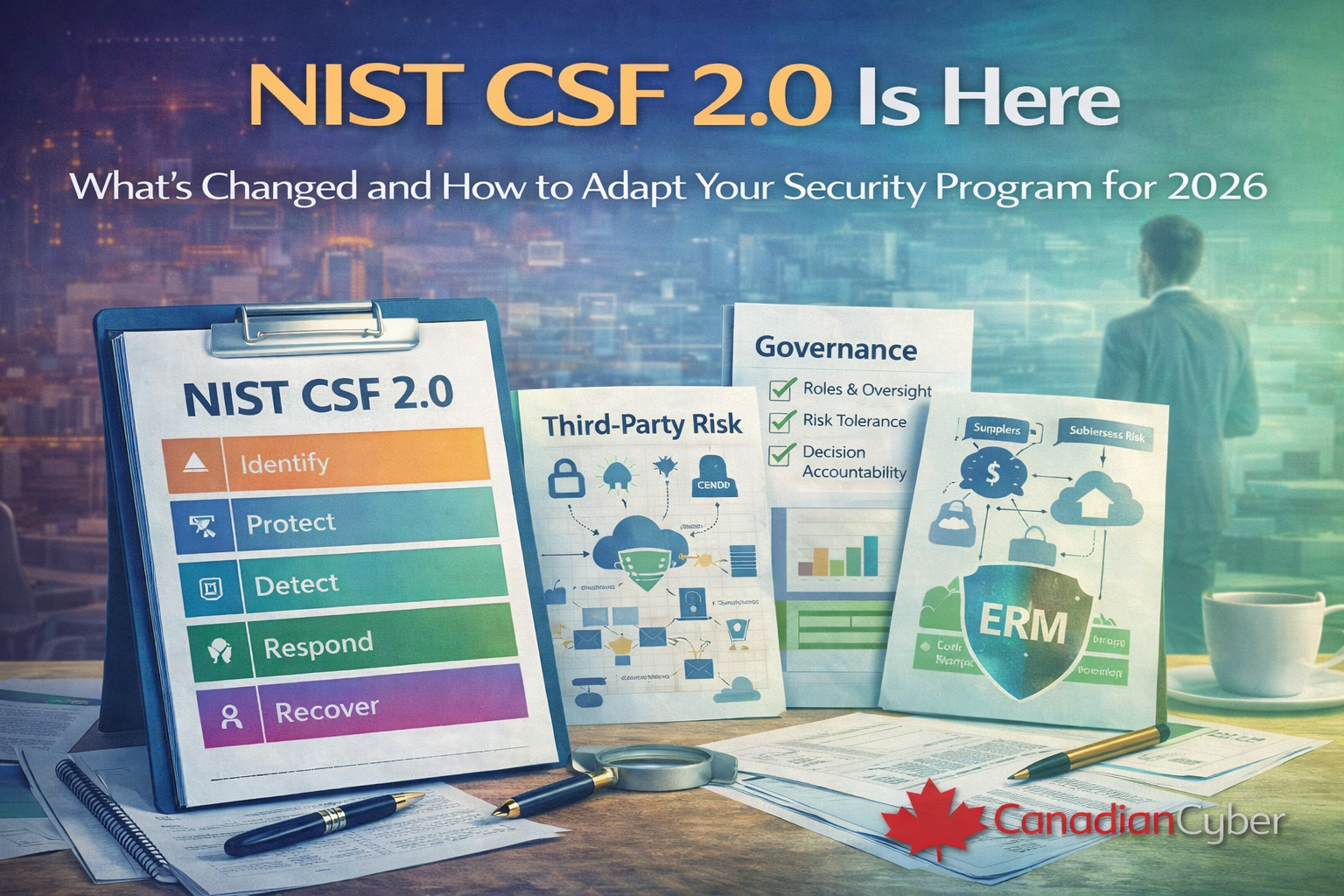
In 2026, security isn’t just about controls. It’s about governance, accountability, and resilience. CSF 2.0 reflects that shift.
For nearly a decade, the NIST Cybersecurity Framework helped organizations answer one simple question:
“Are we managing cyber risk in a structured way?”
Now, with NIST CSF 2.0, the conversation has evolved. Organizations that don’t adapt risk falling behind.
Many organizations assume CSF 2.0 is just a minor refresh. It’s not. CSF 2.0 represents a strategic reset that aligns cybersecurity with executive oversight, supply chain accountability, regulatory pressure, and business risk management.
CSF 2.0 introduces clearer expectations around governance, third-party and supply chain risk, accountability for cyber decisions, alignment with enterprise risk management (ERM), and continuous improvement.
Biggest shift:
Governance moves front and center. Cybersecurity must be governed, not just implemented.
CSF 2.0 makes it explicit that leadership must define risk tolerance, roles, and decision-making. This aligns strongly with
ISO 27001, which already treats governance as foundational.
CSF 2.0 strengthens focus on vendor and third-party security, cloud and SaaS dependencies, and cascading supplier risks.
For many Canadian organizations, this mirrors procurement expectations and customer questionnaires.
Here’s the reality many teams face:
Teams reference NIST but can’t prove how it’s applied.
CSF 2.0 makes that gap hard to ignore.
Goal for 2026: visible governance + consistent evidence + repeatable execution.
Not more paperwork. More clarity and fewer surprises.
We’ll help you map what changed, what matters for your buyers, and what to operationalize first.
Canadian Cyber helps teams bridge the gap between framework theory and operational reality:
An organization says: “We follow NIST.”
A customer asks: “Can you show us?”
CSF 2.0 makes that gap impossible to ignore. The organizations that succeed are the ones that operationalize, not just reference, frameworks.
NIST CSF 2.0 isn’t about more controls. It’s about better decisions, clearer ownership, and visible governance.
Organizations that adapt now won’t just be compliant they’ll be trusted.
Turn CSF 2.0 updates into an executive-ready program with clear ownership, clean evidence, and predictable reviews.
Follow us for practical insights on NIST CSF, ISO 27001, vCISO strategy, and security governance: