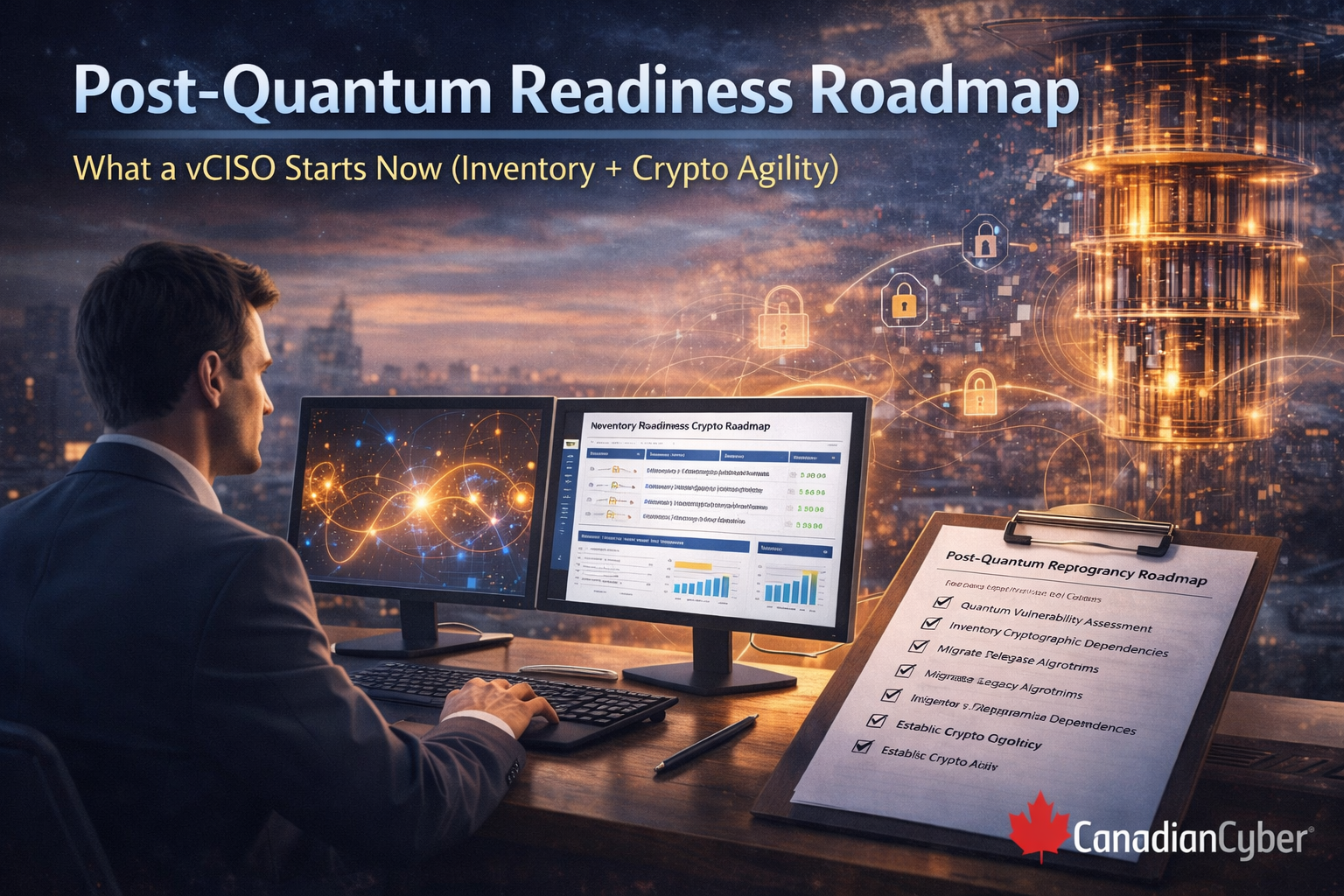
Why post-quantum readiness starts earlier than people think
Even if large-scale quantum decryption is not happening tomorrow, the risk timeline is not only about the future “break moment.” It is also about what gets collected today and becomes readable later.
Why this matters now
The concern often described as harvest now, decrypt later matters most for data with long confidentiality requirements:
- research IP
- strategic plans
- sensitive personal data
- long-lived telemetry
- defense and critical infrastructure information
the work you should start now is mostly organizational, not mathematical.
The vCISO roadmap: two tracks that run in parallel
A practical readiness program runs on two tracks at the same time:
Track A: Crypto Inventory
Know where cryptography lives, what protects what, and where the biggest crypto debt sits.
Track B: Crypto Agility
Make change safe, measurable, reversible, and repeatable so future updates do not become rewrite projects.
Track A — Crypto Inventory
Step 1: Define what “crypto inventory” includes
A useful inventory is much broader than TLS certificates. If you only inventory public certs, you will miss the systems that are hardest to change later.
| Inventory category |
Examples |
| TLS everywhere |
apps, APIs, internal services, VPNs, device-to-cloud paths |
| Key management |
KMS, HSMs, access control, rotation workflows |
| Certificates |
public certs, internal PKI, device certs, mTLS |
| Identity |
OIDC, SAML, token signing, signing keys |
| Code signing |
firmware signing, container signing, CI/CD signing keys |
| Data at rest |
databases, storage, backups, archives |
| Messaging |
queues, brokers, signed messages, secure transport |
| Third parties + hard-coded crypto |
vendors terminating TLS, embedded crypto, custom crypto code |
Step 2: Build a Crypto Register
A vCISO usually starts with one clear register in SharePoint or a spreadsheet. It does not need to be perfect on day one. It needs to be useful.
Minimum columns
- system or service name
- owner team
- data sensitivity
- crypto use case
- algorithms or protocols, if known
- key or cert location
- rotation cadence
- dependencies such as vendors, libraries, or hardware
- change difficulty: low, medium, high
- notes and known constraints
Rule:
do not wait for perfect detail. Get broad coverage first, then refine.
Step 3: Prioritize the crown-jewel paths
Eventually you want broad coverage, but the first pass should target the data and systems with the longest confidentiality horizon and the highest impact if change becomes urgent later.
Start here first
- customer authentication and session systems
- API gateways and internal service meshes
- device identity, provisioning, and mTLS
- research IP repositories and encrypted archives
- backups and long-term storage
- VPN and remote admin pathways
- data that must remain confidential for 5–10+ years
Step 4: Identify high-risk crypto debt
Once the inventory starts filling in, the risky patterns usually become obvious very quickly.
Common crypto debt flags
- legacy TLS or unnecessary protocol support
- long-lived certificates with weak rotation discipline
- shared keys or shared device identities
- custom crypto implementations
- hard-coded keys or secrets in code
- vendors terminating TLS without visibility
- unknown ownership of certs or signing keys
What you get
A prioritized risk list leadership can actually fund, not a vague “post-quantum” idea with no operational anchor.
Quick win
If you do nothing else this quarter, build the first version of the crypto register. Visibility is what unlocks every other readiness step.
Track B — Crypto Agility
Post-quantum readiness succeeds when you can change cryptography safely. That is what agility means in practice.
Step 1: Establish crypto standards and decision ownership
Start with lightweight governance, not a giant program.
A practical Crypto Standard should define
- approved protocols and minimum versions
- key sizes and rotation expectations
- where keys may be stored
- how signing keys are protected
- what is prohibited, such as weak protocols, shared secrets, or custom crypto
Governance should also define: who approves standards, who approves exceptions, and how staged changes are rolled out.
Step 2: Centralize key management where feasible
If keys and certificates are scattered across laptops, scripts, shared drives, or ad hoc repos, crypto agility becomes nearly impossible.
Practical goals
- move toward KMS or HSM-backed keys where possible
- reduce keys stored on endpoints or in code
- restrict access to signing and encryption keys
- make rotation visible and measurable
Step 3: Build swapability into critical services
Crypto agility is strongest when services can change algorithms or libraries without requiring a full redesign.
Engineering patterns
- use abstraction layers around crypto libraries
- make algorithm choice configuration-driven where safe
- support rollback paths
- create test harnesses for crypto-related changes
Goal
A crypto change should behave like a controlled release, not a major rewrite project.
Step 4: Make low-regret improvements now
You do not need to choose post-quantum algorithms today to improve readiness meaningfully.
Useful low-regret moves
- reduce legacy TLS versions and weak ciphers
- improve certificate lifecycle automation
- enforce mTLS on sensitive service-to-service paths where appropriate
- remove custom crypto and standardize libraries
- strengthen signing key protection in CI/CD and firmware workflows
Step 5: Assess vendor and dependency readiness
A large part of your readiness will depend on systems you do not fully control.
Vendor checklist
- Which vendors terminate TLS or handle encrypted data?
- Do they have a PQ or crypto-agility roadmap?
- Can they support certificate, mTLS, and KMS-related changes?
- What is your exit or migration path if they cannot?
Phase 3 — PQ transition planning
Once inventory and agility foundations exist, transition planning becomes much safer and far less speculative.
What you can plan more confidently
- which systems should support PQ first
- where hybrid approaches may be needed
- device and edge constraints
- performance impacts and rollout sequencing
- test strategies and customer communications
What to report to leadership
A vCISO makes this measurable so it becomes a program leadership can actually oversee.
Quarterly board or management update
- % of critical systems with crypto inventoried
- number of high-risk crypto debt items identified and remediated
- certificate and key rotation maturity
- critical vendors assessed for PQ readiness
- top blockers such as legacy devices, embedded systems, or vendor gaps
- next 90-day plan
Common mistakes and how to avoid them
Common mistakes
- treating PQ readiness as a tool purchase
- waiting for perfect standards before acting
- ignoring devices, firmware, and signing keys
- assuming vendors will solve it all
Better approach
- start with inventory, governance, and agility
- improve crypto hygiene now
- treat signing and embedded paths as first-class risks
- track vendor readiness and keep exit options visible
Next step
If you want to start post-quantum readiness without slowing engineering, begin with visibility and change discipline.
Final takeaway
Post-quantum readiness is not about making dramatic technical swaps too early. It is about becoming an organization that knows where crypto lives, knows what is hard to change, and knows how to change it without breaking production.
That is why a vCISO starts with inventory and agility first. Those two tracks create the foundation for every future standards shift, customer demand, or regulatory push.
In one line
Good post-quantum readiness starts now by making crypto visible, governable, and swappable.
Follow Canadian Cyber
Practical cybersecurity + compliance guidance: