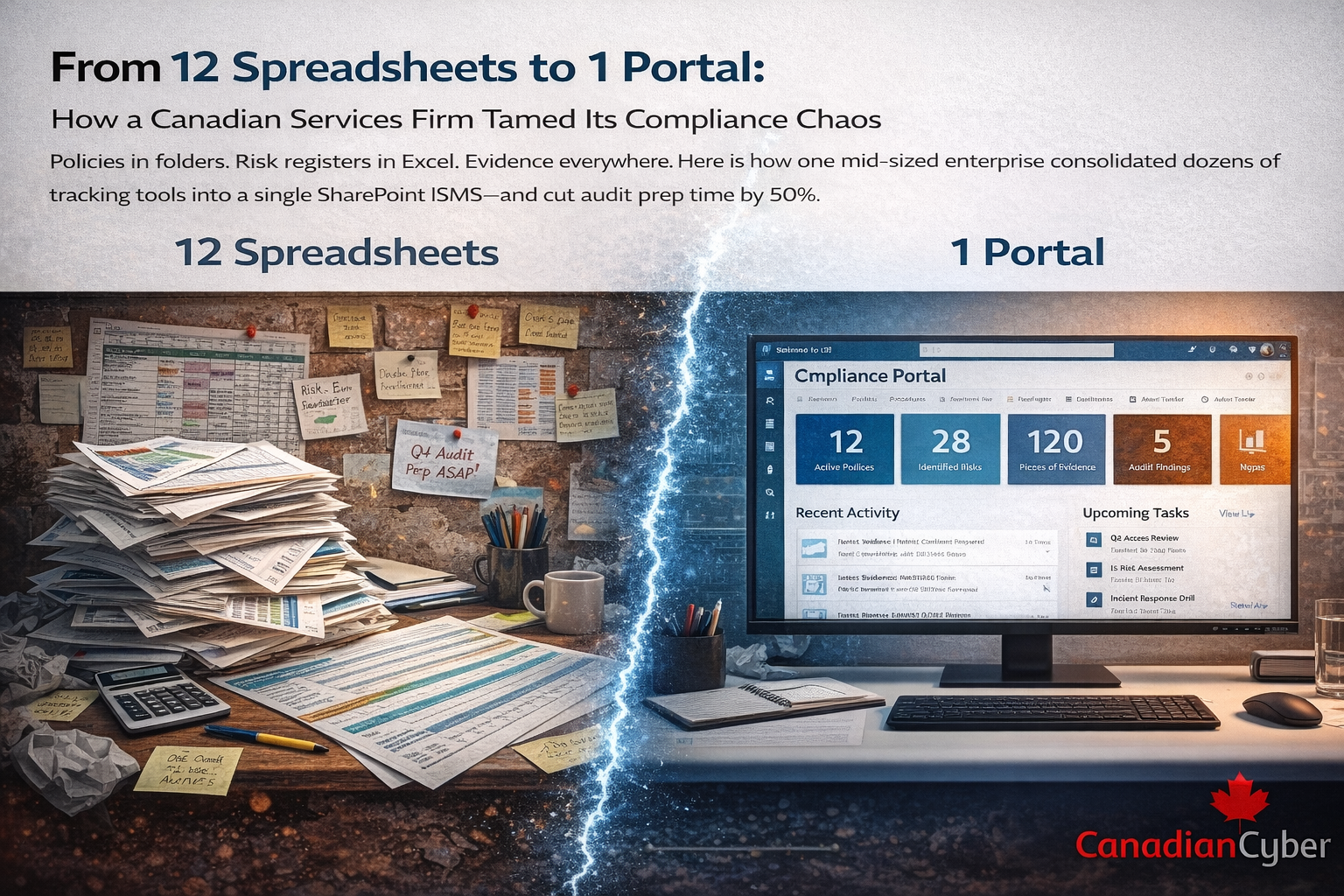
From 12 Spreadsheets to 1 Portal: How a Canadian Services Firm Tamed Its Compliance Chaos
Policies in folders. Risk registers in Excel. Evidence everywhere. Here is how one mid-sized enterprise consolidated dozens of tracking tools into a single SharePoint ISMS and cut audit prep time by 50%.
The Problem Wasn’t the Deadline. It Was the Spreadsheets.
“Please provide the latest approved access control policy and evidence of its last review.”
It seemed like a simple request. The kind auditors make every day.
For the compliance lead at a mid-sized Canadian professional services firm let’s call them North Ridge Consulting it triggered a three-day nightmare.
Which version was final? (There were seven in the folder.)
Who approved it? (The filename said “approved,” but there was no timestamp.)
Was it reviewed on time? (The review date was buried in someone’s calendar.)
By the time the evidence was assembled, the auditor had moved on to the next request and trust had eroded.
This wasn’t a failure of effort. It was a failure of systems.
North Ridge Consulting had everything a growing firm needs: ISO 27001 certification, a dedicated compliance team, and well-intentioned employees.
But their ISMS ran on 12 spreadsheets, 4 shared drives, and countless email chains .
And it was starting to crack.
Company Snapshot
| Detail | Information |
| Industry | Professional Services (Consulting) |
| Size | 200–300 employees |
| Frameworks | ISO 27001, SOC 2 |
| Compliance team | 2 full-time + fractional support |
| Before state | Spreadsheets, folders, email |
| After state | SharePoint ISMS portal |
The Breaking Point
The moment of truth came during an internal audit prep session. A simple request for access control evidence took three people and two days to fulfill .
Leadership gathered for a post-mortem.
The compliance lead said: “We have the evidence. We just can’t find it.”
The IT manager said: “We spend more time documenting than securing.”
The CFO asked: “How much is this costing us in productivity?”
No one had a good answer. But everyone knew the number was too high.
The firm faced a choice: buy an expensive GRC tool, or build something inside the Microsoft 365 tools they already owned .
They chose the latter and partnered with Canadian Cyber to make it happen .
The “Before” State: 12 Spreadsheets and Chaos
Before the transformation, North Ridge’s compliance program ran on:
| Tool | Purpose | Problem |
|---|---|---|
| Excel (6 files) | Risk register, evidence logs, asset inventory | No version control, only one owner could edit |
| Shared drives | Policy storage | Duplicates, no approval tracking |
| Approvals, reviews, communication | No audit trail, lost in inboxes | |
| Word docs | Procedures, guidelines | Unknown versions, no ownership |
| Calendars | Review reminders | Missed dates, no escalation |
| Individual hard drives | Evidence storage | Inaccessible to auditors, no backup |
The hidden cost: Compliance tasks that should have taken minutes took hours. Evidence that should have been centralized was scattered. And every audit began with panic .
The real cost: Leadership estimated the team spent 20–30 hours per month just managing compliance not improving it .
The Decision: Build Inside Microsoft 365
North Ridge evaluated several options:
- Standalone GRC tools: Powerful but expensive and required separate logins
- More spreadsheets: Cheap but already failing
- SharePoint ISMS: Leveraged existing Microsoft 365 licenses, integrated with Teams, and kept data inside their tenant
They chose the SharePoint route and engaged Canadian Cyber to design and deploy an ISMS portal aligned to ISO 27001 and SOC 2 .
The Implementation: From Files to a Living ISMS
Phase 1: The Portal (Week 1–2)
Canadian Cyber built a dedicated SharePoint site that became the single source of truth for everything compliance :
- Policies and procedures in controlled libraries
- Risk register as a SharePoint list (no more Excel)
- Evidence repository organized by control
- Audit findings tracker
- Management review archive
Navigation was designed around how teams actually work—not how auditors think .
Phase 2: Policy Management (Week 3–4)
The policy library was transformed :
| Before | After |
|---|---|
| Folders with unknown versions | Version history enabled |
| No clear owners | Owner column required |
| Review dates in calendars | Review date metadata + automated alerts |
| Email approvals | Approval workflows in SharePoint |
| Manual acknowledgements | Read confirmation tracking |
What changed: Policy reviews stopped being calendar guesses and became automatic workflows .
Phase 3: Risk Register Goes Live (Week 5)
The Excel risk register passed between team members for years—was replaced with a SharePoint list .
New capabilities:
- Risks categorized by severity, owner, and status
- Real-time views (Critical risks, Risks by owner)
- Historical tracking (no more overwritten files)
- Links to controls and evidence
The impact: Leadership could now see risk posture at a glance without asking for an updated spreadsheet .
Phase 4: Evidence That Takes Care of Itself (Week 6–8)
The biggest win was evidence management .
Instead of scrambling before audits, evidence was collected continuously:
| Evidence Type | Before | After |
|---|---|---|
| Access reviews | Emailed spreadsheets | Quarterly workflow + auto-stored |
| Training records | Manual tracking | LMS integration via Power Automate |
| Vulnerability scans | Screenshots saved randomly | Auto-export to evidence folder |
| Policy acknowledgements | “We think everyone read it” | Timestamped records per employee |
The shift: Evidence collection went from “audit-time panic” to a predictable routine .
Phase 5: Collaboration Without Chaos (Week 8–10)
Permissions were configured so that :
- Control owners could edit their evidence
- Auditors could read everything
- Leadership saw dashboards, not raw data
- Employees could acknowledge policies in one click
IT, HR, Operations, and Leadership now worked in the same portal without stepping on each other’s toes .
The “After” State: One Portal, Endless Visibility
Twelve months after implementation, North Ridge’s compliance program looked entirely different.
Quantitative Results
| Metric | Before | After | Improvement |
|---|---|---|---|
| Audit prep time | 3–4 weeks | 1–2 weeks | 50% reduction |
| Policy review compliance | ~60% | 100% | Zero missed reviews |
| Evidence collection | Manual scramble | Continuous | 70% less manual effort |
| Risk register updates | Quarterly | Real-time | Always current |
| Internal audit duration | 5 days | 3 days | 40% faster |
| Stakeholder fatigue | High | Low | Teams work in parallel |
Qualitative Results
From the Compliance Lead:
“For the first time, ISO 27001 feels manageable—not overwhelming. We stopped chasing documents and started improving security.”
From the IT Manager:
“Auditors noticed immediately. Evidence was consistent, approvals were traceable, and ownership was clear. They spent less time auditing our process and more time validating our controls.”
From the CEO:
“I used to dread security questionnaires from enterprise prospects. Now I send them a link to our trust portal. Deals move faster.”
The Metrics That Matter
Beyond the operational wins, North Ridge tracked business outcomes:
| Outcome | Result |
|---|---|
| Enterprise deals unblocked | 3 deals previously stalled by security questions closed within 6 months |
| Cyber insurance premium | Reduced by 12% after demonstrating structured program |
| Employee confidence | 88% of employees reported feeling “confident” in security roles (up from 41%) |
| Leadership visibility | Real-time dashboard replaced quarterly update meetings |
The bottom line: The SharePoint ISMS paid for itself in the first enterprise deal it helped close .
Why It Worked: The Canadian Cyber Difference
North Ridge didn’t just buy a template. They partnered with Canadian Cyber to build a system designed for how compliance actually works .
| Need | Solution |
|---|---|
| Structure | One portal, one navigation, one source of truth |
| Automation | Reviews, approvals, reminders all automated |
| Visibility | Ownership, status, progress visible to leadership |
| Audit readiness | Evidence collected continuously, not during panic |
| Scalability | Designed to grow with the business (more employees, more frameworks) |
The 3 Lessons Every Growing Company Should Learn
1. Spreadsheets Don’t Scale
They work for 20 employees. They fail at 200 . The cost isn’t the software—it’s the hours your team spends wrestling with versions, chasing approvals, and hunting for evidence .
2. You Already Own the Tools
Most mid-sized companies already pay for Microsoft 365. The question isn’t whether to buy new software—it’s whether to configure what you already have .
3. Culture Follows Structure
When systems are messy, compliance feels like a burden. When systems are clean, compliance becomes part of how work gets done . North Ridge’s 88% employee confidence score didn’t come from training—it came from clarity.
Is Your Compliance Program Ready for a Transformation?
You don’t need to wait for an audit near-miss to make a change.
Ask yourself:
- Can you find your current approved policies in under 60 seconds?
- Do you know which controls are owned by whom?
- Is your evidence collection continuous or chaotic?
- How much time does your team spend managing compliance vs. improving it?
If the answers make you uncomfortable, you’re in good company. Most growing companies feel the same way.
The difference is what they do next.
The 15-Minute ISMS Assessment
You do not need to guess whether your compliance systems are ready to scale.
Book 15 minutes with our team.
We will review your current tools, processes, and pain points.
We will tell you:
- How much time your team is losing to manual compliance work
- One workflow you can automate this week that saves 10+ hours/month
- What a SharePoint ISMS would look like for your specific business
This is not a sales pitch. It is a diagnostic.
Because the best time to fix your compliance systems was before the next audit.
About Canadian Cyber
Canadian Cyber helps mid-sized enterprises transform compliance from chaos to clarity. We design SharePoint-based ISMS portals that centralize policies, automate evidence, and keep teams audit-ready year-round.
We don’t sell software. We sell structure.
Let’s build yours.
Results Snapshot
| Metric | Before | After |
|---|---|---|
| Audit prep time | 3–4 weeks | 1–2 weeks |
| Policy review compliance | ~60% | 100% |
| Evidence collection | Manual | Continuous |
| Enterprise deals unblocked | 0 | 3 |
| Employee confidence | 41% | 88% |
| Stakeholder fatigue | High | Low |