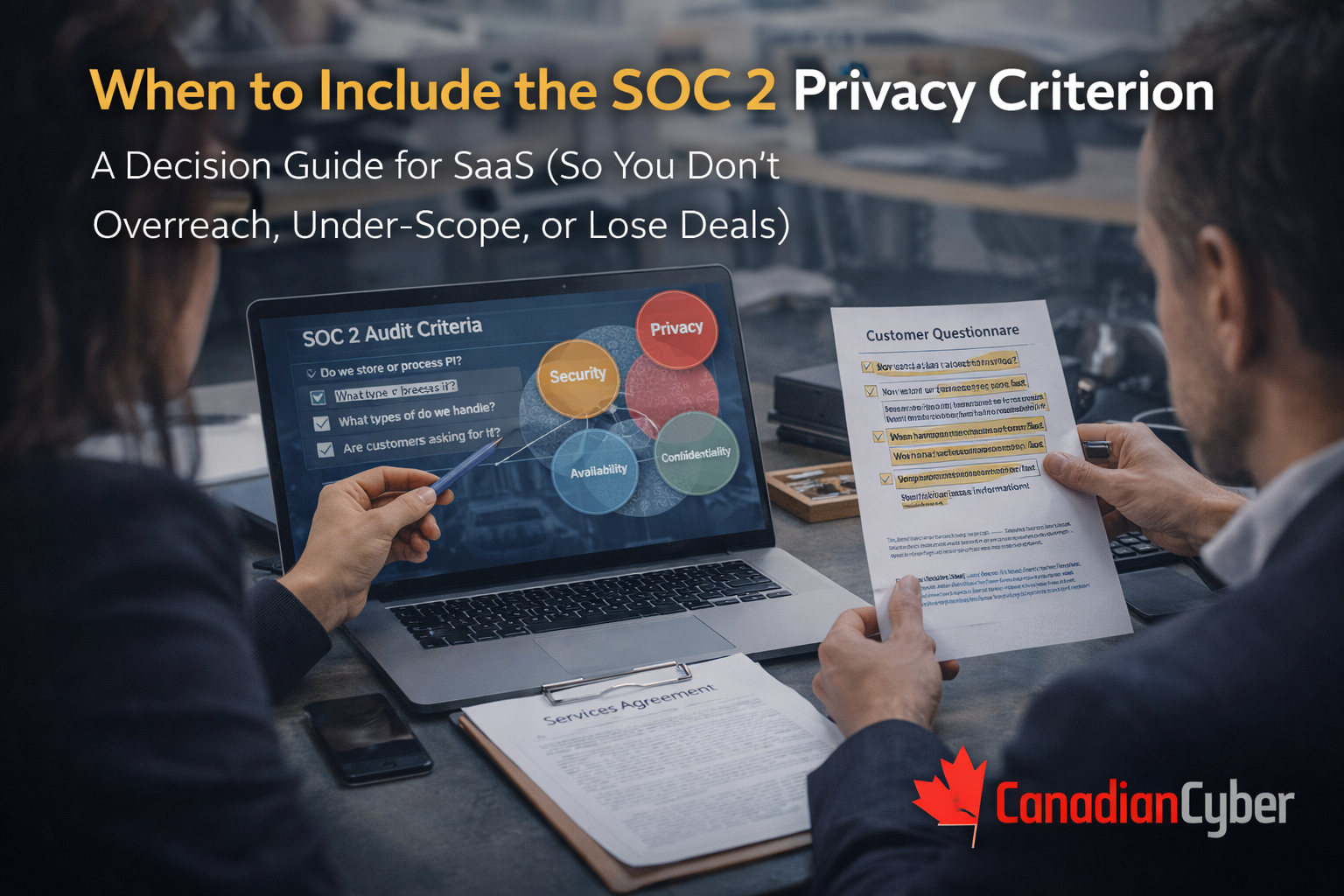
First: what SOC 2 Privacy actually means
SOC 2 Privacy is not just “we care about privacy.” It is about whether your privacy program is operational, documented, and provable.
If you include Privacy, auditors will expect you to show that you:
- collect personal information appropriately
- use it only for stated purposes
- disclose or share it appropriately
- retain and dispose of it according to commitments
- provide access or correction mechanisms where your commitments require them
Plain-English takeaway:
including Privacy means auditors will test more than security controls. They will test privacy governance and lifecycle controls too.
The decision framework
Ask these five questions first. For most SaaS companies, the answers make the decision much clearer than debating Privacy in the abstract.
1) Do you process personal information beyond basic business contact data?
Privacy becomes more relevant when the product handles meaningful personal information, sensitive categories, or large volumes of person-linked data.
Examples that push you toward Privacy
- HR data, employee records, applicant data
- student data in EdTech
- health-related or leave-related data
- consumer identifiers and device IDs tied to individuals
- recordings, transcripts, support attachments with PII
- location data, biometrics, identity verification, or KYC data
2) Are buyers explicitly asking for privacy controls, not just security?
Repeated privacy questions are a strong market signal. They often mean buyers care about privacy assurance whether you intended to scope it or not.
Common signals
- customers requesting your DPA and privacy addendum
- procurement asking about deletion proof, retention schedules, or data subject requests
- buyers asking whether you use their data for analytics or AI training
- public sector, healthcare, education, or regulated buyers asking privacy questions early
3) Are you making privacy commitments that go beyond “industry standard”?
Many SaaS companies already make strong privacy promises in contracts, privacy notices, and sales language sometimes without realizing those promises create an assurance expectation.
Examples of commitments that may point toward Privacy
- “We only use customer data to provide the service”
- “We delete customer data within X days”
- “We don’t sell or share data”
- “We support data access and deletion requests”
- “We restrict subprocessors and notify on changes”
- “We store data in Canada or in a specific region”
4) Do you have a real privacy operating model?
Including Privacy credibly requires more than a policy. It requires operational capabilities that can be demonstrated consistently during the audit period.
Capabilities you usually need
- data inventory and classification
- retention schedule and deletion workflows
- subprocessor governance
- privacy incident assessment
- request handling processes aligned to your commitments
What happens if these are weak
Privacy can slow the audit, expand testing significantly, and create avoidable exceptions or partial results.
5) Does adding Privacy expand scope dramatically?
Privacy often expands what auditors will sample: more processes, more records, more subprocessor detail, and more legal alignment work. If you need SOC 2 quickly to unblock sales, adding Privacy can be scope overreach unless demand is clear.
Mid-decision checkpoint
If Privacy would add a lot of audit work but your buyers are mostly asking for Security and Availability, that is usually a sign to avoid over-scoping the first cycle.
Decision outcomes
Include SOC 2 Privacy if…
- you are in a privacy-heavy vertical such as HR tech, EdTech, health-adjacent SaaS, identity or KYC, or consumer platforms
- buyers are repeatedly blocking on privacy questions like deletion proof, retention schedules, subprocessors, or cross-border processing
- you handle sensitive PII in core workflows, not just business contact data
- you want privacy assurance as a true differentiator in enterprise or public sector deals
Consider deferring SOC 2 Privacy if…
- you are B2B SaaS with limited personal data and little or no sensitive PII
- your main buyer requests are Security and Availability, not privacy governance
- you do not yet have operational privacy workflows that can stand up to sampling
- you are prioritizing speed to Type II and want to keep the first cycle focused
The middle path that works for most SaaS
Many SaaS companies do not need to include Privacy to satisfy buyers—if they build a strong privacy trust layer outside the audit scope.
What to keep in scope
SOC 2 Security, and sometimes Confidentiality if the data profile supports it.
What to build outside the audit
- DPA readiness
- subprocessor list
- retention and deletion statement
- AI use disclosure
- incident notification approach
Important:
make sure your public and contractual claims match what you can actually prove. Do not imply privacy assurance scope you do not have.
What changes if you include Privacy
If you include SOC 2 Privacy, expect the audit to become broader and more operational. It will no longer be just a security audit with privacy language around it.
| Area auditors may test |
What that means in practice |
| Notice and consent |
review of how your commitments are communicated and honored |
| Data use limitations |
testing whether use is limited to stated purposes |
| Retention and deletion |
sampling retention schedules and deletion evidence |
| Disclosure controls |
subprocessors, sharing rules, and disclosure governance |
| Request handling |
testing request workflows where your commitments require them |
| Privacy incident assessment |
review of privacy incident decision-making and documentation |
Quick self-assessment
Answer these ten questions yes or no. This is a fast way to sense whether Privacy is worth serious consideration now.
- Do we store employee, student, patient-like, or other personal records?
- Do we store files or uploads that often contain personal data?
- Do we have a formal retention schedule by data type?
- Can we prove deletion on request with tickets, logs, or certificates?
- Do we have a subprocessor register with change notifications?
- Do we process data outside the customer’s region or outside Canada and disclose it?
- Do we have a documented process for privacy incidents and threshold assessment?
- Do buyers ask privacy questions as often as security questions?
- Do we have a DPA that makes strong privacy commitments?
- Would winning public sector or regulated deals materially change revenue?
If you answered Yes to 6+
Privacy is worth serious consideration.
If you answered Yes to 0–3
Start with Security, and possibly Confidentiality, while building privacy trust assets outside the audit.
Next steps
If you are unsure whether Privacy belongs in your next SOC 2 cycle, the safest move is to decide based on data reality, buyer demand, and operational readiness—not assumption.
Final takeaway
SOC 2 Privacy is not automatically required and it is not automatically optional. It is a scope decision that should match your product’s data reality, your customer commitments, and the maturity of your operating model.
The strongest decision is the one you can explain clearly to buyers. If you include Privacy, it should be because you can support it credibly. If you defer it, you should still have a privacy trust layer strong enough to answer the questions customers actually ask.
Include SOC 2 Privacy when your data, promises, and buyers justify it and only when your privacy operations are ready to prove it.
Follow Canadian Cyber
Practical cybersecurity + compliance guidance: