Get in touch
info@canadiancyber.ca


Rafia Rizwan

April 9, 2026
Understand the real difference between SOC 2 Type I and Type II—and which one SaaS companies need to close enterprise deals faster.
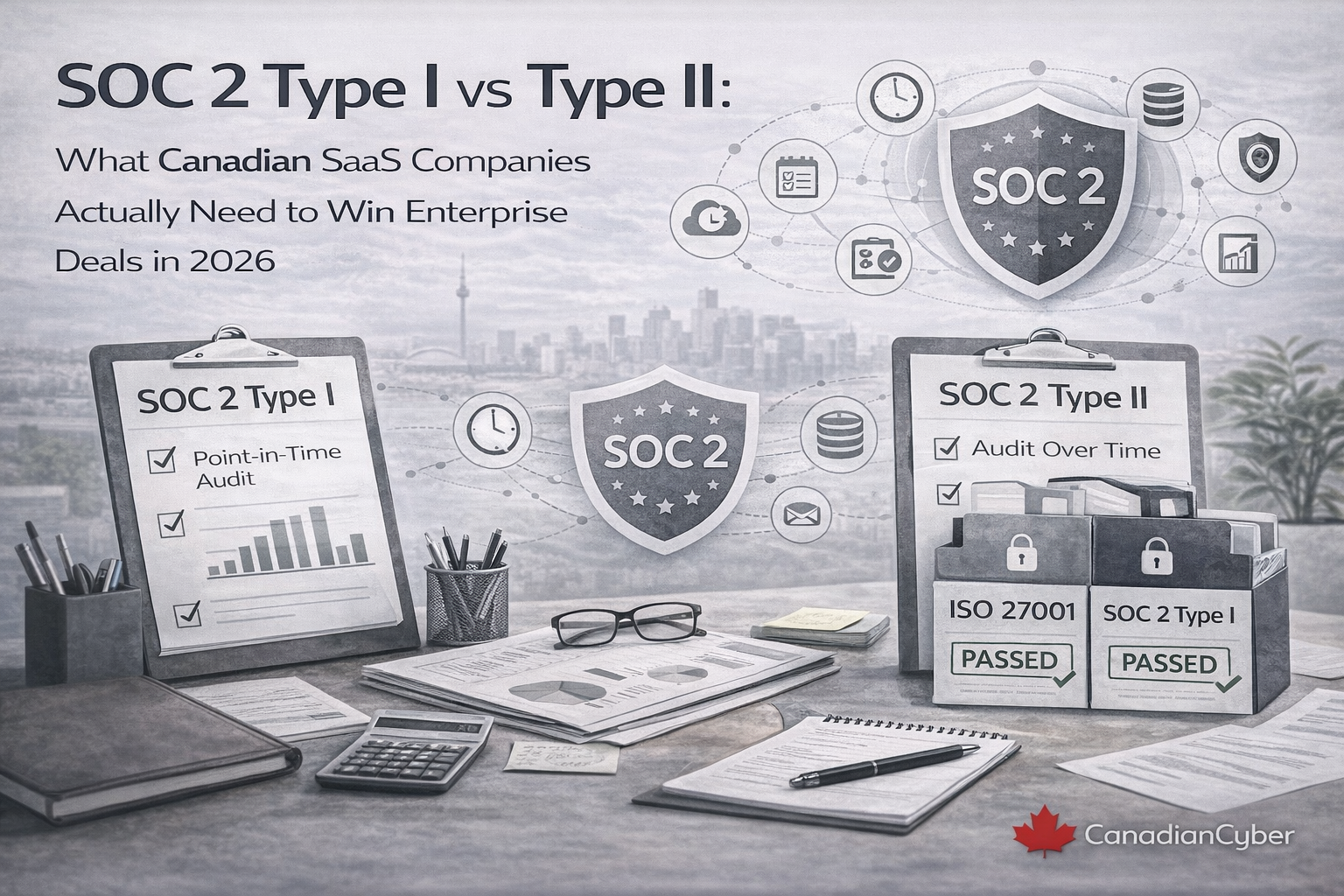
That is when the real decision lands: do you get SOC 2 Type I now, or wait for Type II? For most Canadian SaaS teams, this is not a compliance theory question. It is a revenue timing question.
This guide gives a practical, deal-focused answer. You will see when Type I is enough, when Type II is the real trust signal, and what enterprise buyers still ask for even after you have the report.
That difference matters because enterprise buyers usually care less about whether your controls exist on paper and more about whether your team can operate them consistently when nobody is watching.
Enterprise security teams usually care about three things. Can you protect their data. Can you operate reliably. And can you prove your controls run consistently.
That last point is why Type II usually becomes the real trust signal. Many buyers will accept Type I temporarily, but they often still push for Type II when the vendor touches production workflows or sensitive customer data.
Canadian SaaS vendors often sell into US enterprises, regulated Canadian sectors, and procurement teams that use SOC 2 as a standard gate. That means the decision is rarely whether you should care about SOC 2 at all. The real question is how quickly you can become buyer-ready without wasting months.
Type I makes sense when you need a fast credibility signal to unblock pipeline, especially if your control environment is newly built or still stabilizing.
| Choose Type I if | What it helps with |
|---|---|
| Active deals need a trust signal right now | Reduces questionnaire friction and keeps procurement moving |
| Controls are implemented but still early | Shows that a real control environment exists |
| You need a procurement confidence boost this quarter | Helps negotiate Type II timing into contracts |
Even with Type I, buyers still ask about pen tests, incident response, vendor lists, access reviews, backups, logging, and whether you can operate over time. So Type I is useful, but it does not end scrutiny on its own.
Type II is usually the standard enterprise trust signal because it proves controls operate over time, not just in design. This is what most larger buyers really care about.
Type II needs a defined operating period. Most teams choose a 3-month, 6-month, or 12-month window based on deal urgency and maturity.
| Operating window | What it signals |
|---|---|
| 3 months | Fastest credible option, often useful for growth-stage SaaS under pressure |
| 6 months | A common compromise between speed and maturity |
| 12 months | Strongest signal, often preferred by larger enterprise buyers |
Buyers do not buy reports. They buy confidence. That confidence usually comes from a few control areas that are easy to explain and easy to prove.
If you can prove these well, you will win more deals whether you are in Type I, Type II, or between the two.
SOC 2 stops helping sales when the report exists but evidence is scattered, controls are inconsistent, ownership is fuzzy, and customers still do not trust the answers your team gives. The report only reduces friction when the operating system behind it stays clean and current.
| Choose | If this sounds like you |
|---|---|
| Type I | You need a sales-unblocking signal in the next 30 to 90 days and your controls are newly implemented. |
| Type II | Enterprise buyers require it as a hard gate and you can operate controls consistently across the audit period. |
| Type I plus Type II path | You need deals now and stronger long-term credibility later. This is the most common best fit for growth-stage Canadian SaaS. |
For most Canadian SaaS teams, Type I is the fast credibility signal and Type II is the long-term trust signal. The better choice depends on whether your biggest problem is blocked pipeline right now or repetitive buyer friction over time.
The strongest path is usually the one that keeps deals moving now while building the evidence operating system that makes Type II meaningful later.