Get in touch
info@canadiancyber.ca


Rafia Rizwan

April 7, 2026
Discover 10 high-impact signs your startup needs a vCISO before security risks, audits, or lost deals force a rushed decision.
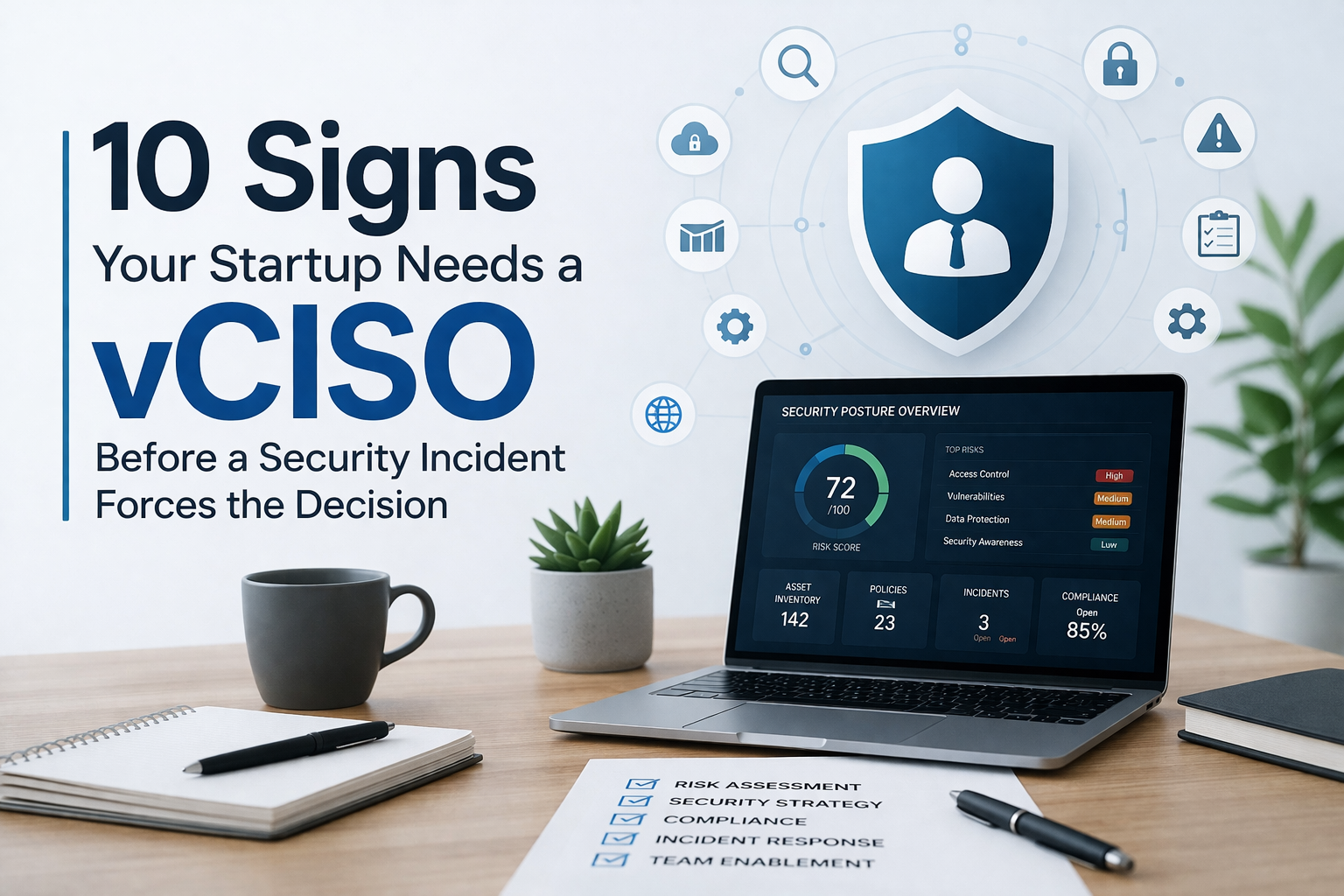
A vCISO is often the right-now leadership model when you need real outcomes such as risk ownership, evidence discipline, and incident readiness, but you are not ready for a full-time CISO hire.
Here are ten clear signs that your startup is already at the point where security leadership should become structured instead of reactive.
Startups often assume they can wait until after the next fundraise, the next enterprise customer, or the next audit request. But the real trigger is usually stress. By the time security leadership feels urgent, the company is already paying in delay, confusion, or exposure.
If enterprise deals stall because questionnaires take days, answers are inconsistent, or you cannot back claims with evidence, you do not have a tooling problem. You have a leadership and evidence system problem.
If the team cannot answer what could hurt the business most, who owns each risk, and when treatment is due, then risk is not managed. It is just discussed.
Too many admins, shared accounts, vendor access that never expires, no quarterly reviews, and no break-glass governance are all signs that access discipline is drifting.
Startups often have backups but no tested recovery path. Auditors and attackers do not care that backups exist. They care whether the business can recover fast and prove it.
If an incident happened today, would your team know who declares the incident, who talks to customers, who preserves evidence, and who makes shutdown decisions? If the honest answer is we would figure it out, you are already late.
If your startup relies on cloud providers, payment vendors, analytics tools, support platforms, outsourced DevOps, MSPs, or AI tools, but you do not have a tiered register, review cadence, tracked renewals, and recorded decisions, vendor risk is unmanaged.
If policies live in folders, evidence lives in screenshots, gaps live in random docs, and nothing runs on a real cadence, your audit will be slower and more expensive than it needs to be.
If security mostly lives in one engineer’s head, one ops spreadsheet, or a founder’s Slack history, you do not have a program. You have a single point of failure.
Fast growth quietly breaks controls. New tools appear, new repos are created, new cloud resources are provisioned, access sprawl grows, and logs stop getting reviewed. Growth without governance creates invisible risk.
If founders or the board ask whether the company is safer than last quarter, what the biggest concerns are, or what help is needed, and the answer becomes vague or tool-heavy, security will not get funded or prioritized correctly.
Waiting often means your first vCISO engagement starts under stress. Incident response is already underway, customer trust is at risk, forensic and legal costs are rising, and decisions are happening without structure.
If your startup matches three or more of the signs above, you are already at the point where vCISO leadership can pay for itself by reducing deal friction, tightening governance, and preventing expensive chaos later.
| Number of signs | What it likely means |
|---|---|
| 1 to 2 | You may still be early, but governance gaps are starting to show. |
| 3 to 5 | Security leadership is probably already overdue. |
| 6 or more | You are likely one incident, one audit, or one enterprise customer away from forced, rushed decisions. |
A vCISO is not just a cheaper CISO substitute. It is a practical leadership model for startups that need clear priorities, working governance, and proof that security is actually being managed before stress makes the decision for them.
The best time to add that structure is before the near miss becomes an incident, before the big customer walks away, and before the board asks a question the company cannot answer clearly.