Get in touch
info@canadiancyber.ca


Rafia Rizwan

April 2, 2026
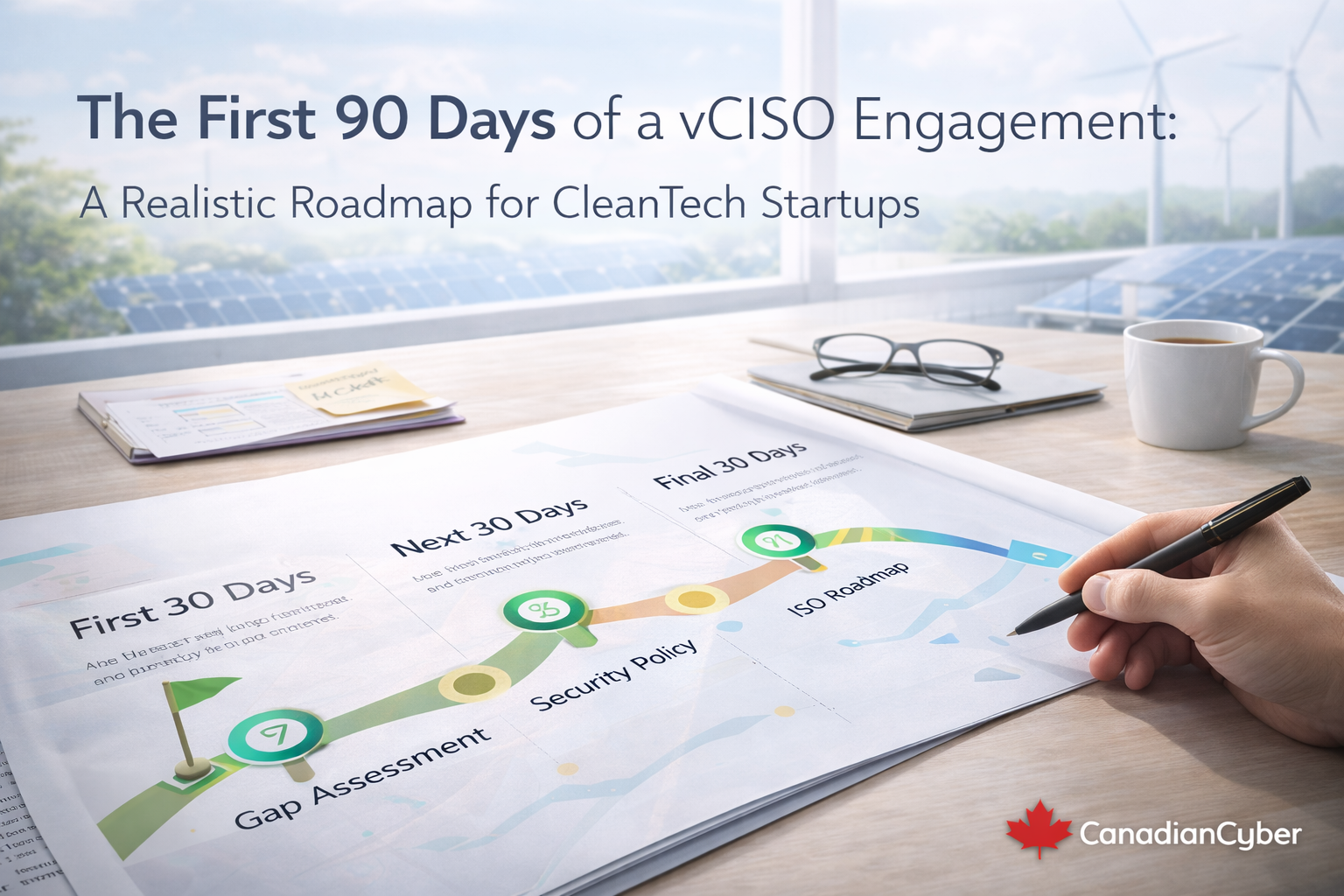
A practical vCISO 90 day roadmap for CleanTech startups. Learn how to stabilize risk, build security operations, and create audit-ready evidence quickly.
CleanTech startups face a different kind of security pressure. Many are connecting edge devices, sensors, gateways, telemetry pipelines, and cloud systems. At the same time, they are selling into utilities, municipalities, manufacturers, infrastructure operators, and other buyers who care deeply about trust.
These buyers do not only want product performance. They want to know who has access, how incidents are handled, what vendors are involved, and whether the company can produce evidence without scrambling.
That is why a vCISO engagement works best when it is run like a product sprint. Clear outcomes. Clear owners. Measurable progress. And evidence that can be reused in sales, audits, insurance reviews, and customer due diligence.
A good first 90 days does not solve every long-term security challenge. It gives the company a stable base. By the end of the period, leadership should feel less uncertainty, sales should have better trust material, and the team should know what happens monthly and quarterly.
If the engagement only produces policies and slide decks, it is drifting. A strong vCISO should create working outputs that the company can keep using after the first 90 days end.
The first two weeks should stop drift. That means setting priorities, defining the real system boundary, identifying the highest-risk paths, and tightening the access routes that matter most.
A strong vCISO starts by asking direct questions. What deals are blocked by security right now? Is the near-term goal ISO 27001, SOC 2, or simply customer due diligence readiness? Which systems are most critical to delivery?
The output should be short and practical. Usually a one-page engagement objectives note is enough. It should capture the top three outcomes, the decision owners, and the communication cadence.
CleanTech platforms often span several layers at once. There may be a device or edge layer, ingestion endpoints, cloud processing and storage, customer delivery portals or APIs, and vendor integrations that sit around the core service.
This step matters because it stops scope creep early. It also makes audits and questionnaires faster later.
The first risk register does not have to be perfect. It does have to be useful. The vCISO should focus on risks that either block revenue or create the highest incident pressure.
Even a simple register is enough at this stage, as long as each risk has an owner, a due date, a treatment approach, and a clear place where evidence will be stored.
This is often the fastest risk reducer in the whole engagement. In the first two weeks, a good vCISO will usually focus on MFA for admins, reducing admin sprawl, documenting break-glass accounts, and restricting vendor access pathways with time-bound approvals.
Once the highest-risk drift is under control, the next month should focus on evidence and cadence. This is where the program becomes usable for sales, audits, and internal decision-making.
Buyers do not want your full internal ISMS. They want a fast way to understand your security posture. A trust pack should include the system scope statement, the data types processed, where data lives, a short control summary, a high-level vendor or subprocessor list, the incident notification approach, and procurement-friendly FAQs.
This becomes one of the most reusable outputs in the whole engagement because sales and partnerships can use it early.
CleanTech stacks are usually vendor-heavy. Cloud providers, device platforms, telemetry brokers, analytics tools, support systems, MSPs, and sometimes hardware manufacturers all create dependency risk.
The output here should be a critical vendor register with tiering, assurance status, renewal dates, review cadence, and time-bound exceptions where needed. This single register often reduces a lot of questionnaire friction later.
In CleanTech, likely scenarios often include device compromise, telemetry tampering, vendor remote access misuse, cloud credential leakage, unusual export activity, and outages that affect operations. The vCISO should turn these into short, runnable scenarios instead of long unread documents.
Resilience cannot be claimed if restore capability has never been tested. By this stage, the company should have a restore-test record for at least one Tier 1 system, including restore steps, time to restore, validation checks, and follow-up actions.
This is strong evidence for both ISO 27001 and SOC 2 and gives leadership something much more credible than a verbal assurance that backups exist.
The last stretch is about making the system sustainable. This is where the engagement shifts from initial stabilization into ongoing operating rhythm.
Waiting for audit season creates scramble. A better model is to test a small set of controls every month. The output should be a simple micro-audit plan that defines the controls reviewed, the sampling rules, the evidence checklist, and the corrective action workflow.
Security becomes much easier to manage when it is predictable. A good vCISO will turn the work into a visible monthly and quarterly cadence.
| Cadence | What happens | Why it matters |
|---|---|---|
| Monthly | Log review sign-off, patch exception review, vendor changes, top 10 risk update | Keeps the program active and visible |
| Quarterly | Privileged access review, critical vendor review, tabletop or simulation, board pack update | Builds proof and keeps leadership engaged |
The output should be a twelve-month calendar with owners and reminders, not just a suggestion that reviews should happen “regularly.”
By the end of the first 90 days, the company should be ready for the next maturity phase. This usually includes a six- to twelve-month roadmap tied to revenue goals, risk reduction, and audit-readiness timelines.
A CleanTech startup should be able to point to a clear set of outputs after ninety days. These are the signs that the engagement is real and not just cosmetic.
CleanTech startups do not need a heavy security bureaucracy in the first ninety days. They need clarity, control over the most important risk paths, a rhythm the team can keep, and evidence that can be reused.
That is what a good vCISO should create early. Not just advice, but a working operating system that helps the company win trust without slowing growth.
If the first ninety days produce clear scope, stronger access control, practical incident readiness, better vendor discipline, and an evidence structure buyers can understand, the engagement is doing its job.