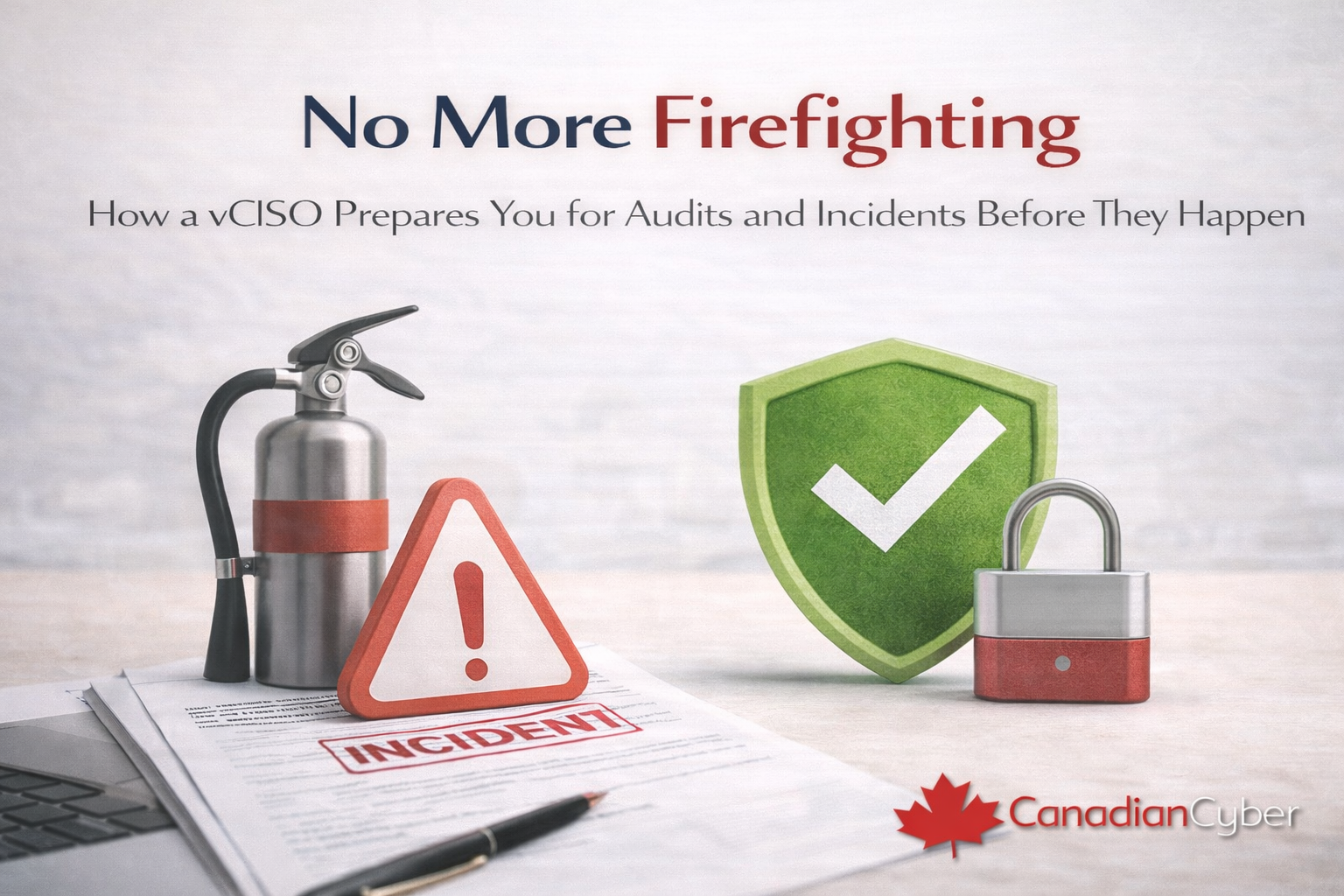
No More Firefighting
How a vCISO Prepares You for Audits and Incidents Before They Happen
Most organizations don’t fail audits or mishandle incidents because they don’t care.
They fail because they’re always reacting.
An audit notice arrives. A security alert goes off. A customer asks for proof. And suddenly, the entire organization is in firefighting mode. This is the difference between organizations with security leadership and those without it.
The Hidden Cost of Reactive Security
Reactive security looks like this:
- Policies updated days before an audit
- Incident response plans written after an incident
- Evidence scattered across emails and folders
- Teams unsure who owns what
It feels busy. It feels urgent. But it’s not effective.
Auditors, regulators, and attackers all thrive in reactive environments.
Why Firefighting Never Ends Without Security Leadership
When no one owns security at a strategic level, risks pile up silently, controls drift out of alignment,
and teams improvise instead of following plans. Every audit becomes a scramble. Every incident becomes chaos.
This is exactly the gap a Virtual CISO (vCISO) is designed to fill.
A vCISO builds structure before you’re forced to.
What a vCISO Does Differently
A vCISO doesn’t wait for things to go wrong. They design systems so things don’t spiral when they do.
Here’s how.
1) Audit readiness is built year-round (not last-minute)
- Policies are reviewed on schedule
- Controls are tested regularly
- Evidence is collected continuously
- Gaps are fixed early
Instead of asking, “Are we ready for the audit?” the organization already knows the answer.
Audits become confirmations, not surprises.
2) Incident response is planned before it’s needed
Most organizations only discover who’s responsible, how to escalate, and who to notify during an incident.
A vCISO prevents this by:
- Creating and testing incident response plans
- Defining roles, escalation paths, and decision authority
- Running tabletop exercises
- Aligning response with customer and regulatory expectations
When something happens, the response is calm, controlled, and documented.
3) Policies match reality (not just templates)
Auditors can spot “paper security” instantly. A vCISO reduces findings and real-world risk by ensuring policies
reflect actual operations and that teams understand what’s expected.
- Reviews policies against day-to-day workflows
- Aligns procedures to how teams really work
- Builds awareness so controls run consistently
4) Evidence is always audit-ready
One of the biggest firefighting triggers is: “Where’s the evidence?”
A vCISO makes evidence easy to produce because it’s managed properly from day one.
- Centralized storage for policies, logs, and approvals
- Version control and traceable sign-offs
- Clear structure so evidence is retrieved in minutes
This is where a SharePoint-based ISMS becomes a force multiplier: no scrambling, no last-minute screenshots, no guessing.
5) Leadership knows the risk before it becomes a crisis
A vCISO translates technical work into executive clarity: business risk, audit exposure, and regulatory impact.
Executives don’t want surprises they want confident answers.
- Clear status and risk posture
- Prioritized roadmap (what matters next)
- Board-ready reporting and accountability
If audits and incidents feel stressful every time, it’s not a tools problem it’s a leadership gap.
Talk to Canadian Cyber about vCISO services today.
How Canadian Cyber Eliminates Firefighting
Canadian Cyber’s vCISO services focus on proactive audit and incident readiness:
- Audit preparation (ISO 27001, SOC 2) with continuous evidence discipline
- Incident readiness: plans, roles, testing, and tabletop exercises
- Ongoing risk management and control ownership
- Executive reporting leadership understands
- ISMS automation using our SharePoint-based ISMS platform
A Common Pattern We See
| Before vCISO | After vCISO |
|---|---|
| “We’ll fix it before the audit.” | “We already tested that.” |
| “Let’s hope nothing happens.” | “Here’s our response plan.” |
| “Where’s the evidence?” | “Here it is versioned and approved.” |
Final Takeaway
Security firefighting isn’t a sign of strong teams it’s a sign of missing structure.
A vCISO replaces panic with preparation so audits and incidents stop controlling your organization.
Stay Connected With Canadian Cyber
Follow us for practical vCISO insights, audit readiness tips, and real-world cybersecurity leadership content: