Translating Tech to Business
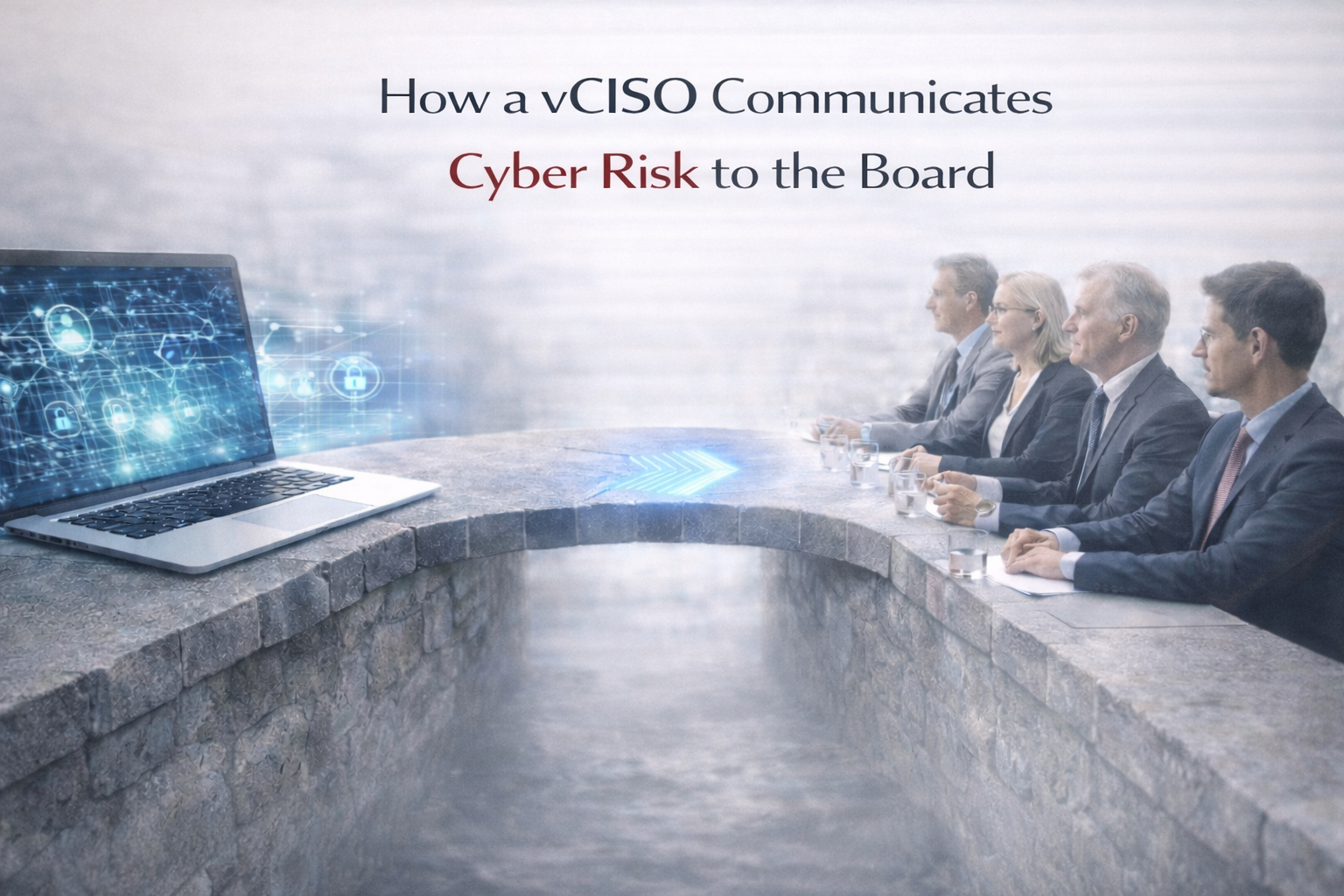
How a vCISO Communicates Cyber Risk to the Board
Boards don’t ignore cybersecurity because they don’t care.
They ignore it because they don’t understand it.
When security updates are filled with acronyms, tool names, and vulnerability scores, the message gets lost.
And when the message is lost, so is buy-in.
Common “board updates” that fail:
- Acronyms with no context
- Tool names instead of outcomes
- Vulnerability counts without impact
This is where a Virtual CISO (vCISO) changes the conversation translating cyber risk into business risk leaders can act on.
Why Board-Level Cyber Conversations Break Down
Most boards ask three simple questions:
- Are we at risk?
- What happens if something goes wrong?
- What do you need from us?
What they often receive instead:
- Tool inventories
- Technical charts without takeaways
- Long explanations with no decisions attached
That disconnect is dangerous.
Cyber risk that isn’t understood doesn’t get funded, fixed, or governed.
The vCISO Advantage: Speaking Both Languages
A vCISO sits at the intersection of technical security, compliance, business operations, and executive accountability.
Their job is not just to secure systems but to secure understanding.
The goal of board communication:
clarity, decisions, and proof not detail for detail’s sake.
1) Turning vulnerabilities into business impact
Instead of reporting counts and scores, a vCISO explains what the board needs to know: impact, likelihood, and urgency.
| Typical Update | vCISO Translation | Decision Needed |
|---|---|---|
| “We have 47 critical vulnerabilities.” | “A revenue system could be disrupted, impacting transactions and SLAs.” | Approve emergency remediation window and temporary change freeze. |
| “Vendor review is pending.” | “A third party processes sensitive data without confirmed safeguards.” | Decide: accept risk, require controls, or pause contract. |
| “We’re working on ISO.” | “Documentation is aligned; evidence coverage is at 90% with owners assigned.” | Confirm timeline and resources for Stage 1 / Stage 2. |
Boards don’t manage CVEs. They manage risk to the business.
2) Using KPIs that executives actually care about
vCISOs focus on decision-ready metrics that show progress, exposure, and accountability:
- Risk reduction over time (top risks trending down)
- Audit readiness status (ISO 27001 / SOC 2)
- Incident response maturity (tested vs. untested)
- Compliance gaps vs. regulatory exposure
- Third-party risk trends (exceptions and high-risk vendors)
3) Visual dashboards over dense reports
Long reports rarely get read. Clear dashboards get decisions.
A strong board dashboard answers: What changed? What’s the risk? What do you need from us?
- Red / amber / green risk views
- Trend lines (monthly/quarterly movement)
- “Decision needed” callouts (budget, exceptions, timelines)
4) Framing cybersecurity as governance, not IT
A vCISO positions cybersecurity as a governance obligation not a tool discussion.
That shifts cyber from “an IT expense” to “a board-level responsibility.”
Governance signals boards respect:
risk tolerance, ownership, testing cadence, and evidence discipline.
5) Aligning cyber risk with business goals
Boards care about growth, reputation, resilience, and compliance. A vCISO connects security initiatives to those outcomes:
- ISO 27001 → enterprise sales enablement
- SOC 2 → faster vendor approvals
- Incident readiness → operational resilience
Struggling to get leadership buy-in for cybersecurity?
You don’t need more tools you need better translation.
How Canadian Cyber Helps Boards See the Full Picture
Canadian Cyber’s vCISO services are designed for clarity, credibility, and audit-ready proof:
- Translate cyber risk into executive language
- Provide board-ready dashboards and reports
- Align security with ISO 27001, SOC 2, and Canadian regulations
- Use our ISMS SharePoint Platform for real-time, defensible evidence
No jargon. No panic. Just clarity.
What Happens When the Board Finally “Gets It”
Organizations with vCISO leadership typically see:
- Faster decisions
- Better funding alignment
- Stronger audit outcomes
- Fewer surprises
Cybersecurity stops being a black box and becomes a managed business risk.
Final Takeaway
Boards don’t want to become security experts. They want clear risk visibility, confident recommendations, and proof that controls work. A vCISO delivers exactly that.
👉 Translate risk. Gain trust. Drive action.
👉 Canadian Cyber helps bridge the gap between tech and the boardroom.
Stay Connected With Canadian Cyber
Follow us for vCISO insights, board-level cybersecurity guidance, and audit-ready best practices: