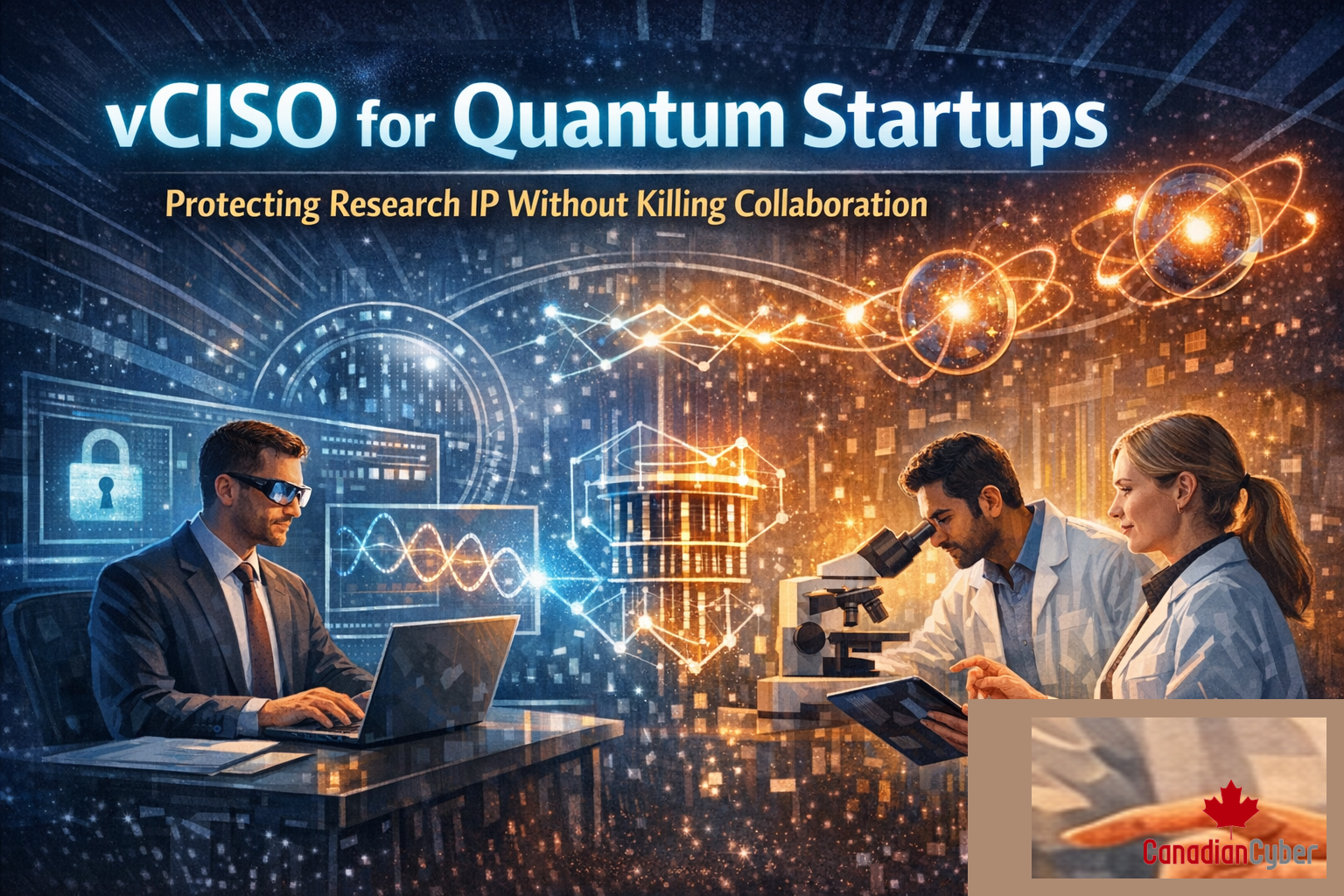
Why quantum startups are a unique security problem
Most SaaS security playbooks assume centralized cloud stacks, stable environments, and clear data boundaries. Quantum startups usually do not look like that.
What quantum startups often have
- hybrid environments across cloud, lab, and vendor hardware
- researchers working across institutions
- sensitive data in notebooks, papers, code, and experimental logs
- hardware and firmware dependencies
- vendor NDAs, export controls, and funding requirements
- collaboration tools not designed for IP containment
The biggest risk is often not ransomware. It is unnoticed IP drift: copied repos, over-shared docs, misconfigured storage, or external collaborators keeping access after a project ends.
The vCISO outcome: secure-by-governance for research environments
A vCISO does not start with buying tools. The work starts with outcomes that research teams can actually live with.
- Know what your crown jewels are and where they live
- Control access by project and sensitivity
- Reduce accidental leakage paths across sharing, exports, repos, and drives
- Make collaboration safe by default through templates, spaces, and approvals
- Create evidence for investors, partners, and future SOC 2 or ISO readiness
What counts as research IP in a quantum startup
You cannot protect what you have not defined. In practice, quantum startup crown jewels usually include:
- algorithm and error-correction research
- gate-level optimizations and compilation techniques
- device characterization methods
- calibration workflows and automation scripts
- experimental datasets, including negative results
- hardware control code and configuration
- partner NDAs and proprietary contracts
- grant documentation
- roadmaps, product strategy, and commercialization plans
Practical rule:
classify these into 3–4 useful tiers, not 12. Complexity kills adoption.
The collaboration-safe IP protection model
1) Build Project Zones instead of one big shared workspace
Many research teams still put everything into one drive, one workspace, or one GitHub org with broad access. That is convenient, but it is also how IP leaks.
vCISO model: Project Zones
- each major research stream gets its own docs, repos, experiment logs, and datasets
- access is granted by zone, not org-wide
- external collaborators only enter the relevant zone
Benefit: collaboration stays fast, but exposure is contained.
2) Use minimum viable classification
Researchers ignore classification systems that feel bureaucratic. Keep it simple and tied to handling rules.
| Tier |
Examples |
Handling idea |
| Public |
publishable content, open-source components |
may be shared deliberately |
| Internal |
day-to-day notes, non-sensitive docs |
internal sharing only |
| Confidential |
research results, code, logs, partner data |
restricted sharing and named owners |
| Restricted |
core algorithms, calibration secrets, key datasets, export-controlled material |
strictest controls, no public repos, tighter access and export rules |
3) Identity and access controls that do not annoy researchers
The goal is not maximum friction. The goal is to stop silent over-access.
Baseline controls
- SSO wherever possible
- MFA for all users, especially admins
- role-based access in repositories and document platforms
- quarterly access reviews for admins, external collaborators, and high-sensitivity zones
- automatic or checklist-driven offboarding for collaborators who come and go
If your research team still shares sensitive work through broad org access, old guest accounts, and unstructured repo permissions, the first win is usually access cleanup not more policy.
4) Safe sharing defaults
Research IP often leaks through convenience features, not malicious hacks.
Controls that work
- disable “anyone with link” for Confidential and Restricted zones
- use time-bound external access with expiry dates
- restrict downloads for the most sensitive spaces where feasible
- publish an approved collaboration tools list
- add lightweight DLP-style rules for secrets, keys, and sensitive identifiers
5) Repository governance for research code
Research code is messy, fast-changing, and sometimes meant to be shared. Governance has to respect that without leaving the org exposed.
vCISO repo controls
- public vs private is a deliberate decision
- public repos require approval and a release checklist
- branch protections for key repos
- PR review required
- CI checks enabled, even if minimal
- secret scanning turned on
- vault or secret manager for keys and tokens
- team and project-based access instead of org-wide access
Why it matters
This keeps research code usable and collaborative, but not leak-prone.
6) Treat lab and hardware environments as a separate trust zone
Lab environments often become the forgotten attack path: control PCs, hardware interfaces, remote vendor support, and data acquisition systems.
Controls that work
- segment lab networks from corporate IT
- use controlled remote access with VPN, MFA, and jump hosts
- make vendor access time-bound and approved
- log remote sessions where feasible
- apply a minimal hardening baseline to lab workstations
7) Data lifecycle controls that do not block experiments
Research produces a lot of logs, outputs, and datasets. You cannot keep everything forever, but you also cannot delete everything blindly.
Practical data lifecycle approach
- define retention by category: raw logs, derived datasets, notebooks, reports, model artifacts
- remove external access when projects end
- confirm data return or closure steps when collaborations end
- be honest about backups: data may persist until backup expiry, but access is controlled
The vCISO governance cadence that keeps it lightweight
Quantum startups do not need constant compliance meetings. They need predictable touchpoints that prevent access and sharing from silently sprawling.
Monthly
- new collaborators and access changes
- new tools introduced
- critical repo and document zone review
- key risks and exceptions
Quarterly
- privileged access review
- external collaborator review
- critical vendor and lab provider review
- risk refresh
Annually
- IP leak tabletop exercise
- vendor compromise tabletop scenario
- policy refresh
- audit readiness checkpoint
What this looks like as actual vCISO deliverables
A vCISO engagement for a quantum startup usually produces practical outputs, not paperwork for its own sake.
- Crown Jewel Map with IP inventory and locations
- research-friendly classification and handling rules
- Project Zone model for docs, repos, and datasets
- external collaborator onboarding and offboarding workflow
- GitHub or GitLab security baseline
- lab network remote access standard
- quarterly access review sprint process
- lightweight incident response runbook for IP exposure
- board and investor-ready risk reporting
Common mistakes that kill collaboration
Mistakes
- locking everything down too hard
- relying on NDAs only
- giving everyone GitHub org access
- ignoring the lab environment
Better alternatives
- safe defaults and approved collaboration zones
- technical access control plus time-bound external access
- project-based teams and public repo approvals
- segmented lab access with controlled vendor sessions
Next step
If you are a quantum startup and want to protect research IP without slowing collaboration, start by mapping the crown jewels and the top leakage paths in your current tools.
Final takeaway
Quantum startups do not need enterprise-style bureaucracy to protect research IP. They need structure where it matters: crown jewels, project zones, collaborator access, repos, lab access, and lightweight governance that actually repeats.
The strongest model is not “lock everything down.” It is “make collaboration safe by default and make exceptions visible, owned, and reviewable.”
In one line
Good vCISO work for quantum startups protects research IP by narrowing exposure, not by slowing science.
Follow Canadian Cyber
Practical cybersecurity + compliance guidance: