Get in touch
info@canadiancyber.ca


Rafia Rizwan

April 7, 2026
Learn how a vCISO helps healthcare SaaS meet PIPEDA, PHIPA, and US client security requirements without building a full security team.
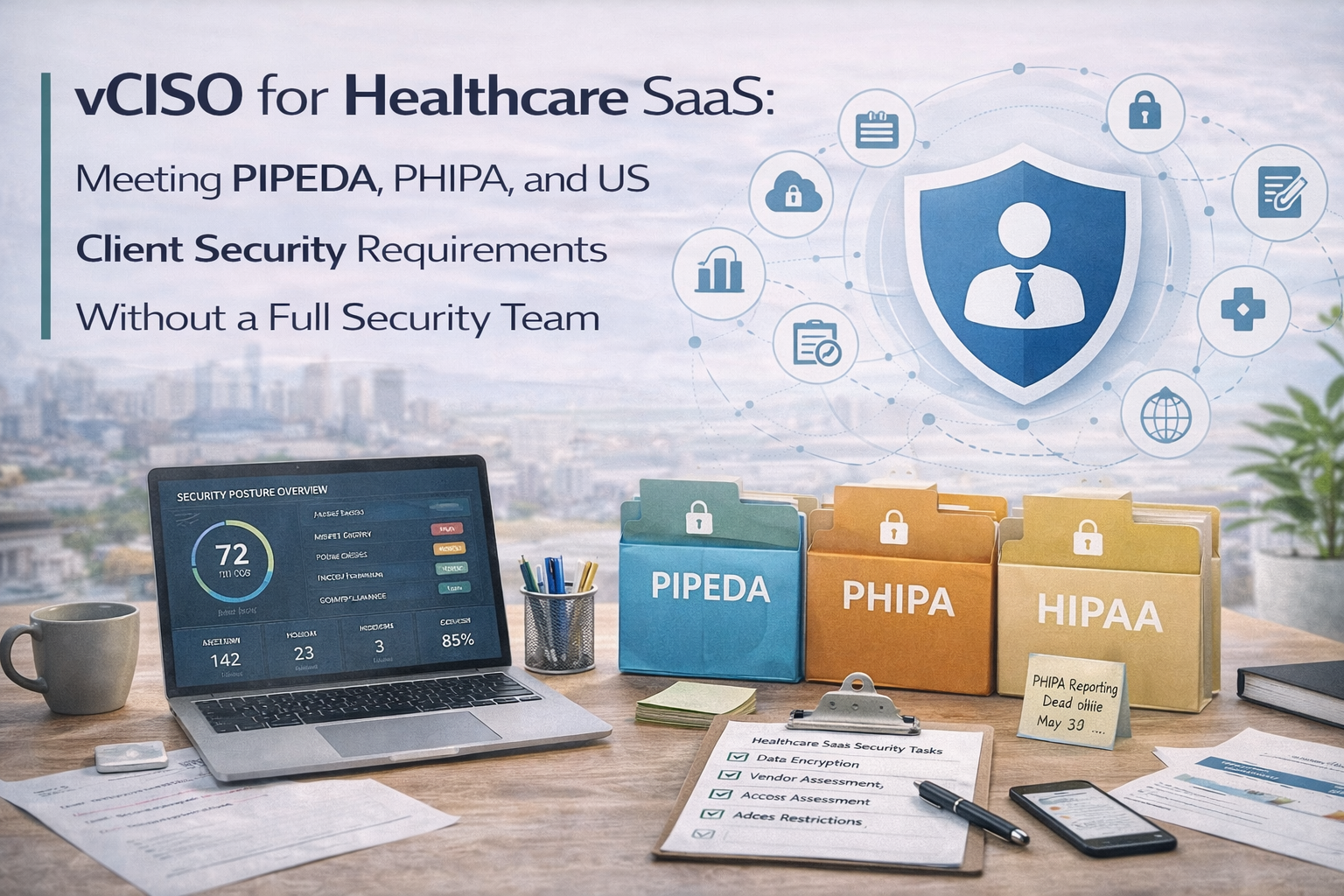
Many healthcare SaaS companies do not need a full security team yet. What they need is senior security leadership that can build a working system quickly: policies, evidence, vendor governance, incident readiness, and a trust package sales teams can actually use.
That is where a vCISO model fits best. It gives growing teams structure and proof without forcing them into a heavyweight security organization too early.
Most healthcare buyers do not reject vendors because they lack a firewall. They reject vendors because they cannot show who has access to sensitive data, how access is reviewed, how data is retained and deleted, how subprocessors are governed, how incidents are handled, and how controls operate over time.
A vCISO’s job is to make that proof real while keeping the execution model practical for a lean team.
Before writing more policies, a good vCISO makes the data picture clear. That means identifying what health data is processed, where it flows, who can access it, and where it is stored or handled across vendors and systems.
This alone makes customer questionnaires and contract conversations much easier.
Healthcare SaaS breaches often start with identity and access gaps. A vCISO focuses on the admin and vendor pathways that create the most exposure.
| Control area | What a vCISO sets up | Evidence you can show |
|---|---|---|
| Admin identity | MFA on cloud, Microsoft 365, GitHub, support tools, and all major admin paths | MFA enforcement proof and admin role export |
| Least privilege | Remove broad super-admin sprawl, limit access by function, and document break-glass accounts | Admin review sign-off and before or after access changes |
| Vendor access | Use time-bound approvals, expiry dates, and documented review cadence | Vendor approval records with expiry and review evidence |
One of the biggest healthcare buyer questions is how long you keep PHI, how deletion works, what happens in backups, and whether you can prove completion. A vCISO turns that into an operational workflow instead of a vague policy sentence.
Healthcare SaaS stacks are vendor-heavy. Cloud, analytics, messaging, support platforms, identity providers, and integration partners all need to be governed in a way buyers can follow.
This is one of the fastest ways to reduce procurement friction because buyers want clear decisions, not just vendor names.
In healthcare, incident response is not only technical. It also includes privacy impact, breach notification decisions, customer communications, evidence preservation, and post-incident improvement.
The goal is simple: if something goes wrong tomorrow, the business knows who does what and can prove it practiced.
If your sales team rewrites security answers every time a healthcare prospect asks for proof, you are losing time and credibility. A vCISO builds a reusable package that keeps answers consistent and fast.
If you already use SharePoint for your ISMS or governance work, a vCISO can make it always-ready instead of folder-heavy.
| SharePoint component | Why it matters for healthcare SaaS |
|---|---|
| Policies and procedures library | Keeps approved documents versioned and reviewable |
| Quarterly evidence packs | Makes access reviews, restore tests, log reviews, and vendor reviews easy to retrieve |
| Risk register | Keeps top risks owned and time-bound |
| Exception register | Prevents temporary gaps from becoming permanent |
| Vendor register | Supports review cadence and renewal-driven governance |
| Auditor or customer view | Lets you share proof without oversharing internal detail |
By day 90, the goal is not perfection. The goal is credibility, consistency, and proof.
Healthcare SaaS does not need a huge security department on day one. It needs a system that can survive buyer scrutiny, privacy expectations, and incident pressure without breaking the team.
A good vCISO makes that system real by turning data sensitivity, access control, retention, vendors, and incident response into proof your customers can trust and your team can sustain.