Get in touch
info@canadiancyber.ca


Rafia Rizwan

April 7, 2026
Compare vCISO, in-house CISO, and security consultants to find the best security leadership model for growing Canadian companies.
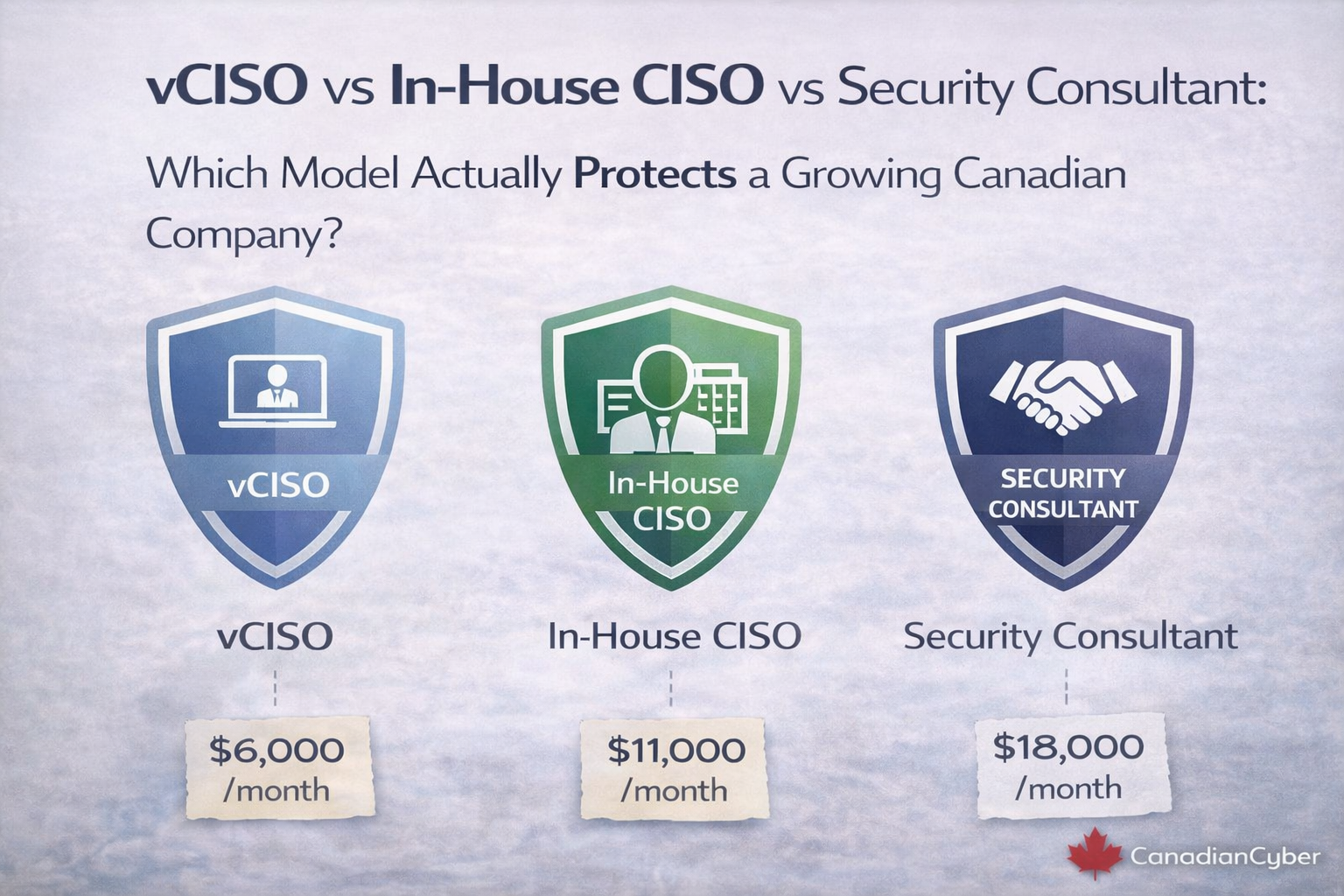
That is why the real question is not who is cheaper. The better question is which model reduces risk and increases trust fastest with the team you actually have right now.
This guide breaks down the three common options for growing Canadian companies: vCISO, in-house CISO, and security consultant. The goal is not theory. It is to help you pick the model that produces the most protection as you scale.
Each option can be valuable. The problem is that many companies buy the wrong thing for the problem they actually have.
Across Canadian SaaS, MSPs, fintechs, and service firms, protection does not come from titles alone. It comes from a few operating outcomes showing up consistently.
A strong vCISO protects you best when you need leadership and governance that pushes execution forward, but you do not need a full-time executive yet.
| Area | What a strong vCISO does |
|---|---|
| Best when | Deals are getting blocked, ISO 27001 or SOC 2 is active, vendor governance and incident readiness are needed now, and engineering or IT exists but lacks senior direction. |
| Strong deliverables | Auditable risk register, treatment plans, expiring exceptions, vendor tiering, incident runbooks, internal audit sampling, board packs, and organized SharePoint evidence packs. |
| Where it can fall short | If the company needs daily executive influence, a growing security team, or expects one part-time leader to do all execution without internal owners. |
An in-house CISO protects you best when security is becoming an everyday executive function and the organization is ready to support a real program team.
Consultants protect you best when you need a defined technical or assessment-based outcome quickly and already have someone who will own the operational follow-through.
The limitation is straightforward. If you rely on consultants alone, you often get a report but no cadence, recommendations but no ownership model, and improvements but no verification loop.
The easiest way to choose is to stop thinking about titles and start thinking about the missing piece in your current model.
For many mid-market Canadian companies, the most practical path is staged rather than permanent from day one.
| Phase | What happens |
|---|---|
| Phase 1: vCISO for 3 to 12 months | Build governance, evidence, vendor program, incident readiness, and a repeatable SharePoint-based system. |
| Phase 2: hire a security lead or manager | Create day-to-day execution capacity while the vCISO stays strategic and board-facing. |
| Phase 3: in-house CISO later | Move to a full executive security function once scale and complexity clearly demand it. |
This approach avoids hiring too early while still getting real protection now.
The best model is not the one with the most prestige. It is the one that gives your company the missing layer fastest, whether that is leadership, daily influence, or specialist depth.
For many growing Canadian companies, that means starting with a vCISO who builds structure and proof, adding execution capacity next, and hiring a full-time CISO when the business is truly ready for that level of daily security leadership.