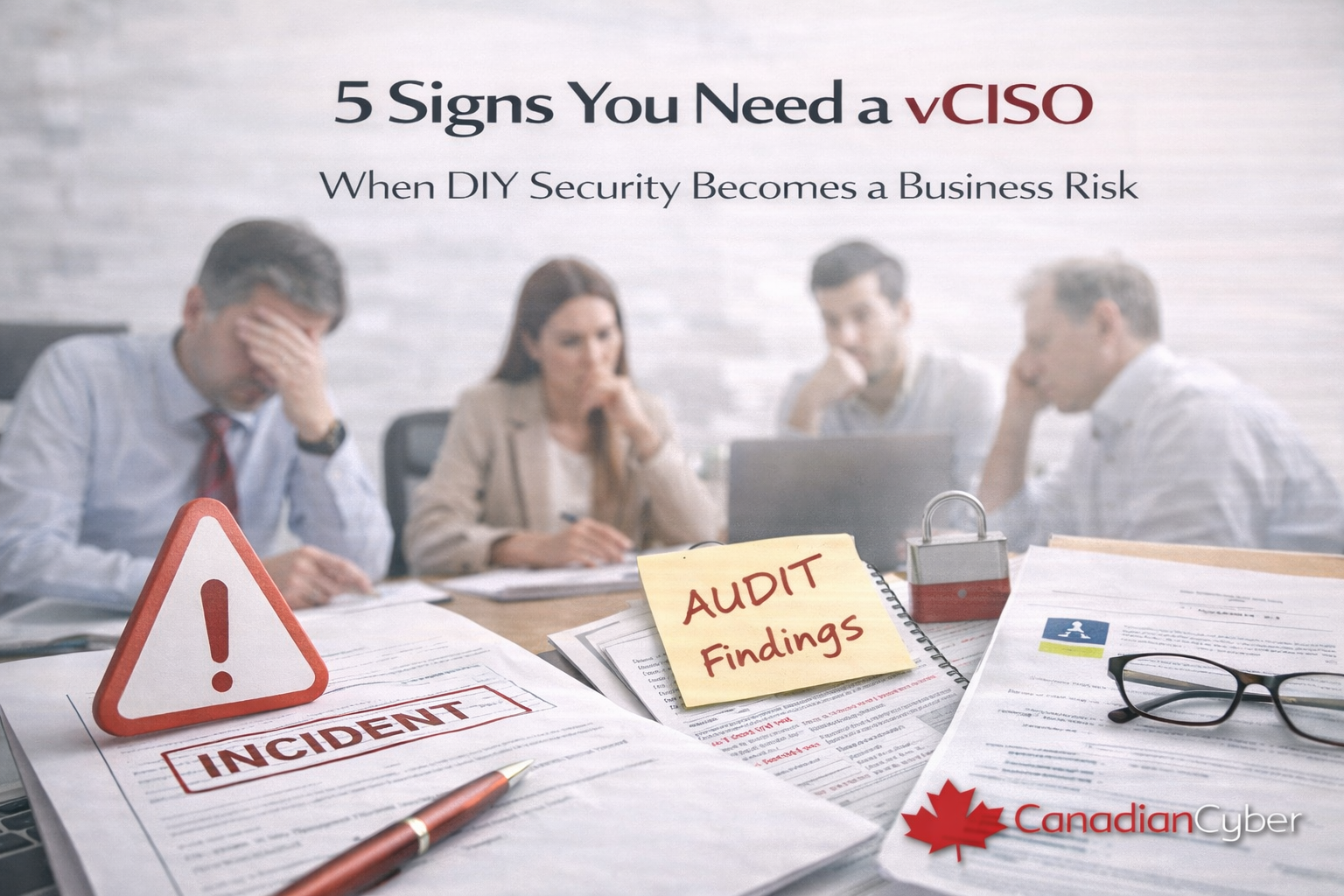
Most companies don’t fail at cybersecurity overnight. They drift into failure slowly and quietly until one email, one audit, or one incident exposes what leadership didn’t want to admit: security was never really under control.
Firewalls. MFA. Policies. On paper, things look fine.
But attackers don’t target paper. Auditors don’t certify intentions. Regulators don’t fine effort.
They fine gaps. And gaps grow fastest when no one owns security at the executive level.
The Hard Truth About “Good Enough” Security
DIY security can work for a while until growth, audits, enterprise deals, and real-world threats collide.
If you’re seeing any of the signs below, you don’t need more tools.
You need leadership, prioritization, and accountability.
| Sign | What it looks like | Business risk |
|---|---|---|
| Reactive decisions | Fixing issues after incidents, audits, or angry customer emails. No roadmap. | Repeat findings, rising exposure, and “surprise” failures. |
| Audit roulette | Anxiety, missing evidence, inconsistent answers, last-minute chaos. | Delayed deals, corrective actions, or failed audits. |
| Compliance as a side job | Overloaded IT/DevOps/HR wearing security “when there’s time.” | Control drift, ownership gaps, and compounding risk. |
| No executive clarity | “Are we secure?” gets technical jargon or “it depends.” | Blind decisions, misallocated budget, and leadership surprises. |
| Breach = catastrophe | No tested incident plan, confusion, scrambling to notify customers. | Prolonged downtime, reputational damage, and broken trust. |
🚨 Sign #1: Security Decisions Are Reactive, Not Planned
Ask yourself:
- Do changes happen after an incident or audit finding?
- Is the roadmap always “we’ll fix it later”?
- Does security depend on whoever has time this month?
If yes: you don’t have a security strategy you have damage control.
A vCISO plans before something breaks, not after.
🚨 Sign #2: Audits Feel Like a Gamble Every Time
Upcoming ISO 27001, SOC 2, or customer audits shouldn’t feel like roulette.
Auditors sense chaos quickly: inconsistent answers, missing ownership, and controls that exist “in theory.”
A vCISO turns audits into predictable outcomes, not stress events.
🚨 Sign #3: Compliance Is Someone’s “Side Job”
If security is owned by an overloaded IT manager, DevOps lead, or a non-technical function, risk compounds quietly. Compliance and security are full-time responsibilities even if the role isn’t. A vCISO makes security someone’s job without the full-time salary.
🚨 Sign #4: You Can’t Explain Your Security Program to Executives
If leadership asks “Are we secure?” and the answer is technical fog or “it depends,” that’s dangerous.
Executives need a clear risk posture, business impact, and prioritized actions.
Without a vCISO, security rarely translates into board-level clarity and leadership makes blind decisions.
🚨 Sign #5: A Breach Would Be “Catastrophic,” Not “Manageable”
If a breach today would mean panic, unclear escalation, and scrambling to respond, the breach isn’t the biggest problem unpreparedness is.
Organizations with vCISO leadership don’t avoid every incident, but they detect faster, respond calmly, contain damage, and preserve trust.
What happens if you ignore these signs?
Lost enterprise deals. Failed audits. Regulatory scrutiny. Leadership asking “how did we miss this?”
Not because people are careless because leadership is missing.
The vCISO Difference
- Owns your security roadmap and priorities
- Aligns compliance with business goals (ISO 27001, SOC 2, customer audits)
- Prepares you before audits and incidents
- Speaks to engineers and executives
- Makes risk visible, manageable, and defensible
If any of these signs felt uncomfortably familiar:
you don’t need more tools you need leadership.
Why Canadian Cyber’s vCISO Model Works
We don’t just advise we help you operate. We embed into your organization, guide audits and ISMS execution, and use our ISMS SharePoint Platform to enforce structure and evidence. Executives get reporting they can act on.
Our goal isn’t to scare you.
It’s to make sure you’re never caught off-guard.
Final Thought (Read This Slowly)
Most breaches don’t start with hackers. They start with:
“We’ll deal with it later.” “We don’t need a CISO yet.” “We’ve never had a problem.”
Until you do.
Ready to reduce risk before it becomes a crisis?
The best time to bring in a vCISO is before you’re forced to.
Let’s build a roadmap leadership can defend and teams can execute.
Stay Connected With Canadian Cyber
Follow us for real-world security leadership insights, audit readiness, and compliance guidance: