Get in touch
info@canadiancyber.ca


Rafia Rizwan

December 8, 2025
Skipping ISO 27001 isn’t saving money it’s quietly costing your business. From lost enterprise deals and higher cyber insurance premiums to operational chaos, regulatory fines, and lost investor trust, the hidden costs of inaction far outweigh certification. ISO 27001 isn’t just compliance it’s risk avoidance, operational discipline, and financial protection.
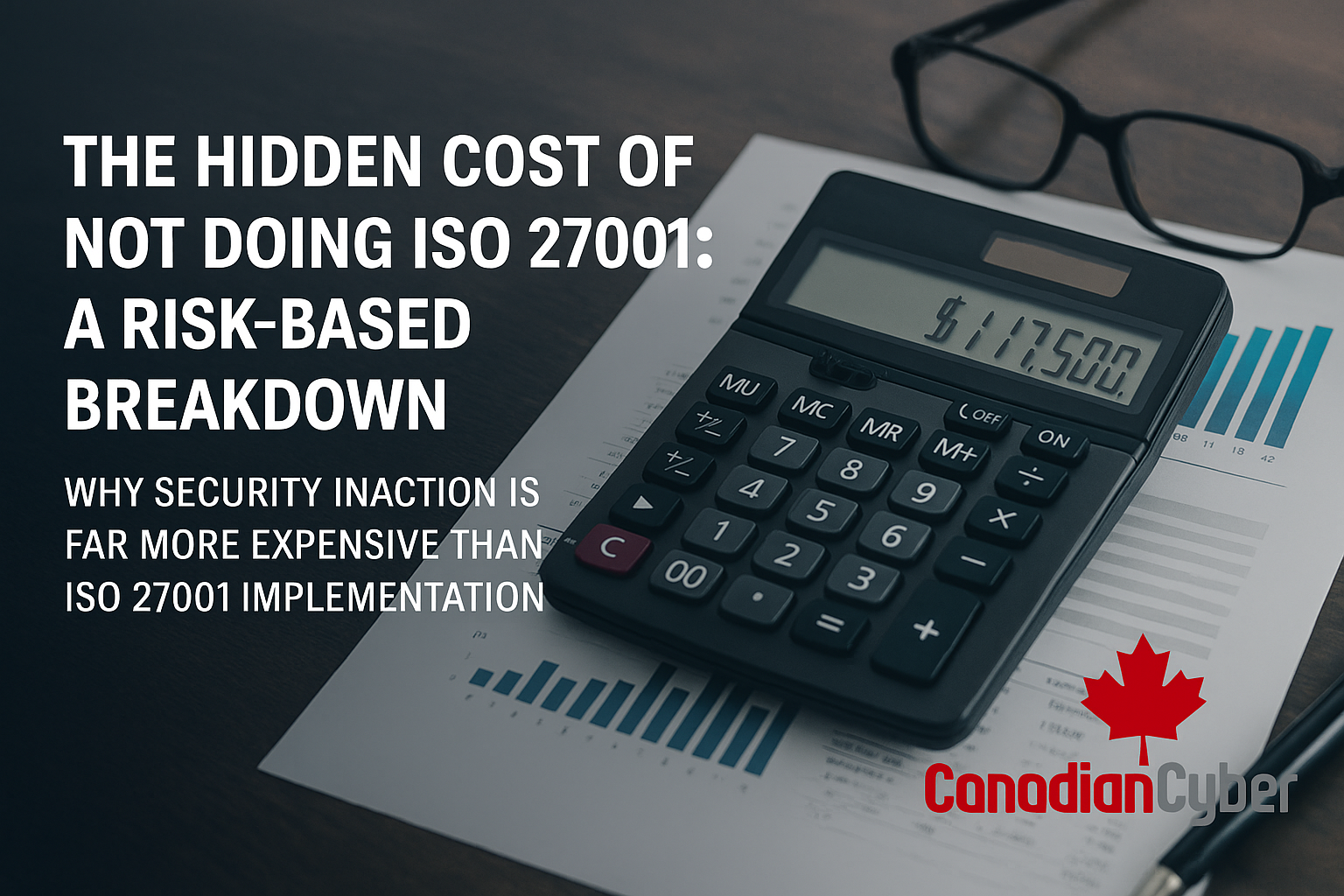
Why Security Inaction Is Far More Expensive Than ISO 27001 Implementation
This guide uses fictional but realistic examples to show how not implementing ISO 27001 quietly erodes revenue, trust, and operational stability often costing far more than the certification itself.
The price of inaction is always higher than the cost of prevention.
Most organizations see ISO 27001 as a compliance investment. Smart organizations see it as risk insurance, operational discipline, and financial protection.
But companies that delay or avoid ISO 27001 often don’t realize they are paying hidden costs quietly, continuously, and sometimes catastrophically.
In reality:
ISO 27001 is not expensive.
Ignoring ISO 27001 is what becomes expensive.
Let’s break down the real, measurable consequences of not adopting ISO 27001 and bring them to life with fictional, illustrative examples based on real client patterns.
Here’s how the hidden costs of skipping ISO 27001 typically show up over time:
| Cost Category | Primary Impact | Typical Loss Range* |
|---|---|---|
| Lost Enterprise Revenue | Deals blocked due to missing security proof. | $250k – $3M+ |
| Higher Cyber Insurance Premiums | Insurers penalize weak controls. | $10k – $100k (multi-year) |
| Incident Chaos & Downtime | Unstructured response increases damage. | $50k – $500k per incident |
| Productivity & Process Waste | Slow onboarding, rework, and confusion. | $20k – $150k per year |
| Lost Investor Confidence | Funding delayed or declined. | $1M – $5M+ missed |
| Regulatory & Legal Exposure | Fines, investigations, reputational damage. | Highly variable, often 6–7 figures |
*Illustrative ranges based on common industry patterns, not guarantees or predictions.
Canadian Cyber helps leadership teams map real business risks to ISO 27001 controls turning security into a clear financial and operational decision, not a vague IT expense.
Large clients now demand proof of security. That proof is often:
Without it, companies lose deals before they even truly begin.
Illustrative Example (Fictional, but realistic)
ClearBridge Analytics, a 25-person SaaS startup, pitched a major financial institution.
The demo was flawless. The pricing was accepted.
Then procurement asked:
“Do you follow ISO 27001 or any formal security framework?”
The CEO replied:
“We have strong internal security practices, but no certification.”
The deal died immediately.
The client could not approve a vendor without a formal security program.
Hidden Cost: Huge revenue loss.
ISO 27001 Benefit: Unlocks and protects enterprise clients.
Cyber insurance companies now ask questions directly aligned with ISO 27001 controls:
If not, insurers respond with:
Illustrative Example (Fictional)
StonePath Logistics applied for cyber insurance renewal. Their insurer requested:
They had none of it. Their premium quote jumped from $17,000 to $41,000 per year a 141% increase.
ISO 27001 would have provided the structure and evidence to avoid this penalty.
Hidden Cost: Paying thousands more every year.
ISO 27001 Benefit: Lower premiums, smoother renewals, better leverage with insurers.
Without ISO 27001, organizations typically lack:
When an incident hits, chaos replaces control.
Illustrative Example (Fictional)
At NimbusHR, an employee clicked a phishing link, compromising their email account. Because they had no ISO 27001-aligned Incident Response Plan:
Total measurable cost of this single incident:
Total incident cost: $117,500
With ISO 27001, incident playbooks, roles, and evidence would have reduced this to a manageable, low-impact event.
Organizations without ISO 27001 often lack:
This creates constant friction:
Illustrative Example (Fictional)
MediaCraft Studio had no structured onboarding process. New hires needed laptop setup, system access, password manager enrollment, training, and tool approvals.
Instead of a 1-day onboarding, it took 8–10 business days.
Productivity loss per new hire: ~$2,000
Hiring 18 people/year: $36,000 lost annually
Over 3 years: $108,000 burned silently.
ISO 27001 encourages standardized, documented processes that streamline onboarding, access, and daily operations.
Investors now evaluate operational maturity before writing a cheque. ISO 27001 is a signal of:
Companies without ISO 27001 often hear:
“Come back when your security posture is stronger.”
Illustrative Example (Fictional)
FinEdge AI, a machine-learning startup, pitched to a VC firm. The VC loved the product but asked:
“What’s your risk management structure?”
The founder replied:
“We don’t have a formal one yet.”
The VC firm declined the investment.
Estimated lost funding opportunity: $2.5 million seed round.
ISO 27001 could have been the trust signal that secured that confidence.
Compliance failures can lead to:
ISO 27001 doesn’t eliminate regulatory obligations it makes them structured and defensible.
Without it, organizations struggle with:
This becomes a real, measurable financial and reputational threat especially under modern privacy and sector specific laws.
Without ISO 27001:
These issues compound over years, and reversing them later is far more expensive than building healthy habits early.
ISO 27001 fixes culture by:
Companies that avoid ISO 27001 eventually learn the same lesson:
You always pay for security.
You either pay before the breach…
…or after the breach at 10x the cost.
The hidden cost of not doing ISO 27001 includes:
ISO 27001 is one of the few frameworks that simultaneously:
It is a business investment not an IT project.
Canadian Cyber helps organizations:
ISO 27001 isn’t about passing an audit it’s about protecting your business from the risks you can’t afford to ignore.
Follow Canadian Cyber for more practical ISO 27001, risk management, and security governance insights: