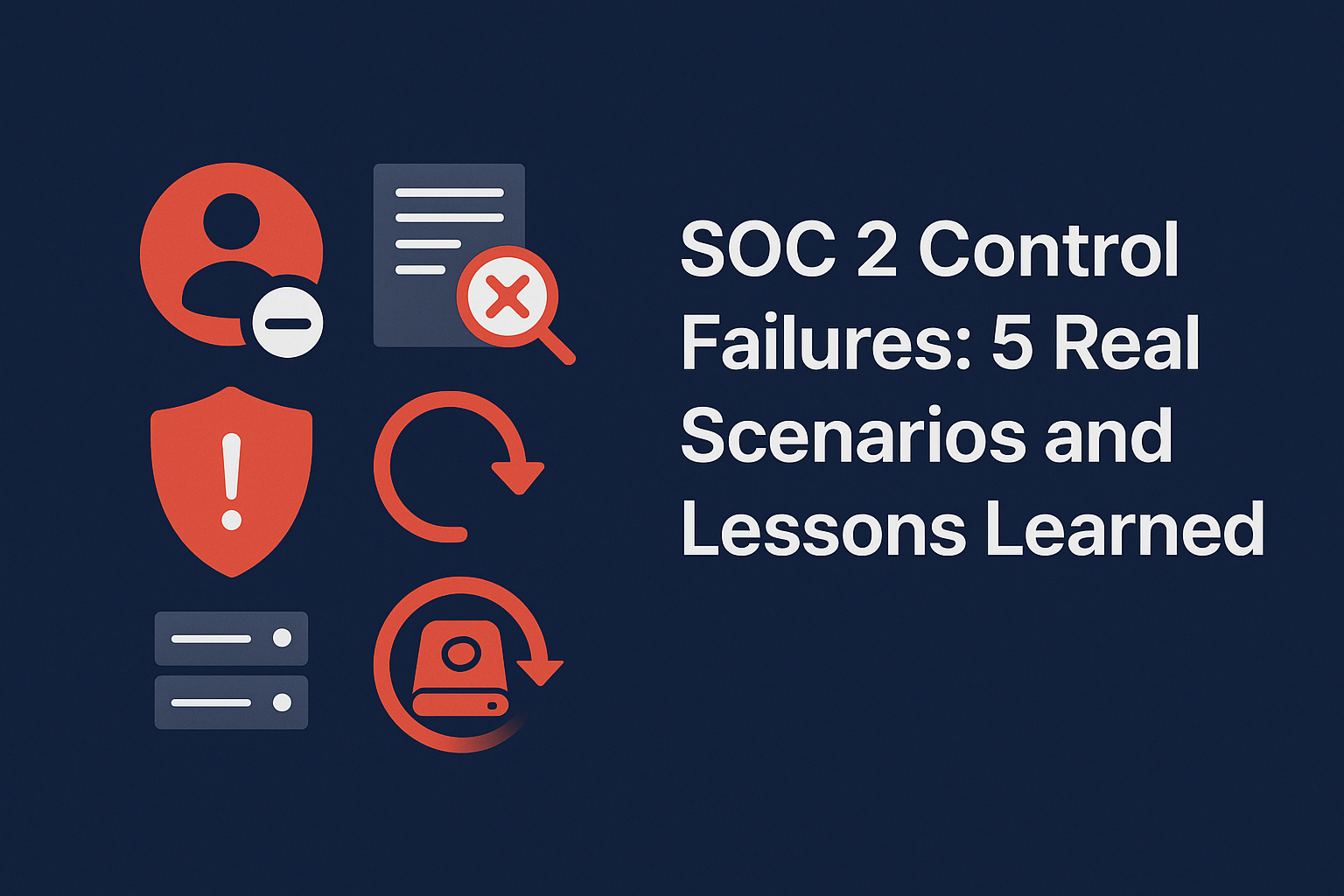
SOC 2 Control Failures: 5 Real Scenarios and Lessons Learned
How real-world SOC 2 control gaps appear in day-to-day operations and how to fix them before your next audit.
SOC 2 is built on a simple idea: your organization must prove that its controls are real, consistent, and repeatable. But in practice, many teams discover gaps during audits or, worse, during incidents.
This blog explores five anonymized SOC 2 control failure scenarios based on real patterns seen across Canadian organizations and the practical lessons leaders can use to avoid them.
Quick Snapshot
| Topic | Real-world SOC 2 control failures and lessons learned. |
| Who this is for | CISOs, founders, MSPs, compliance managers, IT and security leaders. |
| Purpose | Show how control gaps appear in everyday operations not just in theory. |
| Key Insight | Most SOC 2 failures happen due to weak execution, unclear ownership, and missing evidence not because policies are wrong. |
Introduction: When Controls Look Good on Paper but Fail in Reality
SOC 2 frameworks are clear. Controls are documented. Policies exist.
Yet controls fail every day. Why?
Because:
- People get busy
- Processes rely on memory
- Tools are misconfigured
- Ownership is unclear
- Evidence is inconsistent or missing
Below are five realistic scenarios that show how SOC 2 controls break and what stronger organizations do differently.
All names and examples are fictional and used for illustration.
Scenario 1: Offboarded… But Still in the System
LumiCloud, a fictional SaaS startup, believed they had a solid offboarding process. HR sent a termination notice.
Email access was removed.
But one step was missed: removing access to production systems.
During the audit, the auditor asked for:
- Termination dates
- Account activity logs
- Evidence of deprovisioning
One former engineer still had active infrastructure access three months after leaving.
What Failed
- No automation between HR and identity systems.
- Offboarding relied on manual, spreadsheet-based checklists.
- No recurring access review to catch lingering accounts.
Lesson Learned
Offboarding requires both automation and verification.
A SOC 2 access control is complete only when access is disabled and provably documented.
Practical fixes:
- Sync your HRIS with your identity provider (IdP).
- Automate account deactivation workflows based on termination dates.
- Run quarterly privileged access reviews for production and admin accounts.
- Require two-person verification for critical or elevated account deprovisioning.
Scenario 2: A Quick Change That Broke Everything
NorthBridge Ops, a fictional MSP, had a formal change management process: tickets, approvals, testing, and rollbacks.
On a busy day, an engineer pushed a firewall update directly from the console no ticket, no approval, no record.
The result:
- VPN outage for a major client
- Confusion during incident response
- No evidence for the SOC 2 audit
What Failed
- Culture quietly tolerated “emergency exceptions.”
- No guardrails to block ad-hoc console changes.
- No reconciliation between system logs and approved tickets.
Lesson Learned
A realistic change process must balance speed and accountability.
If controls are too heavy, people bypass them. If they’re too loose, controls fail.
Practical fixes:
- Create “quick change” templates for true emergencies — with lightweight approval.
- Enforce peer review for high-risk changes (firewalls, identity, core infrastructure).
- Move toward infrastructure-as-code (IaC) where possible.
- Regularly match console logs with approved change tickets.
Scenario 3: The Vendor No One Really Owned
BrightLedger, a fictional fintech company, relied on a third-party tool that processed sensitive customer data.
But no one tracked:
- How the vendor secured that data
- Whether the vendor’s certifications were still valid
- Whether the service still aligned with current compliance needs
During their SOC 2 review, the auditor asked for vendor assessments and the team could not produce any.
What Failed
- No centralized vendor inventory.
- No risk assessments for critical suppliers.
- No clearly assigned internal owner for the vendor.
Lesson Learned
If a vendor touches your data or your service, they must be included in your SOC 2 scope with a named owner.
Practical fixes:
- Maintain a vendor inventory with risk classifications (low / medium / high).
- Assign an internal owner to every critical vendor.
- Perform annual vendor reviews for high-risk providers.
- Document data flows and where each vendor stores or processes information.
Scenario 4: Logging Without Monitoring
SignalCore, a fictional platform provider, had excellent log collection. Everything flowed into a central system:
firewalls, applications, servers.
But no one consistently reviewed the logs. Alerts went unnoticed. Suspicious activity wasn’t escalated.
When auditors examined evidence of monitoring, they found:
- No documented review cadence
- No alert investigation records
- No incident timelines or follow-up notes
What Failed
- Logging existed but monitoring did not.
- Responsibility for reviewing alerts was unclear.
- No metrics around detection and response time.
Lesson Learned
Logging alone is not a SOC 2 control. Monitoring and response are the real controls.
SOC 2 asks: “How do you know something went wrong?” Your answer must be more than “We collect logs.”
Practical fixes:
- Assign clear monitoring responsibilities (SOC, NOC, or on-call roles).
- Define alert severity levels and thresholds.
- Write simple playbooks for login anomalies, new admin accounts, and unusual access.
- Track response times, resolutions, and escalations in a ticketing system.
Scenario 5: Backups That Couldn’t Restore
AtlasForms backed up all production data daily. Logs showed “successful” every night.
When a database corruption incident occurred, the team discovered that the backups:
- Were incomplete for some key tables
- Had not been tested recently
- Lacked updated restore documentation
Recovery took days, not hours.
What Failed
- False confidence in “successful backup” messages.
- No regular restore testing.
- Outdated recovery runbooks and unclear responsibilities.
Lesson Learned
Backups only matter if you can restore them reliably and quickly. In SOC 2, a backup without restore evidence is an incomplete control.
Practical fixes:
- Test restores quarterly (or monthly for critical systems).
- Define realistic RTO (Recovery Time Objective) and RPO (Recovery Point Objective).
- Document restore steps clearly, including who does what.
- Track restore success, duration, and issues as evidence.
Common Themes Across SOC 2 Failures
Despite different stories, the patterns are similar — and they repeat across industries.
| SOC 2 Failure Pattern | Impact on Audit & Security |
|---|---|
| Unclear ownership of controls | Tasks fall through gaps; no one feels accountable when something breaks. |
| Manual, memory-based processes | Inconsistent execution, missed steps, and weak or missing evidence. |
| Paper policies without practical tools | Controls don’t match reality; staff quietly work around the documented process. |
| Weak monitoring and review practices | Issues are discovered late or first noticed by auditors or clients. |
| No testing (restore, DR, reviews) | Controls fail during real incidents, damaging trust and delaying recovery. |
The encouraging news? Almost all of these gaps are fixable with better structure, automation, and ownership.
What This Means for Your Organization
Ask yourself:
- Do we rely on “tribal knowledge” for key SOC 2 controls?
- Can we produce time-stamped evidence for every control in scope?
- Is ownership clear, or do multiple teams assume “someone else” is responsible?
- Are our controls tested regularly or only documented?
SOC 2 is not about perfection. It is about consistency, evidence, and continuous improvement.
Control failures are not the core problem. Unnoticed and uncorrected failures are.
How Canadian Cyber Helps Prevent SOC 2 Control Failures
Canadian Cyber supports organizations across Canada with practical, audit-ready SOC 2 programs that map to how you actually operate.
SOC 2 Readiness & Gap Assessment
We identify fragile controls, missing evidence, and operational risks before your auditor does.
Control Ownership & Workflow Design
We help you assign clear owners and build simple, repeatable processes that your team can follow under real pressure.
Evidence Automation & Audit Preparation
We design workflows that capture evidence naturally through the tools you already use ticketing systems, cloud platforms, HR systems, and monitoring tools.
vCISO & Continuous SOC 2 Support
We help you maintain your controls year after year so your SOC 2 Type II report stays strong, not just on the first attempt.
Ready to Avoid These SOC 2 Mistakes?
If you want a smoother audit, stronger controls, and fewer surprises, Canadian Cyber can help you move from
reactive fixes to a stable, predictable SOC 2 program.
We’ll walk through your current controls, highlight common pitfalls, and build a path to a clean SOC 2 report.
Stay Connected with Canadian Cyber
Follow Canadian Cyber for more practical SOC 2, vCISO, and security governance insights: