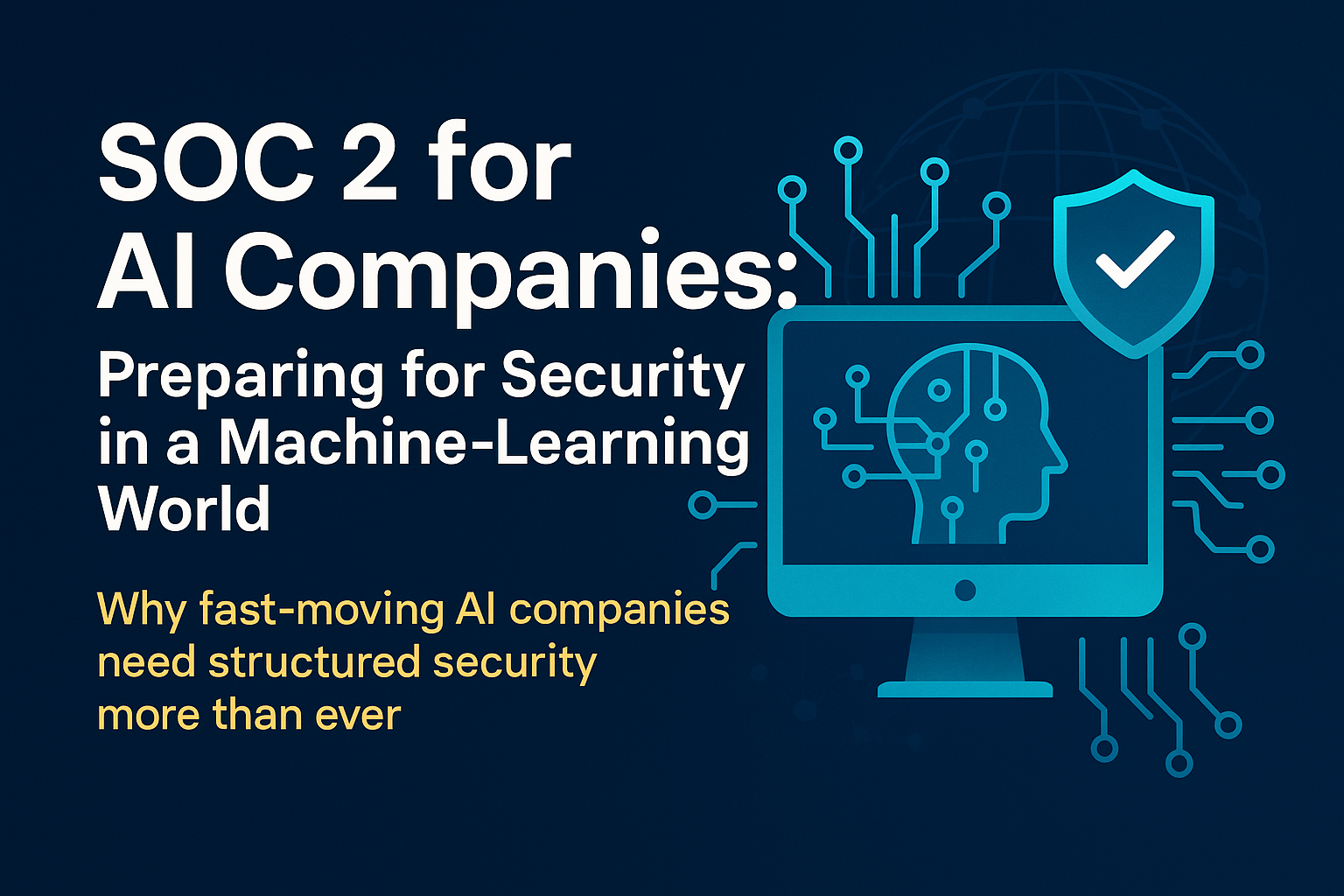
SOC 2 for AI Companies: Preparing for Security in a Machine-Learning World
Why fast-moving AI companies need structured security more than ever.
AI companies move fast. Models change quickly. Teams test ideas every day. New tools seem to arrive almost weekly.
This speed creates opportunity but it also introduces real security risk. Without a clear security framework, that risk becomes harder to control and harder to explain to customers, investors, and partners.
For most AI and ML companies, the framework that brings structure and proof is SOC 2.
SOC 2 shows customers, investors, and enterprise buyers that your AI systems are secure and governed.
It also helps internal teams avoid mistakes that can damage your data, your model, or your reputation.
This article breaks down SOC 2 for AI companies in a simple, friendly, and practical way.
Quick Snapshot
| Category | Detail |
|---|---|
| Topic | SOC 2 for AI and ML companies building data-driven products. |
| Audience | AI founders, ML leaders, CTOs, data teams, vCISOs. |
| Purpose | Explain SOC 2 controls for AI pipelines, models, APIs, and tools in clear language. |
| Key Insight | AI risk is more than code. It includes data, vendors, and change. SOC 2 brings structure to all of it. |
The Truth: AI Companies Face Risks Traditional SaaS Never Did
AI companies do more than store data. They shape it, learn from it, and apply it across pipelines, models, and APIs.
This creates three major challenges:
- ✔ AI data is more complex and often highly sensitive.
- ✔ Pipelines change constantly as models evolve and experiments run.
- ✔ Model outputs depend entirely on the integrity of the inputs.
If one part breaks, everything can break accuracy, stability, and customer trust.
SOC 2 helps reduce these risks by adding structure, visibility, and accountability to your ML environment without blocking innovation when it is designed correctly.
A Fictional Example: The “Helpful” Dataset That Broke Everything
This example is fictional, but similar to issues we see in real AI teams.
SignalShift, a Toronto AI startup, built a model that ranked customer sentiment. It worked well until a junior developer added a new dataset to “improve accuracy.”
He uploaded it, retrained the model, and deployed it all in one afternoon.
- No review
- No documentation
- No validation steps
- No approval
The next morning, the model flagged ordinary messages as “very negative.” Clients were confused and frustrated.
After investigation, the team found the problem:
- The new dataset had mislabeled samples.
- There was no model version control.
- There was no repeatable testing process.
- There were no approvals or reviewer sign-offs.
- There was no tracking of who changed what and when.
Nothing malicious happened. They simply lacked structure and guardrails.
SOC 2 is designed to fix exactly this kind of problem.
How SOC 2 Protects AI Companies (Explained Simply)
SOC 2 is built on five Trust Services Criteria (Security, Availability, Processing Integrity, Confidentiality, Privacy).
Each one maps directly to the AI and ML lifecycle.
Below is a simple explanation no heavy jargon, just practical concepts.
1. Protecting Your Training Data
Training data is the heart of every model. If the data is biased, incorrect, or corrupted, the model will
learn and repeat those mistakes.
SOC 2 encourages AI companies to:
- Restrict access to datasets with role-based access control.
- Encrypt data at rest and in transit.
- Use simple approval processes for new training datasets.
- Document where data came from and how it is used.
- Log who accessed, changed, or exported datasets.
These controls prevent unapproved uploads, reduce data leakage risk, and make your training process easier to explain to auditors and customers.
2. Securing the AI Pipeline
An AI pipeline usually includes:
- Ingestion
- Cleaning and transformation
- Feature extraction
- Training and tuning
- Testing and evaluation
- Deployment to production
If any step is uncontrolled, the entire pipeline becomes unreliable.
SOC 2 supports pipeline stability by requiring that:
- Each step is documented in a clear, understandable way.
- Access to pipeline tools is based on job role.
- Changes to pipelines are reviewed and approved.
- Logs track who made which changes and when.
This makes your ML workflow easier to manage, debug, and prove to auditors.
3. Managing Third-Party AI Tools
AI teams rely on many external tools, such as:
- Prompt platforms and LLM sandboxes
- Embedding and vector search services
- Annotation and labeling providers
- Pre-trained model APIs
- GPU cloud services and MLOps platforms
Some of these tools store your data or use it for training. Others operate outside Canada or your main jurisdiction.
SOC 2 expects AI organizations to evaluate each vendor by asking:
- Where does the data go?
- How is it stored and protected?
- Is it used to train other models?
- What security and compliance certifications do they have?
This prevents accidental data leaks through “shadow AI tools” and unmanaged integrations.
4. Strengthening Model Updates
AI companies update models often. That is good for performance but risky if changes are not controlled.
SOC 2 brings discipline into model lifecycle by encouraging:
- Model versioning with clear identifiers.
- Review and approval before production deployment.
- Documented experiments and evaluation results.
- Testing steps before and after major changes.
- Clear rollback plans if something goes wrong.
This prevents “mystery changes” in production and makes it easier to explain what changed and why.
5. Monitoring for Drift and Abnormal Activity
AI models often fail quietly. Inputs change, user behaviour shifts, and data distributions move.
SOC 2 supports ongoing reliability by requiring:
- Logging across key systems and services.
- Monitoring for unusual or out-of-range behaviour.
- Alerts for suspicious activity or spikes.
- API usage tracking and rate limiting.
- Regular access and privilege reviews.
These controls help detect model drift, misuse, or attacks early before customers notice something is wrong.
Need SOC 2 Guidance Tailored to AI Pipelines?
Canadian Cyber helps AI companies apply SOC 2 in ways that work for data scientists, ML engineers, MLOps teams, CTOs, and compliance owners without slowing innovation.
| Service | How We Help AI Teams |
|---|---|
| vCISO for AI | Security leadership for SOC 2 strategy, AI governance, data protection, access decisions, and policy creation all tuned to your ML stack. |
| Internal Audit (AI-Focused) | Testing of dataset handling, model deployment, pipeline workflows, AI tool usage, and evidence readiness so you avoid last-minute audit issues. |
| SOC 2 Implementation | Full SOC 2 programs mapped to your data pipelines, feature stores, training process, deployment flow, APIs, and AI tools. |
A Quick Reference Table
| AI Challenge | SOC 2 Advantage |
|---|---|
| Unsafe datasets | Access control, approvals, and clear dataset onboarding steps. |
| Untracked experiments | Versioning, change logs, and experiment documentation. |
| Shadow AI tools | Vendor risk management and formal approval processes. |
| Model drift | Monitoring, performance baselines, and alerting. |
| High-risk API use | Strong authentication, rate limits, and usage reviews. |
| Training data leakage | Encryption, privacy controls, and clear data handling rules. |
Clear. Simple. Practical. SOC 2 turns AI risk into something you can see, manage, and prove.
A Look Back at SignalShift (Fictional Summary)
After implementing SOC 2 controls, SignalShift improved quickly:
- ✔ Data was reviewed and approved before use.
- ✔ Pipelines were documented from end to end.
- ✔ Models had clear, trackable versioning.
- ✔ Experiments became traceable and repeatable.
- ✔ Outputs became more stable and predictable.
- ✔ Clients regained trust in the platform.
SOC 2 didn’t slow them down it reduced chaos and improved reliability.
Why AI Companies Choose Canadian Cyber
AI companies need SOC 2 guidance that understands ML systems, rapid iteration, and data-heavy workflows.
🔹 vCISO Services for AI
Your vCISO provides ongoing leadership for:
- SOC 2 strategy and roadmap.
- AI governance and risk decisions.
- Data protection and access control.
- Policy creation, reviews, and approvals.
- Customer-facing security support during sales cycles.
🔹 Internal Audit Services
We test and review:
- Dataset handling and approvals.
- Model deployment and change management.
- Pipeline workflows and access control.
- AI tool and vendor usage.
- Evidence readiness for your SOC 2 audit.
🔹 Full SOC 2 Implementation
We map SOC 2 directly to your:
- Data pipelines and feature stores.
- ML training and experiment flows.
- Deployment processes and rollback paths.
- APIs and prediction endpoints.
- AI tools, platforms, and infrastructure.
The result is a realistic and effective SOC 2 program built for AI teams not generic checklists.
🚀 SOC 2 Helps AI Companies Earn Trust and Scale Faster
SOC 2 helps you show strong data governance, secure ML pipelines, reliable models, and safe third-party usage.
In a fast-growing AI market, trust is your greatest advantage.
👉 Explore Our SOC 2 Services
👉 Ask About Our vCISO & Internal Audit Programs
Stay Connected With Canadian Cyber
Follow Canadian Cyber for SOC 2 insights, AI security guidance, and practical governance tips: