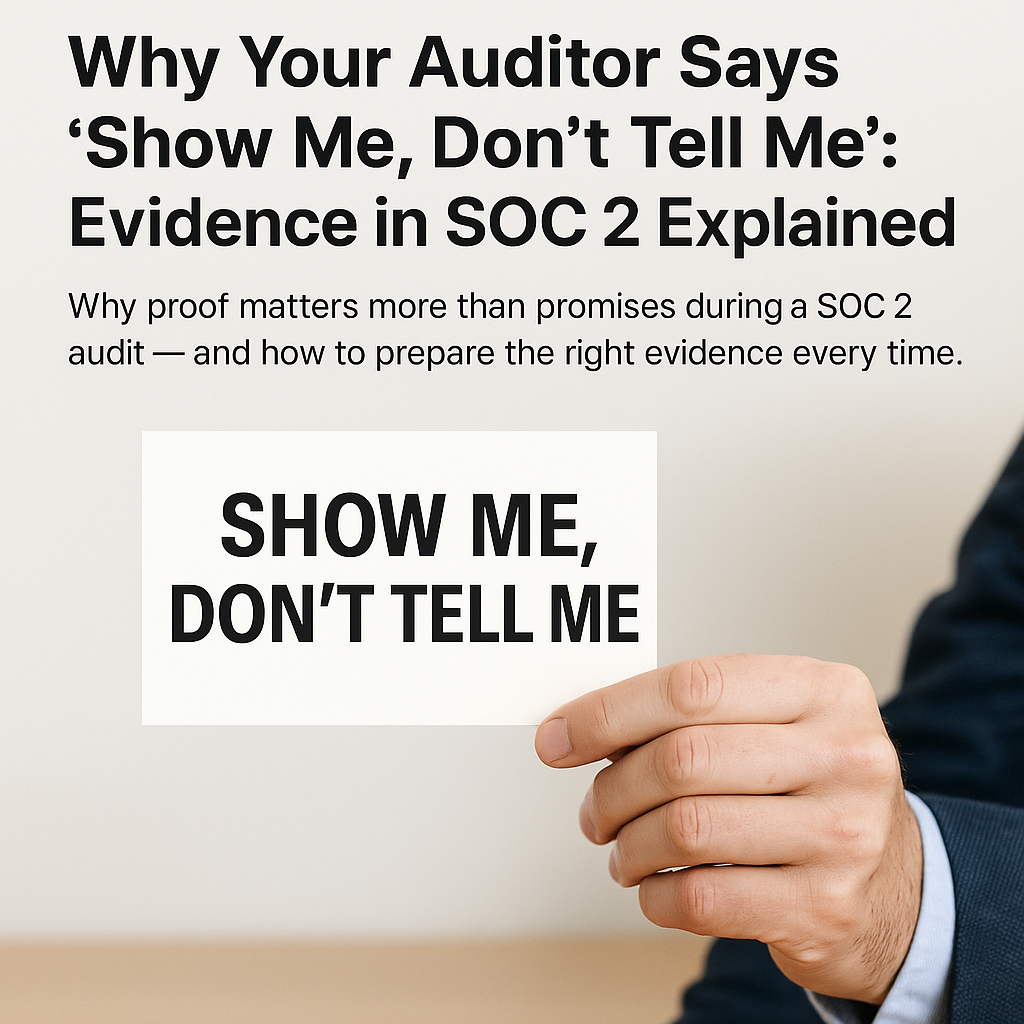
Why Your Auditor Says “Show Me, Don’t Tell Me”: Evidence in SOC 2 Explained
Why proof matters more than promises during a SOC 2 audit and how to prepare the right evidence every time.
One of the biggest surprises companies face during their first SOC 2 audit is this: auditors don’t want explanations they want evidence.
You can tell an auditor, “We review access quarterly.” You can even explain how the process works. But unless you show proof screenshots, logs, tickets, approvals, or reports the control is considered not operating effectively.
This is the core principle behind SOC 2:
If it isn’t documented, it didn’t happen.
This blog explains why auditors take this approach, what “good evidence” looks like, and how to avoid last-minute scrambling during an audit.
Why “Show Me, Don’t Tell Me” Matters in SOC 2
SOC 2 is built on trust and verification. The goal is to prove that your security controls work in real life not just on paper.
Your auditor needs to confirm that each control:
- Exists and is clearly defined
- Operates consistently over time
- Worked across the entire audit period
Words alone cannot prove that. Evidence can.
This is why SOC 2 audits focus heavily on sampling auditors pull real examples from real dates to show that controls were not ignored or skipped.
A Fictional Example: “We Definitely Did That… Didn’t We?”
This example is fictional but inspired by common SOC 2 failures.
BrightGate Cloud, a 35-person SaaS company, proudly told their auditor:
Team:
“We always remove access for departing employees within 24 hours.”
The auditor replied:
Auditor:
“Great please show me two samples from this quarter.”
Suddenly, things fell apart:
- Offboarding tickets were missing.
- IT had no screenshots of disabled accounts.
- HR had no logs that matched the dates.
- One former engineer still had access to a dev system.
The team did remove access most of the time but without documented proof, none of it counted.
Auditor:
“SOC 2 is evidence-based. If we can’t see it, we can’t trust it.”
This is the difference between intention and verification.
The Types of Evidence SOC 2 Auditors Expect
Different controls need different types of evidence. Here is a simple breakdown to keep things clear and practical.
1. Screenshots (Most Common)
Screenshots prove the current state of a system at a point in time.
Useful for showing:
- MFA enforcement in your identity provider
- Logging or SIEM configuration
- Password and session policies
- Firewall rules or security groups
- Disabled user accounts after offboarding
Tip: Make sure timestamps, usernames, and system names are visible wherever possible.
2. System Logs
Logs prove that activity actually happened not just that a setting exists.
Examples include:
- Authentication and access logs
- Deployment logs and CI/CD history
- Alert and incident logs
- Change history for critical systems
Logs help auditors pull samples and verify that activities were performed on real dates.
3. Tickets or Workflow Records
Tickets show who requested, who approved, and when it was done.
Tickets are key evidence for:
- Onboarding and offboarding
- Change management and releases
- Risk acceptance decisions
- Vendor onboarding and reviews
If something important happened, there should be a ticket or workflow record.
4. Policies and Procedures
Policies show intent. Procedures show how work is done.
But policies alone cannot prove compliance. They must match the evidence.
For example, if your policy says “We perform quarterly access reviews,” your auditor will ask for:
- The review document or export
- The reviewer’s name and role
- The date of the review
- Any findings and remediation actions
5. Sampling Evidence
Sampling is one of the most misunderstood parts of SOC 2.
Typically, an auditor will:
- Pick a random month, user, or ticket.
- Ask for evidence tied to that specific sample.
- Mark an exception if the evidence is missing.
Common sample types include:
- A set of onboarding or offboarding records
- Several change tickets for major releases
- Access reviews for key systems
- Training completion lists for selected dates
This is where companies panic because evidence is often stored inconsistently across tools.
A Simple Table: Good vs. Bad Evidence
| Control | Bad Evidence (Will Fail) | Good Evidence (Will Pass) |
|---|---|---|
| Offboarding | “We always do it.” | Offboarding ticket + screenshot of disabled account. |
| MFA | “Everyone has MFA.” | Screenshot showing MFA enforced for all users. |
| Log monitoring | “We review alerts weekly.” | Alert logs + review notes from sampled weeks. |
| Vendor review | “We checked them.” | Completed vendor questionnaire + approval record. |
| Access review | “We checked permissions.” | Signed or recorded access review with date and results. |
The pattern is simple: statements fail, proof passes.
Why SOC 2 Evidence Feels Hard for Many Teams
Most organizations do the work. The problem is that they don’t capture the work.
Common challenges include:
- Evidence spread across many tools and folders
- Teams forgetting to take screenshots or save reports
- Tickets not created for every change or access request
- No clear ownership for each control
- People assuming “someone else documented it”
SOC 2 doesn’t fail because companies never perform controls. It fails because companies don’t document those controls in a repeatable way.
How to Make SOC 2 Evidence Easy (Not Stressful)
You can reduce audit chaos with a few structured habits.
1. Assign Ownership for Every Control
Every SOC 2 control should have a single named owner not a committee and not “the security team.”
- One owner per control.
- Clear responsibilities.
- Defined expectations per month or quarter.
This removes confusion and makes follow-up easier.
2. Create a Monthly or Quarterly Evidence Checklist
Instead of gathering everything at the end of the year, build a rhythm:
- Collect screenshots monthly.
- Save logs in a central location.
- Document changes as they happen.
- Update access reviews on a fixed schedule.
This makes the audit feel like a review, not a rescue mission.
3. Automate What You Can
Automation helps maintain consistency across the audit period.
Tools can:
- Pull and store logs on a schedule
- Track access changes automatically
- Alert when controls are missed
- Generate reports that map directly to SOC 2 controls
The more your evidence is automated, the less you rely on memory.
4. Use a Central Evidence Repository
Store everything in one place, such as:
- SharePoint or Google Drive
- Confluence or Notion
- A dedicated SOC 2 or compliance platform
Organize evidence by:
- Control ID or area (e.g., access control, change management)
- Audit period and date
- Type of evidence (logs, screenshots, tickets)
Auditors love organized evidence and your internal team will too.
A Fictional Timeline: What “Good Evidence” Looks Like
Here’s a simple fictional timeline that illustrates what “audit-ready” looks like across a year.
- January: Access review performed, screenshot saved, sign-off recorded.
- March: New vendor added, security review completed, approval stored.
- May: Offboarding ticket created, account disabled, timestamp logged.
- August: Incident response test completed, outcomes documented.
When an auditor arrives, the team doesn’t scramble they simply share the evidence repository.
🧩 How Canadian Cyber Helps You Stay Evidence-Ready All Year
SOC 2 doesn’t get easier on its own your process does. Canadian Cyber helps you build that process with services tailored to growing organizations.
| Service | How We Help |
|---|---|
| vCISO Services | Ongoing security leadership that keeps controls active, defines ownership, and makes sure evidence is collected on time not just before the audit. |
| Internal Audit Services | Quarterly or annual internal SOC 2 audits, evidence reviews, and control testing to catch issues early and avoid surprises with your external auditor. |
| SOC 2 Programs | End-to-end SOC 2 implementation: control design, documentation, evidence workflows, and audit readiness for both Type I and Type II reports. |
🚀 Ready to Make SOC 2 Easier? Strengthen Your Evidence Process.
If you are tired of scrambling for screenshots, tickets, and logs at audit time, it’s time to
build an evidence process that works all year, not just during SOC 2 season.
👉 Explore Our SOC 2 Services
👉 Book a Free Consultation
👉 Ask About vCISO & Internal Audit Programs
Stay Connected With Canadian Cyber
Follow Canadian Cyber for SOC 2 insights, vCISO guidance, and practical security tips: