

Third-Party Cyber Risk: Assessing Your Vendors’ Security
Why your organization’s security is only as strong as the vendors you trust.
Your organization may have strong internal security controls. Your systems may be patched. Your staff may be trained.
Yet your biggest cyber risk might not sit inside your network at all.
It might sit with a vendor.
In today’s interconnected business environment, organizations rely on dozens sometimes hundreds of third parties. Cloud providers, SaaS platforms, payroll processors, IT support firms, marketing tools, and data processors all touch sensitive information.
And attackers know it.
Quick Snapshot
| Category | Detail |
|---|---|
| Topic | Third-party (vendor) cyber risk management |
| Why it matters | Vendors can be an indirect path to your data, systems, and customers |
| Common problem | High access + low oversight = high exposure |
| Key takeaway | Vendor risk must be assessed, documented, and monitored not assumed |
The Reality: Third-Party Breaches Are Rising
Cybercriminals increasingly target vendors as an indirect path to their real targets.
Across the industry, third-party incidents are consistently reported as a meaningful share of breaches and the trend continues to grow.
Why? Because vendors often have:
- Broad access
- Weaker controls
- Less oversight
- Shared credentials
- Trusted connections
One weak link is enough.
What Is Third-Party Cyber Risk?
Third-party cyber risk is the risk introduced when external vendors:
- Access your systems
- Process your data
- Store sensitive information
- Integrate with your environment
If a vendor is compromised, your organization may still be held accountable — especially under privacy laws, contractual obligations, or regulatory frameworks.
Why Vendor Risk Hits Canadian Organizations Hard
Canadian organizations face increasing pressure to manage third-party risk due to:
- PIPEDA accountability expectations
- Quebec’s Law 25, which extends responsibility to service providers
- Enterprise customer security reviews
- Cyber insurance requirements
- Board and regulator expectations
Regulators and customers now ask:
“How do you assess and monitor your vendors’ security?”
A vague answer is no longer acceptable.
A Fictional Example: The Vendor No One Reviewed
This example is fictional but reflects real-world incidents.
A Canadian company outsourced customer support to a third-party platform. The vendor had access to sensitive customer data.
No security questionnaire was completed. No SOC 2 report was requested. No access review was performed.
Months later, the vendor experienced a breach.
The organization faced:
- Customer notifications
- Legal review
- Reputation damage
- Emergency vendor replacement
The breach did not start internally but the consequences were very real.
Why Traditional Vendor Due Diligence Is No Longer Enough
Many organizations still rely on:
- Basic procurement checks
- Legal contracts alone
- Vendor reputation (“they’re a big name, so they must be secure”)
Unfortunately, attackers don’t care about brand names.
Modern third-party risk management requires ongoing security assessment, not one-time trust.
Best Practices for Assessing Vendor Cybersecurity
A strong vendor risk program doesn’t need to be complex but it must be consistent. Here’s what effective organizations do.
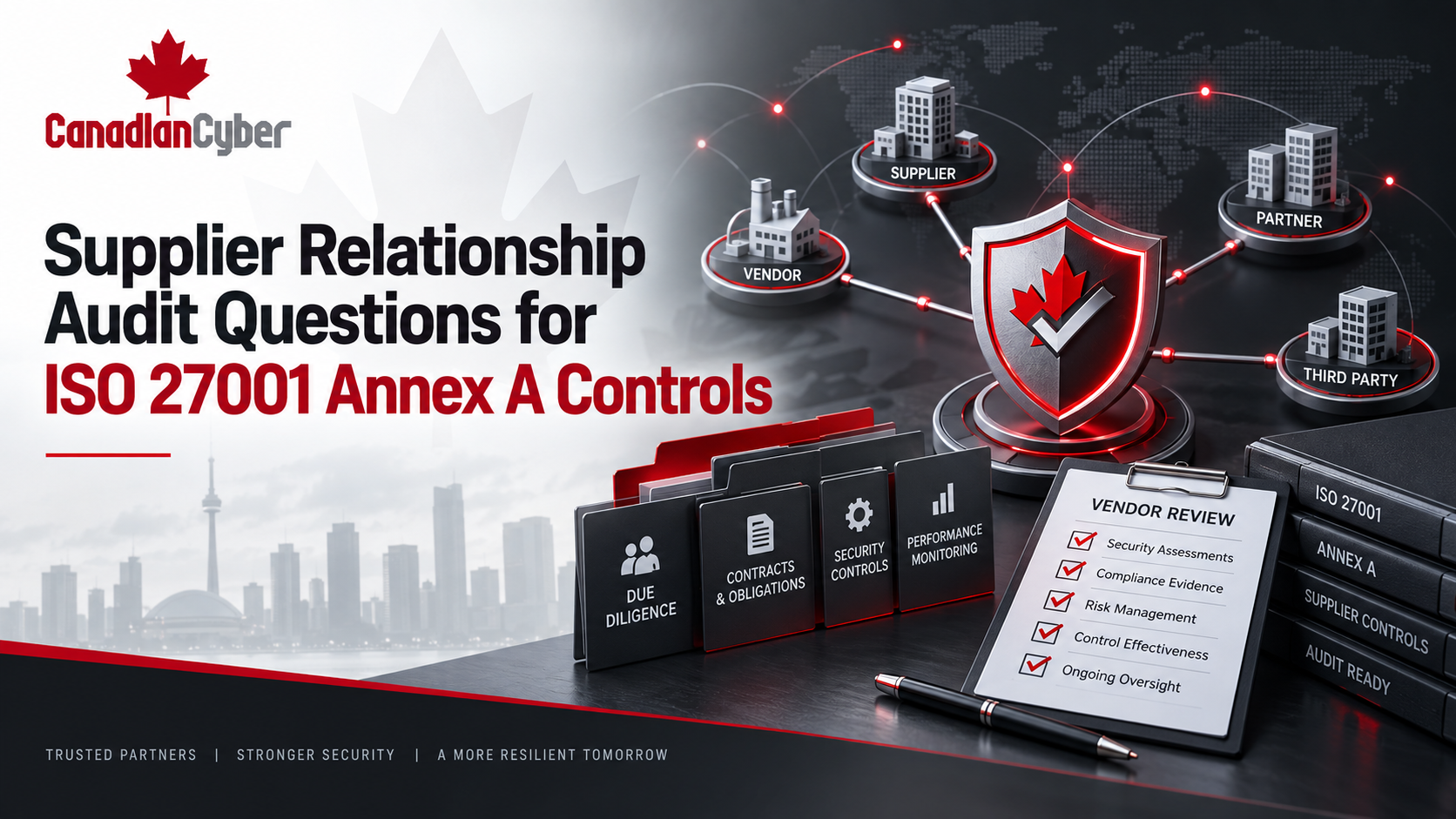
1) Identify high-risk vendors first
Not all vendors carry the same risk. Focus first on vendors that:
- Handle personal or sensitive data
- Have system or network access
- Support critical operations
- Process financial or health information
This risk-based approach prevents overload and keeps your program practical.
2) Use vendor security questionnaires
Vendor questionnaires help assess:
- Access controls (MFA, least privilege, admin management)
- Data protection practices (encryption, retention, backups)
- Incident response readiness (detection, notification, timelines)
- Employee security training and onboarding
- Subcontracting and fourth-party risk
Questionnaires aren’t just paperwork they create documentation, accountability, and a baseline for follow-ups.
3) Request independent assurance (SOC 2, ISO 27001)
One of the most effective controls is requiring independent security validation.
| Evidence Type | What it helps you validate |
|---|---|
| SOC 2 Type II | Whether controls operated effectively over a defined period |
| ISO/IEC 27001 | Whether an ISMS exists and is certified against a recognized standard |
| Pen test summary | Whether key systems were recently tested for exploitable weaknesses (scope dependent) |
4) Define security expectations contractually
Contracts should clearly define:
- Security responsibilities (shared responsibility clarity)
- Incident notification timelines
- Data handling requirements (encryption, retention, deletion)
- Audit rights and evidence obligations
Security must be enforceable not assumed.
5) Monitor vendors continuously
Vendor risk changes over time. Best-practice programs include:
- Periodic reassessments (annual/bi-annual based on risk)
- Review of updated reports (SOC 2 / ISO / attestations)
- Re-evaluation after scope or access changes
- Tracking major incidents and vendor notifications
Vendor risk is not static. Your oversight shouldn’t be either.
Want a Vendor Risk Program That’s Practical (Not Bureaucratic)?
We can help you identify high-risk vendors, collect the right evidence, and build a repeatable assessment process that stands up to audits and customer reviews.
Explore Third-Party Security Assessment Services
Book a Free Consultation
Why Third-Party Risk Is a Board-Level Issue
Third-party breaches often result in:
- Regulatory scrutiny
- Customer loss
- Financial penalties
- Executive accountability
That’s why boards increasingly expect management to demonstrate:
- Visibility into vendor risk
- Formal assessment processes
- Clear ownership
- Ongoing oversight
A mature third-party risk program protects leadership not just systems.
How Third-Party Risk Fits Into Broader Security Frameworks
Vendor security is not a standalone activity. It aligns directly with:
- ISO 27001 supplier relationship controls
- SOC 2 vendor management expectations
- Cyber risk assessments
- Privacy compliance obligations
Strong programs integrate vendor risk into overall governance so it becomes repeatable, measurable, and auditable.
How Canadian Cyber Helps Manage Third-Party Cyber Risk
At Canadian Cyber, vendor risk management is treated as a strategic security function — not an administrative task.
| Service Layer | What you get |
|---|---|
| Third-Party Security Assessments | Identify high-risk vendors, design assessment programs, review questionnaires/evidence, interpret SOC 2 and ISO reports, prioritize remediation. |
| vCISO-Led Vendor Risk Governance | Define vendor risk frameworks, set risk acceptance thresholds, support executive/board reporting, align vendor risk with business goals. |
| Integration With ISO 27001 & SOC 2 | Embed vendor risk into ISMS programs, SOC 2 controls, and ongoing compliance/audits so it’s maintained year-round. |
Third-Party Risk Is Shared Responsibility Is Not
Vendors may cause incidents. But accountability often stays with you.
That’s why proactive vendor security assessments are no longer optional they are essential.
Organizations that assess vendor risk early:
- Reduce breach likelihood
- Improve regulatory posture
- Strengthen customer trust
- Avoid last-minute surprises
Ready to Strengthen Your Vendor Security Program?
If your organization relies on third parties and most do it’s time to take control of vendor cyber risk.
👉 Explore Our Third-Party Security Assessment Services
👉 Learn How Canadian Cyber Helps Organizations Manage Vendor Risk
Stay Connected With Canadian Cyber
Follow Canadian Cyber for insights on cybersecurity risk, vendor management, and governance: