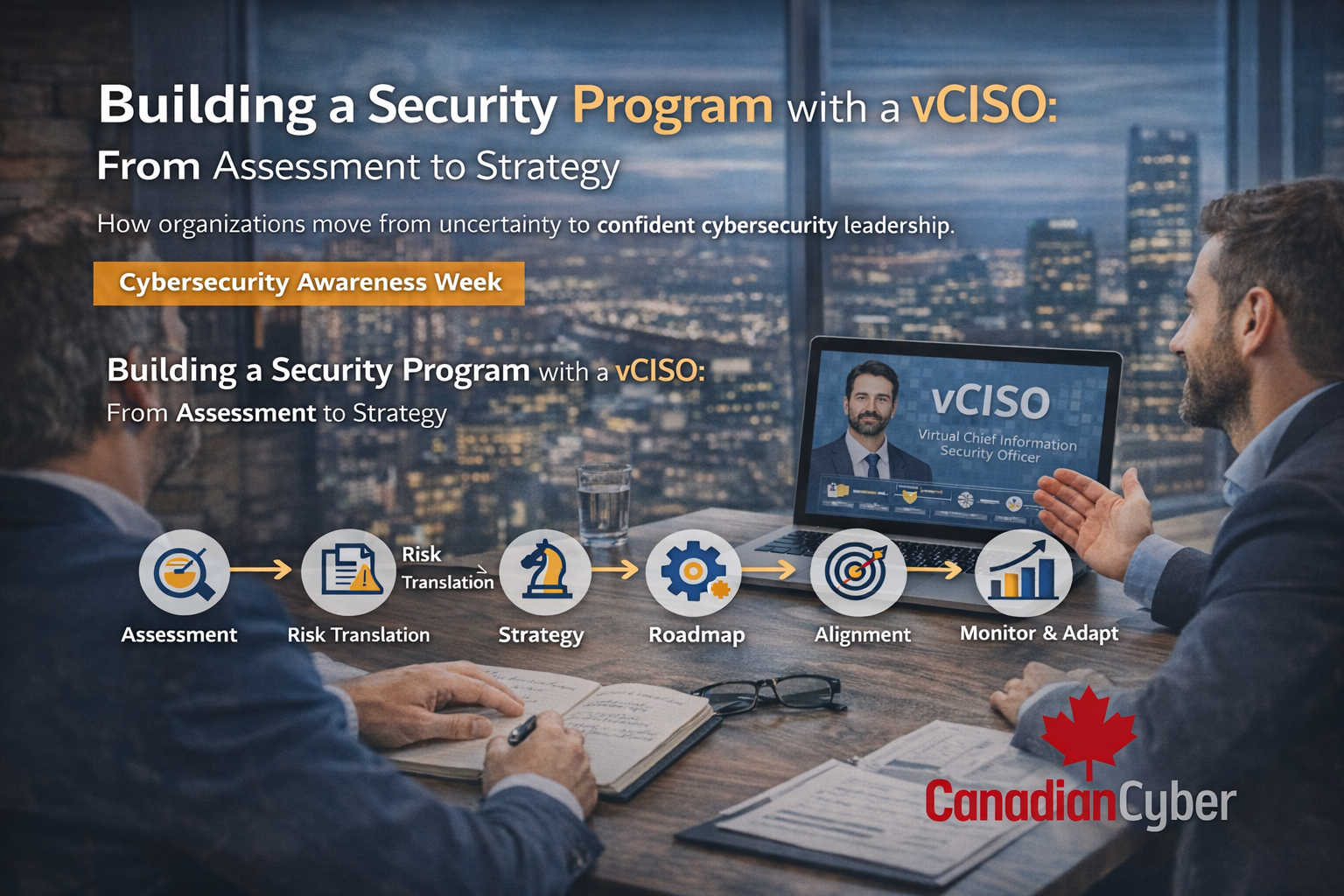
Building a Security Program with a vCISO: From Assessment to Strategy
How organizations move from uncertainty to confident cybersecurity leadership.
Many organizations know they need better cybersecurity. Few know where to start.
- They have tools in place
- They have policies scattered across folders
- They respond to issues as they appear
But when leadership asks a simple question
“Do we actually have a security program?”
The answer is often unclear.
This is exactly where a Virtual CISO (vCISO) makes the difference.
A vCISO doesn’t just fix security issues they help organizations build a structured, sustainable security program that grows with the business.
Quick Snapshot
| Category | Detail |
|---|---|
| Goal | Move from reactive security to a structured, repeatable program |
| How it starts | A vCISO-led assessment to establish a baseline and real risks |
| How it scales | Roadmap + governance + ongoing leadership, aligned to business goals |
| Best for | SMBs, scaling orgs, regulated teams, and companies under customer security pressure |
Why Security Programs Fail Without Leadership
Security programs usually fail for one reason: no one owns them end to end.
Without clear leadership:
- Risks are identified but not prioritized
- Policies exist but are not followed
- Compliance efforts feel chaotic
- Security decisions are reactive
- Business goals and security controls drift apart
A vCISO provides accountability, structure, and direction without the cost or rigidity of a full-time executive.
The vCISO Approach: From Assessment to Strategy
A successful vCISO engagement follows a clear progression. It is not random. It is not tool-driven. It is risk-driven and business-aligned.
| Phase | Outcome |
|---|---|
| Assess | Baseline visibility into gaps, risks, and blind spots |
| Translate | Technical findings converted into business risk and priorities |
| Strategize | A tailored strategy aligned with growth, compliance, and risk tolerance |
| Roadmap | Phased execution plan with ownership, milestones, and timelines |
| Operate | Ongoing leadership, reporting, and continuous improvement |
Let’s walk through what that journey looks like.
Step 1: Start with a Security Assessment
Every strong security program begins with understanding reality.
The purpose of the assessment is simple: identify gaps, risks, and blind spots without assumptions.
A vCISO-led assessment typically reviews:
- Critical systems and data
- Access controls and identity management
- Policies and procedures
- Incident response readiness
- Vendor and third-party risk
- User awareness and training
- Compliance posture
This creates a baseline. Without a baseline, strategy becomes guesswork.
A Fictional Example: “We Thought We Were Doing Okay”
This example is fictional but reflects common real-world experiences.
A growing Canadian organization believed security was “handled by IT.”
After a vCISO-led assessment, leadership learned:
- Admin access was shared
- Risk assessments had never been done
- Incident response plans were untested
- Vendor security had never been reviewed
- Policies didn’t match how teams worked
Nothing was broken but nothing was coordinated. The assessment didn’t assign blame. It created clarity.
Step 2: Translate Findings Into Business Risk
One of the most important roles of a vCISO is translation.
Assessment findings are meaningless unless leadership understands:
- What the risk is
- Why it matters
- What happens if it’s ignored
A vCISO converts technical gaps into business-level risk statements, such as:
- Operational disruption
- Regulatory exposure
- Customer trust impact
- Financial consequences
This is where cybersecurity becomes a leadership conversation not a technical debate.
Step 3: Define a Tailored Cybersecurity Strategy
Once risks are understood, the vCISO works with leadership to define a cybersecurity strategy. This is not a generic template.
A good strategy considers:
- Business size and growth plans
- Industry and regulatory environment
- Risk tolerance
- Available resources
- Customer and vendor expectations
Strategy answers: “Where are we going, why, and what does success look like?”
Step 4: Select the Right Frameworks and Priorities
Not every organization needs every framework. A vCISO helps select what fits best, such as:
- ISO 27001 for governance and ISMS structure
- CIS Critical Security Controls for practical security hygiene
- SOC 2 for service providers and SaaS organizations
- Privacy alignment for PIPEDA, Law 25, or PHIPA
The vCISO ensures frameworks support the business not overwhelm it.
This is where many DIY programs fail.
Want a Roadmap Built Around Your Risk Not Generic Templates?
If you’re unsure where to start, a vCISO-led assessment and roadmap is the fastest way to gain clarity and control.
Step 5: Build a Practical Security Roadmap
Strategy without execution is useless. A vCISO turns strategy into a phased roadmap, typically including:
- Policy and governance development
- Risk treatment plans
- Control implementation
- Staff training and awareness
- Vendor risk management
- Incident response planning
- Audit and assessment milestones
Each step is prioritized based on risk and impact, not theory.
Step 6: Align Security with Business Objectives
Security should enable growth not block it. A vCISO ensures cybersecurity supports:
- New product launches
- Customer onboarding
- Vendor partnerships
- Mergers or acquisitions
- Regulatory readiness
This alignment prevents friction between security teams and business leaders and keeps priorities realistic.
Step 7: Execute, Monitor, and Adapt
Cybersecurity is never “done.”
A vCISO provides ongoing leadership to:
- Track progress
- Adjust priorities
- Review incidents and near misses
- Update risk assessments
- Prepare for audits and reviews
This turns security into a living program not a one-time project.
A Fictional Outcome: From Reactive to Resilient
Six months after engaging a vCISO, the fictional organization saw:
- Clear ownership of cyber risk
- Defined security governance
- Reduced audit stress
- Improved leadership confidence
- Fewer surprises
The biggest change wasn’t technology. It was direction.
Why vCISO-Led Programs Succeed
vCISO-led security programs work because they:
- Start with assessment, not assumptions
- Focus on risk, not tools
- Align security with business goals
- Provide executive-level accountability
- Adapt as the organization grows
How Canadian Cyber Builds Security Programs with vCISO Services
At Canadian Cyber, vCISO services are designed to act as true security leadership not just advisory input.
| Service | How it supports your program |
|---|---|
| vCISO Services | Security strategy, risk ownership, compliance leadership, and executive reporting. |
| Cybersecurity Assessments | Baseline posture review, gap analysis, and prioritized recommendations. |
| ISO 27001 Implementation | ISMS structure, governance, risk process, and certification readiness. |
| SOC 2 Readiness & Maintenance | Control design, evidence workflows, and audit support year-round. |
| Internal Audits & IR Planning | Independent validation, tabletop exercises, and improvement cycles. |
From Uncertainty to Strategy With the Right Leadership
Building a cybersecurity program is not about buying tools or copying policies. It’s about leadership, structure, and clarity.
A vCISO provides all three in a way that fits your organization today and scales for tomorrow.
Ready to Build a Security Program That Actually Works?
If you want to move from reactive security to a structured, strategic program, a vCISO is the right place to start.
👉 Book a Free Consultation
👉 Learn How Canadian Cyber Builds Security Programs That Scale
Stay Connected With Canadian Cyber
Follow Canadian Cyber for insights on cybersecurity leadership, governance, and risk management in Canada: