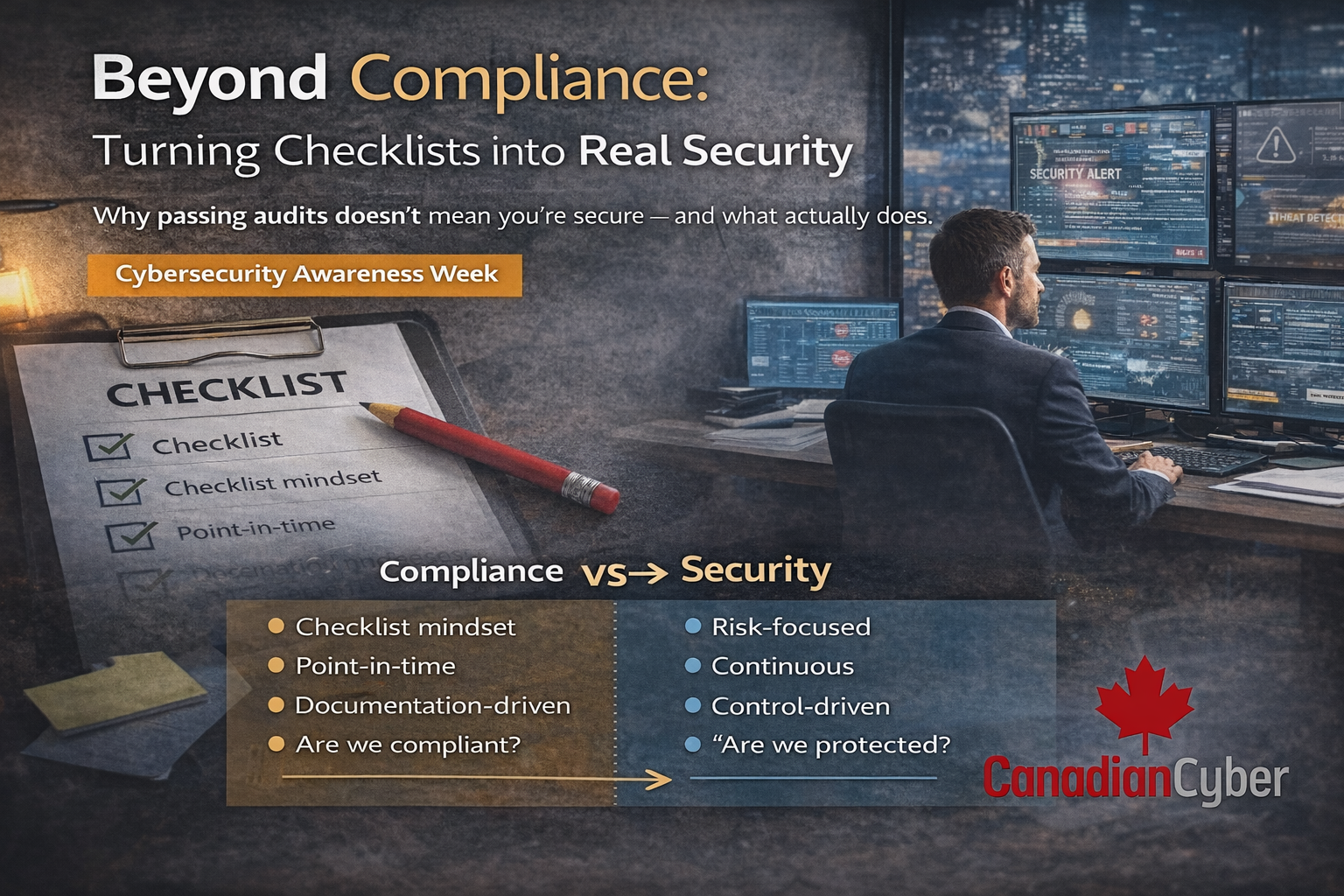
Beyond Compliance: Turning Checklists into Real Security
Why passing audits doesn’t mean you’re secure and what actually does.
Many organizations feel a sense of relief after passing an audit.
- The report is clean
- The certificate is issued
- The checkbox is ticked
And then, months later, a breach happens.
Compliance does not equal security.
In fact, one of the worst mistakes a business leader can make is believing that compliance alone means their organization is secure.
Quick Snapshot
| Category | Detail |
|---|---|
| Problem | Audit success can create a false sense of security |
| Reality | Compliance is point-in-time; attackers operate continuously |
| Goal | Prove controls work in real operations not just on paper |
| How to win | Control effectiveness, continuous monitoring, culture, and leadership ownership |
The Compliance Trap: When “Good Enough” Becomes Dangerous
Compliance frameworks exist for a reason. They provide structure, consistency, and minimum expectations. But problems start when organizations treat compliance as:
- The finish line
- A paperwork exercise
- A one-time event
- A substitute for real security
Passing an audit proves only one thing: you met the requirements at a point in time. It does not prove that your controls are effective today or tomorrow.
A Common Scenario: Compliant, Yet Compromised
This example is fictional but reflects real-world incidents.
A company had a documented password policy. It met the compliance requirement:
- Minimum length
- Complexity rules
- Regular rotation
On paper, everything looked correct. In practice:
| Audit view | Operational reality |
|---|---|
| Password policy exists | Passwords were reused |
| Access rules documented | Shared accounts existed |
| “Strong authentication” referenced | MFA was optional and inconsistent |
The company passed its audit. It still got breached.
The issue wasn’t lack of compliance. It was lack of real-world control enforcement.
Why Compliance Alone Fails to Stop Breaches
Compliance frameworks focus on what should exist. Security focuses on how things actually work. That gap is where incidents happen.
Common “checkbox” failure patterns:
- A policy exists, but no one follows it
- Training is completed, but behaviour doesn’t change
- Controls are designed, but not monitored
- Risks are documented, but never revisited
Compliance vs. Security: A Simple Comparison
| Compliance | Security |
|---|---|
| Minimum requirements | Risk-based decisions |
| Point-in-time | Continuous |
| Documentation-focused | Behaviour and control-focused |
| Audit-driven | Threat-driven |
| “Are we compliant?” | “Are we protected?” |
Compliance asks if something exists. Security asks if it works when it matters.
Why Checklists Are Still Useful (If Used Correctly)
This is not an argument against compliance. Frameworks like ISO 27001, SOC 2, or regulatory standards are valuable when used as a baseline. Used properly, frameworks help organizations:
- Establish governance
- Define responsibilities
- Create structure
- Set minimum expectations
The problem is stopping there. Real security begins after the checklist is complete.
How Organizations Move Beyond Checkbox Compliance
Organizations that mature beyond compliance do a few key things differently.
1) Treat frameworks as starting points, not end goals
Instead of asking: “Did we pass the audit?”
They ask: “What risks still worry us?”
2) Focus on control effectiveness
Having a control is not enough. Mature organizations ask:
- Is the control enforced?
- Is it monitored?
- Does it actually reduce risk?
3) Monitor continuously, not periodically
Threats change faster than audit cycles. Going beyond compliance means:
- Continuous monitoring
- Regular reviews
- Ongoing assessments
- Evidence that stays current
4) Build a culture that supports controls
Even the best controls fail without buy-in. Organizations with real security:
- Train employees regularly
- Encourage reporting
- Reward vigilance
- Learn from mistakes
Want Security That Holds Up Beyond the Audit?
If you’re tired of “paper compliance,” we help you build controls that are enforceable, measurable, and resilient in real operations.
The Role of a vCISO: Turning Compliance into Security
This is where leadership matters. A Virtual CISO (vCISO) helps organizations bridge the gap between compliance and real security.
A vCISO ensures:
- Controls align with real risk
- Compliance efforts support security goals
- Gaps are identified before attackers do
- Leadership understands residual risk
- Security programs evolve continuously
Instead of asking, “Are we compliant?” the better question becomes: “Are we resilient?”
A Fictional Turning Point: When Leadership Asked the Right Question
This example is fictional but reflects common leadership discussions.
After passing multiple audits, a leadership team asked their vCISO:
“If we were attacked tomorrow, how confident are we?”
The answer wasn’t black or white but it was honest. That honesty led to:
- Stronger access controls
- Better monitoring
- Improved incident response
- Real risk reduction
Security finally moved beyond the checklist.
How Canadian Cyber Helps Organizations Go Beyond Compliance
At Canadian Cyber, we believe compliance should enable security not replace it.
| Service Area | How it helps |
|---|---|
| vCISO & Security Governance | Translate compliance into real controls, prioritize risk beyond audit scope, provide executive oversight, and align security with business goals. |
| Risk Assessments & Internal Audits | Identify gaps between policy and practice, test control effectiveness, and uncover areas audits may miss. |
| Continuous Improvement Programs | Ongoing monitoring, control testing, and security maturity growth that stays current between audit cycles. |
Compliance Is a Floor — Not a Ceiling
Compliance frameworks define the minimum. Security defines what actually protects your organization.
Use compliance as a foundation then build something stronger on top.
Ready to Move Beyond Checkbox Security?
If your organization wants real protection, not just clean audit reports, we can help.
Learn About Our Security Governance Programs
Book a Free Consultation
Stay Connected With Canadian Cyber
Follow Canadian Cyber for practical guidance on governance, audits, and building security that actually works: