

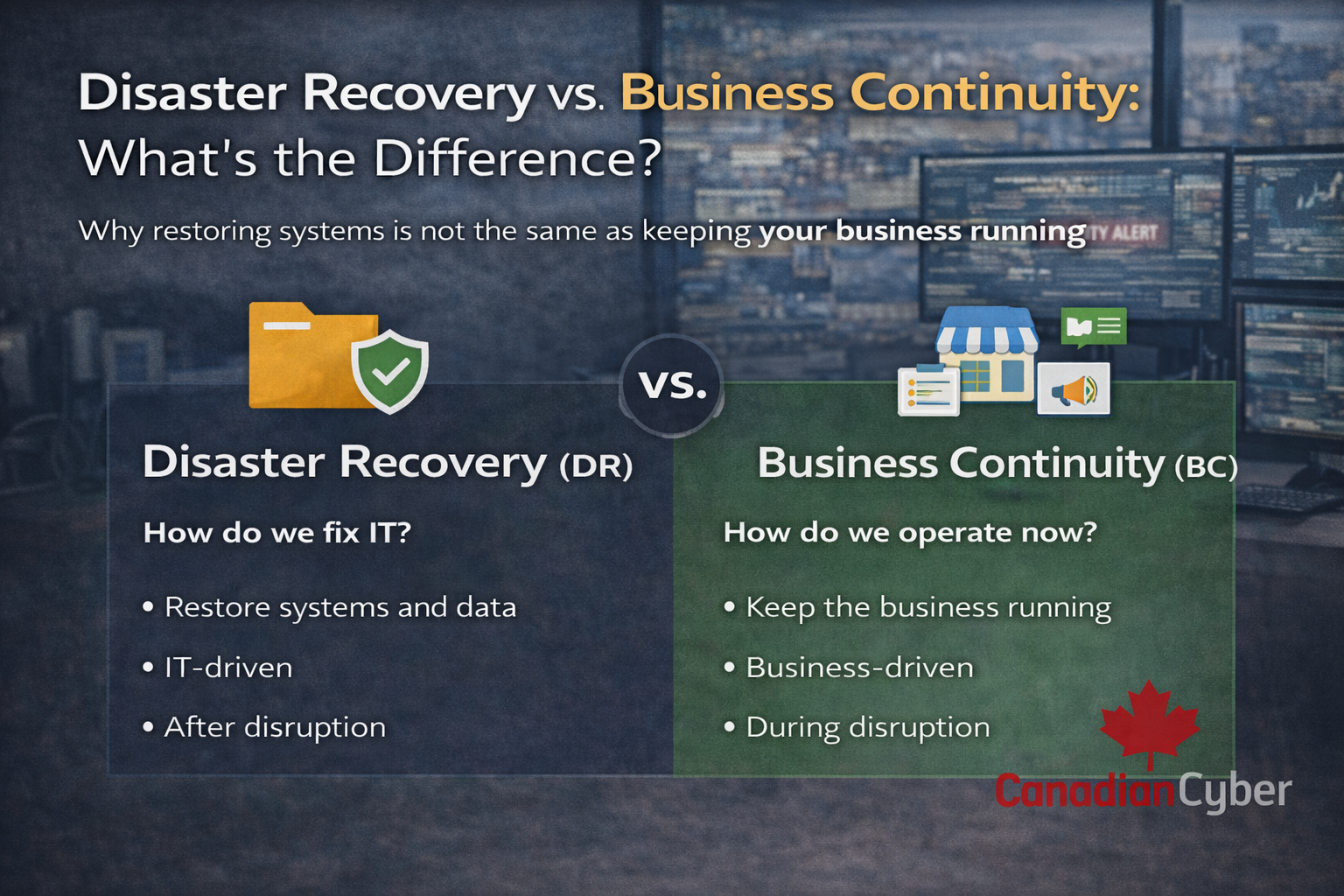
Disaster Recovery vs. Business Continuity: What’s the Difference?
Why restoring systems is not the same as keeping your business running.
When a cyber incident hits, many organizations focus on one question:
“How fast can we get our systems back?”
That’s an important question but it’s only half the story.
The more important question is often:
“How do we keep operating while systems are down?”
The simple truth:
A Disaster Recovery plan cleans up the mess.
A Business Continuity plan keeps the business running during the mess.
What Is Disaster Recovery (DR)?
Disaster Recovery (DR) is primarily IT-focused. It answers:
✅ How do we restore systems, applications, and data after a disruption?
A DR plan typically includes:
- Backup and restore procedures
- System rebuild steps
- Recovery Time Objectives (RTOs) how quickly services must be restored
- Recovery Point Objectives (RPOs) how much data loss is acceptable
- Infrastructure recovery priorities
In short: DR is about returning technology to normal.
What Is Business Continuity (BC)?
Business Continuity is broader and business-focused. It answers:
✅ How do we continue operating while systems are unavailable?
A Business Continuity Plan (BCP) typically includes:
- Identification of critical business functions
- Manual or alternative processes
- Internal and external communication plans
- Staff roles, responsibilities, and escalation paths
- Customer service continuity approach
- Third-party and supply chain considerations
BC keeps the organization functioning even in limited mode during disruption.
Disaster Recovery vs. Business Continuity: Side-by-Side
| Area | Disaster Recovery (DR) | Business Continuity (BC) |
|---|---|---|
| Focus | Technology | Business operations |
| Goal | Restore systems and data | Keep the business running |
| Timing | After the disruption | During the disruption |
| Owners | IT teams | Business + leadership |
| Examples | Backup restores, server rebuilds | Manual processes, communications |
| Question answered | “How do we fix IT?” | “How do we operate now?” |
Key point: One cannot replace the other. DR supports recovery. BC protects operations.
Why Organizations Often Confuse DR and BC
Many organizations assume: “If we can restore our systems, we’ll be fine.”
What that assumption misses
- Restoration may take days or weeks, especially after ransomware
- Customers won’t wait for internal recovery timelines
- Regulators and insurers may expect continuity planning
- Staff need direction immediately, not after IT is restored
Disaster Recovery without Business Continuity creates a dangerous gap: the business stalls while IT rebuilds.
A Fictional Scenario: Same Incident, Two Outcomes
This example is fictional but reflects real-world situations.
Company A: Strong DR, No BCP (high disruption)
- Backups exist
- Systems can be restored in 72 hours
- But: no continuity procedures
- Orders stop
- Customer service is offline
- Staff are unsure what to do
- Leadership scrambles
Company B: DR + BCP Together (controlled impact)
- IT restores systems on a defined timeline
- Business continues operating in limited mode
- Manual order processing continues
- Customers are informed clearly
- Staff follow predefined procedures
- Revenue impact is limited
Same incident. Very different outcomes.
How ISO 22301 Brings It All Together
ISO 22301 (Business Continuity Management) helps organizations:
- Identify critical business activities
- Define acceptable downtime
- Coordinate BC and DR strategies
- Test and improve response plans
Practical view: DR becomes a supporting component of a broader resilience strategy.
Why Both DR and BC Are Essential During Cyber Incidents
Cyber incidents often cause extended outages, not brief interruptions. Ransomware may require system isolation,
forensic investigation, and data validation before recovery.
What BC protects while DR restores
- Revenue and critical service delivery
- Customer communication and trust
- Regulatory confidence and reporting readiness
- Operational coordination across teams
The Leadership Role in Continuity and Recovery
Neither DR nor BC succeeds without leadership. This is not an IT responsibility alone it is a business leadership responsibility.
Executives should be able to answer
- What are our top recovery priorities (and why)?
- How long can critical functions be down before impact becomes severe?
- What is our customer and regulator communication approach during outage?
- Who makes the final trade-off decisions under pressure?
How a vCISO Aligns Disaster Recovery and Business Continuity
A Virtual CISO (vCISO) helps ensure DR and BC work together preventing gaps between technology recovery and business needs.
- Aligns DR capabilities with business priorities and BIA outcomes
- Integrates BC, DR, and incident response planning
- Supports ISO 22301 and ISO 27001 alignment
- Guides leadership during disruptions with clear decision frameworks
✅ Want a clear DR + BC roadmap (not two disconnected documents)?
Canadian Cyber helps organizations design continuity and recovery that work together aligned to real cyber disruption scenarios.
👉 Explore Business Continuity & Disaster Recovery Services
👉 Book a Free Consultation
How Canadian Cyber Helps Organizations Build Resilience
At Canadian Cyber, we help organizations design both sides of resilience continuity and recovery so you’re prepared for real cyber disruptions.
Business Continuity Management (ISO 22301)
- Business Impact Analyses (BIA)
- BCP design and testing
- Executive tabletop exercises
Disaster Recovery & Cyber Resilience
- DR strategy alignment to business priorities
- Incident response integration
- Risk-based recovery planning (priorities, validation, sequencing)
vCISO Leadership
- Executive-level oversight
- Governance and decision support
- Continuous improvement
You Don’t Have to Choose Between DR and BC
Disaster Recovery and Business Continuity are not competing approaches. They are complementary capabilities.
- DR gets your systems back
- BC keeps your business alive until they are
Organizations that understand this difference recover faster and suffer less.
🚀 Ready to Strengthen Both Recovery and Continuity?
If your organization wants to be resilient not just compliant we can help.
Stay Connected With Canadian Cyber
Follow Canadian Cyber for insights on cyber resilience, continuity, recovery, and security leadership: