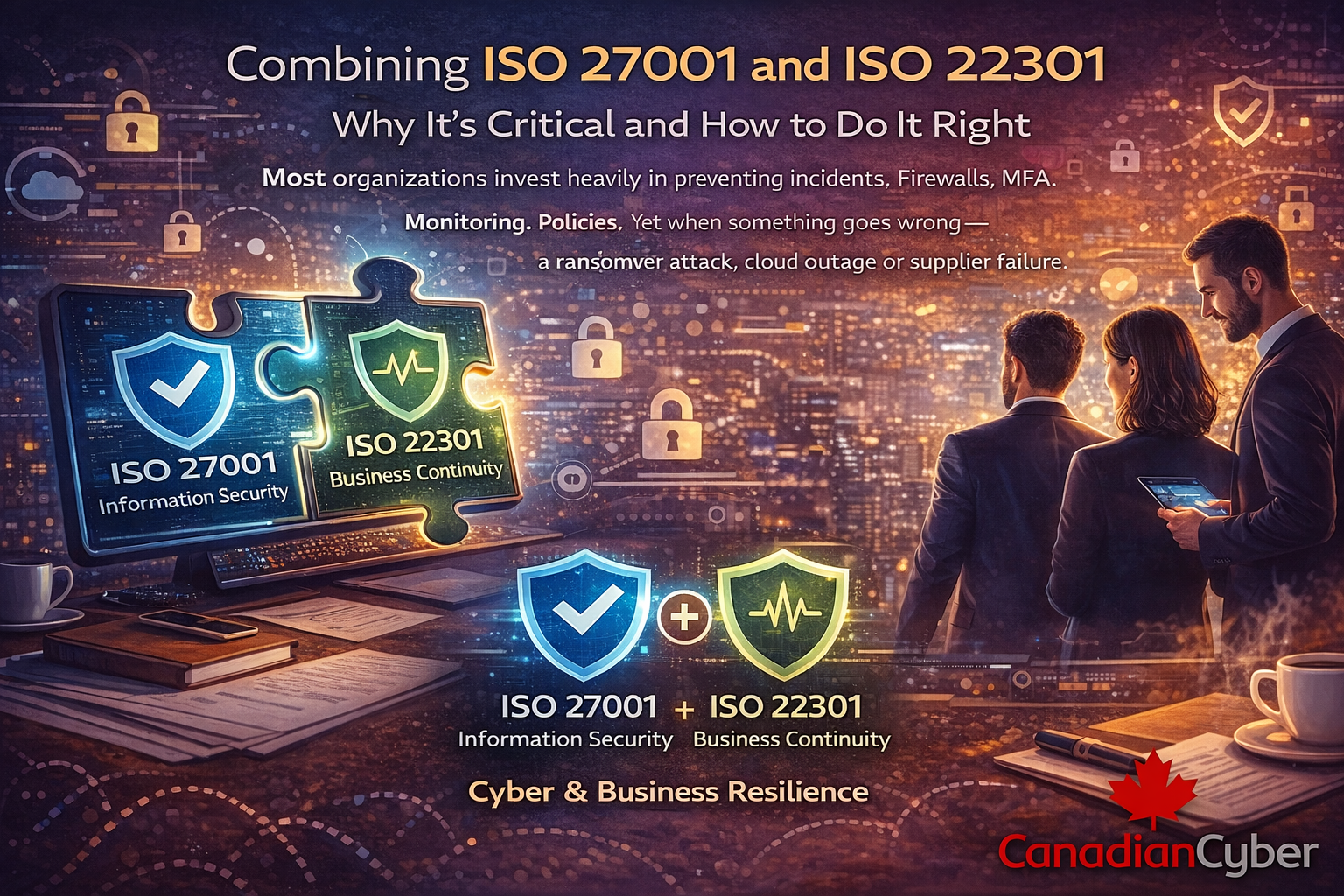
Combining ISO 27001 and ISO 22301 for True Cyber Resilience
Why security without continuity is no longer enough.
Most organizations invest heavily in preventing incidents firewalls, MFA, monitoring, and policies.
Yet when something goes wrong a ransomware attack, cloud outage, or supplier failure many still struggle to stay operational.
This is where cyber resilience breaks down.
ISO 27001 protects information.
ISO 22301 keeps the business running.
Together, they create operational resilience.
This blog explains how integrating ISO 27001 and ISO 22301 strengthens your organization’s ability to withstand, respond to, and recover from disruptions not just survive audits.
What You’ll Learn
- Why cyber resilience is now a board-level business issue
- The difference between ISO 27001 and ISO 22301 (and why both matter)
- Where siloed security and continuity programs create gaps
- What integration looks like in real operations
- Common mistakes to avoid when combining both standards
- A practical integration checklist you can start today
Why Cyber Resilience Is a Business Issue
Cyber resilience is no longer just an IT concern. Regulators, customers, and boards now expect organizations to:
- Prevent incidents where possible
- Detect issues quickly
- Respond effectively
- Recover operations with minimal impact
A security program that cannot support recovery is incomplete. That’s why leading organizations align information security and business continuity under a single resilience strategy.
ISO 27001 vs ISO 22301: Different Focus, Shared Goal
ISO 27001 and ISO 22301 address different sides of the same risk equation reducing incident likelihood and minimizing operational impact.
| Standard | Primary Focus | Executive Question It Answers |
|---|---|---|
| ISO/IEC 27001 | Information security risk management (CIA) | How do we reduce the likelihood of security incidents? |
| ISO 22301 | Business continuity and recovery of critical operations | How do we keep running when disruption happens? |
Simple way to think about it: ISO 27001 helps reduce probability. ISO 22301 reduces impact and downtime.
Why Treating Them Separately Creates Gaps
Many organizations implement these standards in silos. The result is predictable:
- Security teams focus on prevention
- Continuity teams focus on recovery
- Plans don’t align during real incidents
- Responsibilities overlap or conflict
- Critical assumptions go untested
Cyber incidents rarely stay “technical.” They become operational, legal, and reputational fast.
Integration prevents the handoff chaos.
What Integration Looks Like in Practice
Combining ISO 27001 and ISO 22301 means aligning risk, response, and recovery under one resilience story.
Shared Risk Understanding
- ISO 27001 risks inform BIA priorities
- Critical assets tie to critical processes
- Availability requirements become explicit
Aligned Plans
- IR plans feed continuity workflows
- Cyber scenarios built into BC exercises
- Recovery steps are validated, not assumed
Clear Escalation
- Defined triggers for continuity activation
- Decision points understood by leadership
- Roles don’t conflict during disruption
Unified Governance
- One management review narrative
- One improvement cycle
- Stronger audit and regulatory defensibility
✅ Want a resilience roadmap that ties security + continuity together?
We help organizations align ISO 27001 risk programs with ISO 22301 continuity planning in a way that works in real incidents.
Why Regulated Industries Benefit the Most
Organizations in regulated sectors face stronger expectations around both prevention and recovery. This includes:
- Financial services
- Healthcare
- Technology and SaaS
- Critical infrastructure
- Government and public sector
Regulators increasingly ask:
“How do you prevent incidents and how do you recover?”
Integrated ISO 27001 + ISO 22301 provides a clear, defensible answer.
A Fictional Example: Security Without Continuity
This example is fictional but reflects real-world patterns.
A technology company implemented ISO 27001 successfully. Security controls were strong and audits went smoothly.
| What worked | What failed |
|---|---|
|
|
After integrating ISO 22301, they defined recovery priorities, validated timelines, improved communications, and reduced downtime significantly. Security didn’t fail continuity was missing.
How ISO 27001 and ISO 22301 Strengthen Each Other
ISO 27001 enhances ISO 22301
- Identifies realistic cyber disruption scenarios
- Protects recovery data, backups, and admin access
- Improves detection and escalation triggers
ISO 22301 enhances ISO 27001
- Validates availability requirements (what “must stay up”)
- Tests recovery assumptions with exercises
- Improves real-world readiness beyond documentation
Together, they close the loop: reduce likelihood + reduce impact.
That’s resilience.
Common Integration Mistakes to Avoid
- Treating ISO 22301 as only an “IT disaster recovery plan”
- Running separate risk assessments with no shared narrative
- Testing continuity without cyber scenarios (ransomware, identity compromise, SaaS outage)
- Failing to involve leadership in recovery decision points
- Over-documenting but under-testing
Resilience is proven in practice not on paper.
How to Start Integrating ISO 27001 and ISO 22301
You don’t need to rebuild everything. Start with small alignment steps that create outsized resilience gains:
- Map critical information assets to critical business processes
- Align risk assessments (ISO 27001) with business impact analysis (ISO 22301)
- Update incident response + continuity plans together (shared triggers and handoffs)
- Run joint tabletop exercises using cyber disruption scenarios
- Use one management review narrative covering security + continuity outcomes
Practical tip: start by aligning the top 3 critical services. Prove recovery, then expand.
How Canadian Cyber Helps Build Resilience
At Canadian Cyber, we help organizations move beyond compliance and build real operational resilience.
ISO 27001 & ISO 22301 Integration
- Aligned risk and continuity planning
- Practical implementation and evidence design
- Audit-ready documentation with clear ownership
vCISO Services
- Unified security + resilience leadership
- Executive reporting and decision support
- Ongoing improvement cycles (not “audit sprints”)
Internal Audits & Health Checks
- Validate alignment across both programs
- Identify gaps before surveillance or regulatory reviews
- Strengthen evidence and operational readiness
Resilience Is the New Measure of Security Maturity
Strong security reduces risk. Strong continuity protects the business. Together, they define resilience.
Organizations that integrate ISO 27001 and ISO 22301 are better prepared for cyber incidents, operational disruptions, regulatory scrutiny, and customer trust challenges.
Ready to Strengthen Your Resilience Strategy?
If you want a practical approach to combining ISO 27001 and ISO 22301, we can help you build a resilience program that works in real disruption.
👉 Learn About ISO 22301 & Business Continuity
👉 Book a Free Consultation
Stay Connected With Canadian Cyber
Follow Canadian Cyber for practical ISO guidance, cyber resilience strategies, and audit-ready governance: