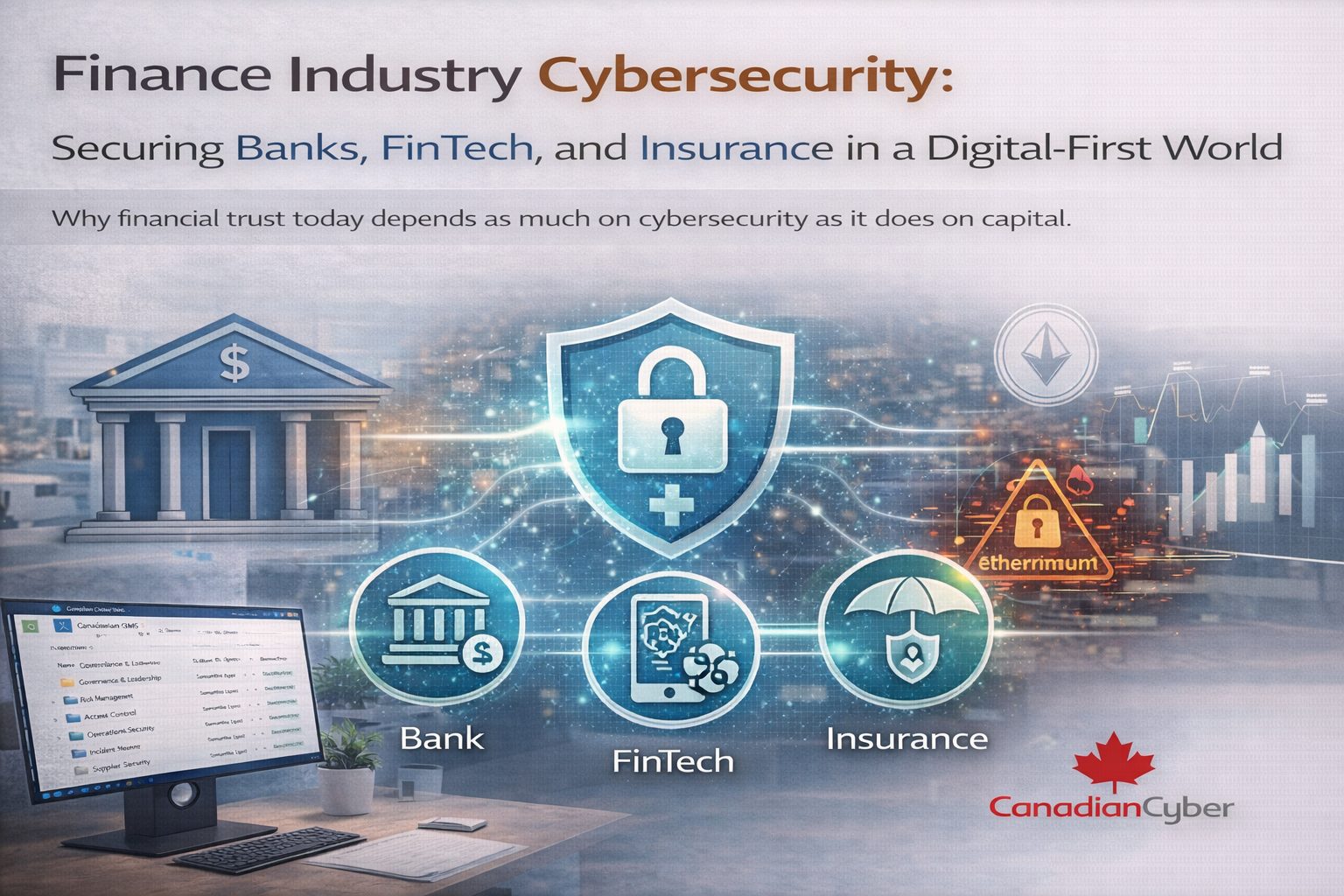
Finance Industry Cybersecurity: Securing Banks, FinTech, and Insurance in a Digital-First World
Why financial trust today depends as much on cybersecurity as it does on capital.
The financial industry runs on trust.
Customers trust banks with their savings. They trust insurers with sensitive personal data.
They trust FinTech platforms with instant access to money.
Cybercriminals know this. That’s why financial services consistently rank among the most targeted industries and why modern security programs must protect money, data, and reputation at the same time.
From account takeover fraud to banking malware, the threat landscape is evolving faster than traditional controls can keep up.
In a digital-first world, cybersecurity is now a core business function.
Quick Snapshot
| What attackers want | Why finance is targeted |
|---|---|
| Money | Direct fraud, transfers, and monetization opportunities |
| Identity | Highly sensitive PII and financial records enable long-term abuse |
| Access | Complex ecosystems (apps, APIs, partners) increase attack surface |
| Leverage | Uptime pressure and customer impact can force fast decisions |
Why Financial Institutions Are Prime Targets
Financial organizations are attractive to attackers because they offer direct access to money, sensitive personal data, complex digital ecosystems, and high pressure to maintain uptime.
For cybercriminals, even a short disruption or small weakness can lead to massive gains especially when fraud and identity abuse can be automated at scale.
Key Cyber Threats Facing the Finance Industry
The finance sector faces a mix of fraud-driven attacks, advanced malware, and ecosystem risk.
Here are the most common threats leaders should understand.
1) Account Takeover (ATO) Fraud
Account takeover attacks often rely on stolen credentials, phishing, and credential stuffing.
Once attackers gain access, they can:
- Drain funds and initiate fraudulent transfers
- Change contact details and lock out users
- Launder money through mule networks
Without strong authentication and monitoring, ATO remains one of the most damaging finance threats.
2) Banking Malware and Advanced Phishing
Modern banking malware can evade traditional antivirus, manipulate sessions in real time, and exploit weak authentication.
Phishing has also evolved:
- AI-generated messages that sound authentic
- Brand impersonation across email and SMS
- Multi-stage social engineering that bypasses basic awareness
Human error is still a major entry point which makes training and verification steps critical.
3) Open Banking and API Risks
Open banking has enabled faster innovation and better customer experiences through APIs.
It also introduces new risks such as:
- Weak API authentication and authorization
- Excessive data exposure
- Poor third-party oversight
Without governance, open banking can become an open door.
4) Third-Party and Supply Chain Risk
Financial institutions rely on payment processors, cloud providers, SaaS platforms, and data aggregators.
A breach at a vendor can quickly become your breach.
Strong vendor governance and continuous oversight reduce the chance of hidden dependencies becoming a crisis.
5) Lessons from Cryptocurrency Exchange Hacks
High-profile cryptocurrency exchange breaches have highlighted what happens when:
- Keys are poorly managed
- Monitoring is weak or inconsistent
- Governance is missing
The key lesson for traditional finance is simple:
technology without governance creates systemic risk.
Why Security in Finance Is No Longer Just an IT Issue
Cybersecurity in finance affects regulatory compliance, financial stability, brand reputation, and customer confidence.
That’s why regulators increasingly expect executive-level oversight, clear risk ownership, and continuous control monitoring.
A useful leadership question is:
Do we know our top cyber risks and can we prove our controls are working?
Core Security Controls Financial Institutions Must Prioritize
Financial security programs are strongest when they combine strong technical controls with measurable governance.
These are the controls that consistently reduce real-world risk.
1) Multi-Factor Authentication (MFA)
MFA significantly reduces account takeover risk and credential-based attacks. It should be mandatory for:
- Customers
- Employees
- Privileged users and administrators
2) Encryption Everywhere
Sensitive data should be encrypted at rest and in transit, with strong key management practices.
Encryption is foundational not optional.
- Encrypt customer and financial data at rest
- Enforce TLS for all data in transit
- Protect keys with role-based access and rotation
3) Continuous Monitoring and Detection
Security monitoring should detect abnormal behavior, correlate events across systems, and trigger rapid response.
In financial incidents, speed matters.
- Centralize logging for critical systems
- Monitor authentication, API, and transaction anomalies
- Define clear escalation paths and response SLAs
4) Strong Governance and Compliance Alignment
Financial organizations often align security with frameworks and obligations such as: PCI DSS, SOC 2, ISO 27001, and privacy regulations.
- Document risk decisions and control ownership
- Maintain audit-ready evidence, continuously
- Use compliance to strengthen security, not distract from it
Why Governance and Leadership Matter More Than Ever
Security tools alone do not manage financial risk. Institutions need clear cyber risk ownership, risk-based prioritization, and board-level visibility.
This is where vCISO services play a critical role. A vCISO helps leadership:
- Translate technical risk into business impact
- Align controls with regulatory requirements
- Guide executive decisions with clear options and trade-offs
A Fictional Example: Preventing Financial Loss Through Governance
(This example is fictional but reflects real-world patterns.)
A FinTech platform invested heavily in security tools. Yet risk ownership was unclear, API security wasn’t reviewed, and incident response was untested.
After engaging a vCISO:
- MFA was enforced platform-wide
- API access was reviewed and restricted
- Incident response plans were tested
When a fraud attempt occurred, it was detected early and contained.
Customer trust remained intact.
How Canadian Cyber Supports Financial Organizations
At Canadian Cyber, we help financial institutions secure growth without slowing innovation.
We focus on risk reduction, resilience, and trust.
What we deliver for banks, FinTech, and insurance
| Service | Outcome |
|---|---|
| vCISO Services | Executive cyber leadership, risk and compliance oversight, board and regulator reporting |
| ISO 27001 & SOC 2 Support | Practical implementation, audit readiness, and continuous compliance |
| Risk & Incident Readiness | Threat modeling, incident response planning, tabletop exercises, and operational resilience |
Cybersecurity Is Now a Competitive Advantage in Finance
Customers choose institutions they trust. Trust today is built on security, transparency, and resilience.
Organizations that treat cybersecurity as a business priority not just an IT task are better prepared for what’s next.
Ready to Strengthen Financial Cybersecurity?
Let’s reduce fraud risk, improve audit readiness, and strengthen customer trust without slowing innovation.
Stay Connected With Canadian Cyber
Follow Canadian Cyber for ISO 27001, SOC 2, and finance-focused cybersecurity insights: